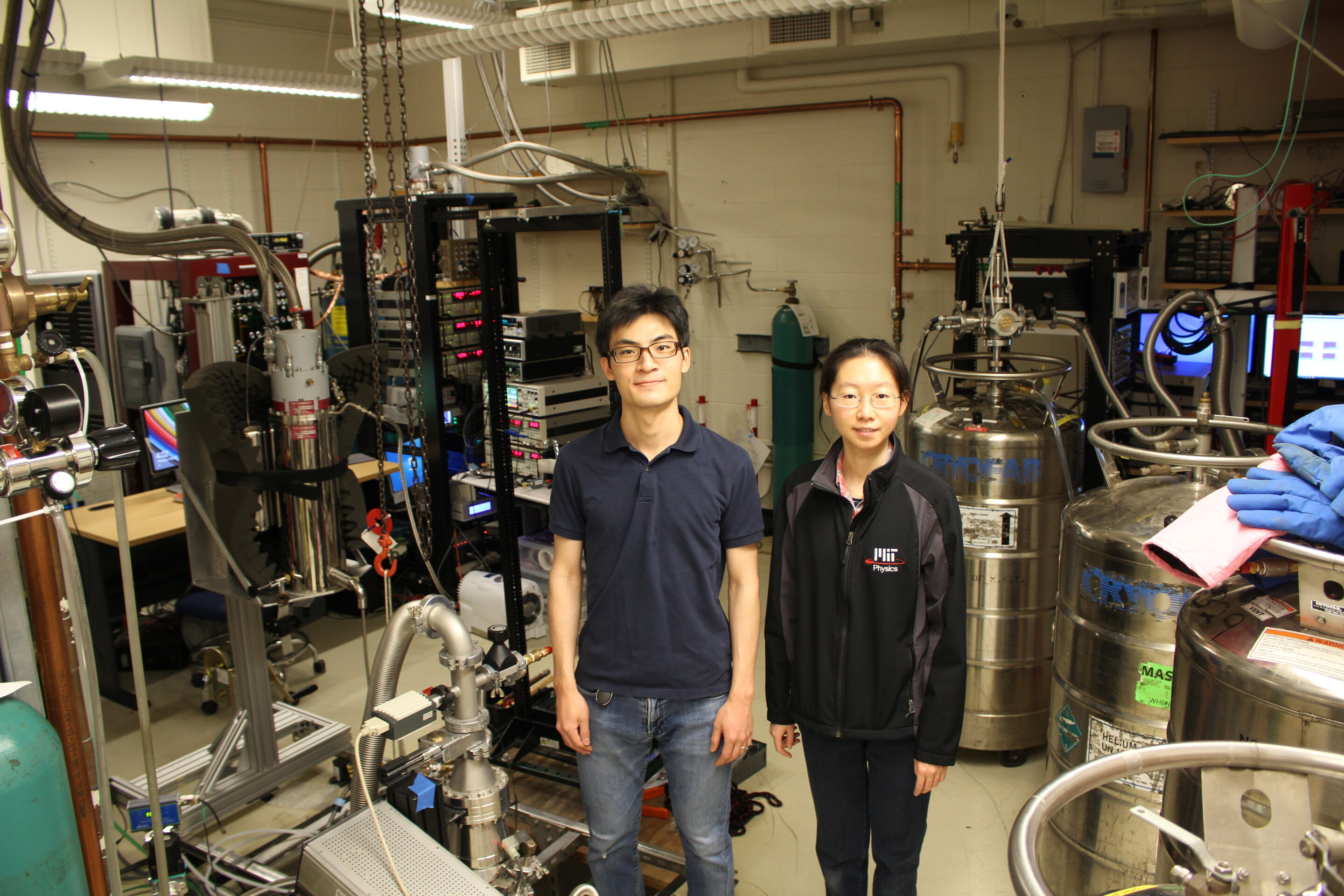
Ultrathin materials made of a single layer of atoms have riveted scientists' attention since the discovery of the first such material—graphene—about 17 years ago. Among other advances since then, researchers including those from a pioneering lab at MIT have found that stacking individual sheets of the 2D materials, and sometimes twisting them at a slight angle to each other, can give them new properties, from superconductivity to magnetism.
Now MIT physicists from the same lab and colleagues have done just that with boron nitride, known as "white graphene" in part because it has an atomic structure similar to its famous cousin. The team has shown that when two single sheets of boron nitride are stacked parallel to each other, the material becomes ferroelectric, in which positive and negative charges in the material spontaneously head to different sides, or poles. Upon the application of an external electric field, those charges switch sides, reversing the polarization. Importantly, all of this happens at room temperature.
The new material, which works via a mechanism that is completely different from existing ferroelectric materials, could have many applications.
"Wide varieties of physical properties have already been discovered in various 2D materials. Now we can easily stack the ferroelectric boron nitride with other families of materials to generate emergent properties and novel functionalities," says Pablo Jarillo-Herrero, the Cecil and Ida Green Professor of Physics and leader of the work, which was reported in the journal Science. Jarillo-Herrero is also affiliated with MIT's Materials Research Laboratory.
In addition to Jarillo-Herrero, additional authors of the paper are Kenji Yasuda, an MIT postdoctoral fellow; Xirui Wang, an MIT graduate student in physics, and Kenji Watanabe and Takashi Taniguchi of the National Institute for Materials Science in Japan.
Potential Applications
Among the potential applications of the new ultrathin ferroelectric material, "one exciting possibility is to use it for denser memory storage," says Yasuda, lead author of the Science paper. That's because switching the polarization of the material could be used to encode ones and zeros—digital information—and that information will be stable over time. It won't change unless an electric field is applied. In the Science paper the team reports a proof-of-principle experiment showing this stability.
Because the new material is only billionths of a meter thick—it's one of the thinnest ferroelectrics ever made—it could also allow much denser computer memory storage.
The team further found that twisting the parallel sheets of boron nitride at a slight angle to each other resulted in yet another "completely new type of ferroelectric state," Yasuda says. This general approach, known as twistronics, was pioneered by the Jarillo-Herrero group, which used it to achieve unconventional superconductivity in graphene.
New Physics
The new ultrathin ferroelectric material is also exciting because it involves new physics. The mechanism behind how it works is completely different from that of conventional ferroelectric materials.
Says Yasuda, "The out-of-plane ferroelectric switching occurs through the in-plane sliding motion between two boron nitride sheets. This unique coupling between vertical polarization and horizontal motion is enabled by the lateral rigidity of boron nitride."
Toward Other Ferroelectrics
Yasuda notes that other new ferroelectrics could be produced using the same technique described in Science. "Our method for turning a non-ferroelectric starting material into an ultrathin ferroelectric applies to other materials with atomic structures similar to boron nitride, so we can vastly expand the family of ferroelectrics. Only a few ultrathin ferroelectrics exist today," he says. The researchers are currently working to that end and have had some promising results.
The Jarillo-Herrero lab is a pioneer at manipulating and exploring ultrathin, two-dimensional materials like graphene. Nevertheless, the conversion of ultrathin boron nitride to a ferroelectric was unexpected.
Says Xirui Wang:
"I still remember when we were doing the measurements and we saw an unusual jump in the data. We decided that we should run the experiment again, and when we did it again and again we confirmed that there was something new happening."
Reference
Stacking-engineered ferroelectricity in bilayer boron nitride
Kenji Yasuda, Xirui Wang, Kenji Watanabe, Takashi Taniguchi, and Pablo Jarillo-Herrero
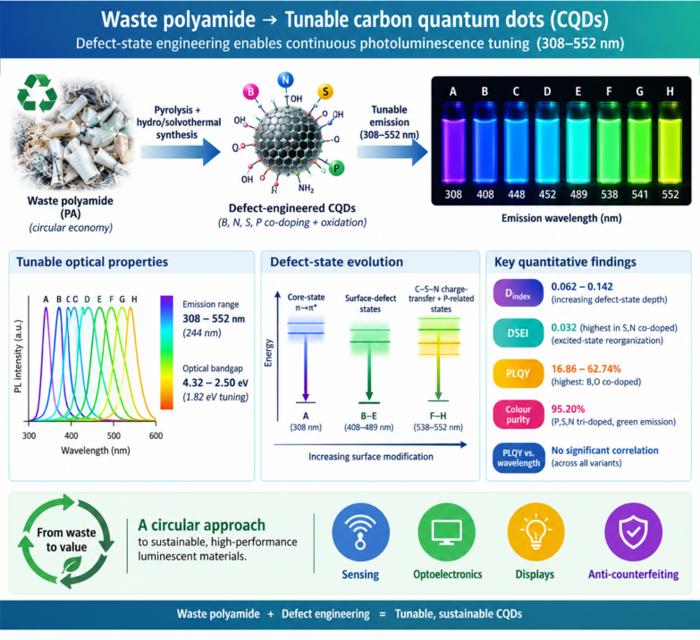
Waste polyamide-derived CQDs show continuous photoluminescence tuning from 308 to 552 nm through sequential defect-state engineering, with optical transition energies decreasing from 4.32 to 2.50 eV. @Christian Ebere Enyoh from Saitama University Carbon quantum dots (CQDs) are fluorescent carbon nanomaterials with potential applications in sensing, optoelectronics, displays, anti-counterfeiting, and environmental technologies. Their optical properties can be adjusted by modifying the carbon...
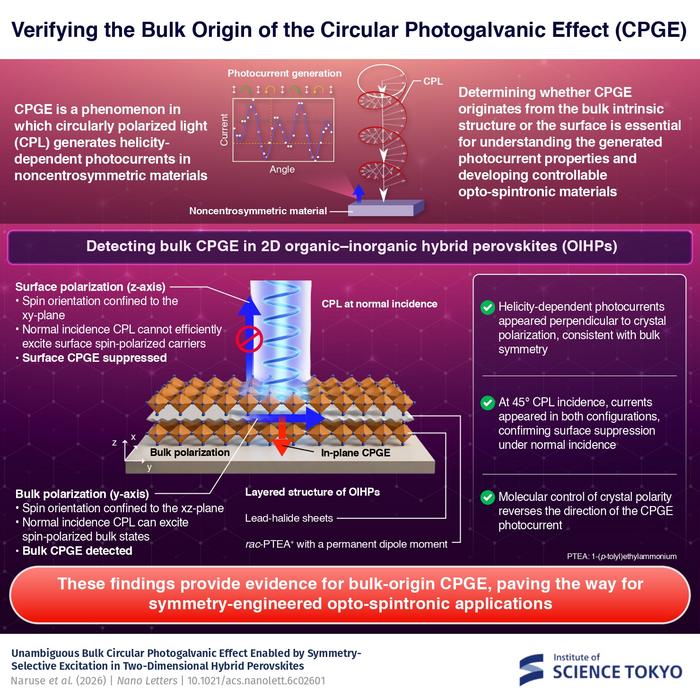
The researchers used circularly polarized light at normal incidence and found that helicity-dependent photocurrents appeared perpendicular to the crystal’s polarization but vanished when measured parallel to it, supporting a bulk origin of CPGE. @Institute of Science Tokyo The circular photogalvanic effect (CPGE), a phenomenon that generates helicity-dependent photocurrents in noncentrosymmetric materials, can originate purely from a crystal's internal structure without contribution from the...
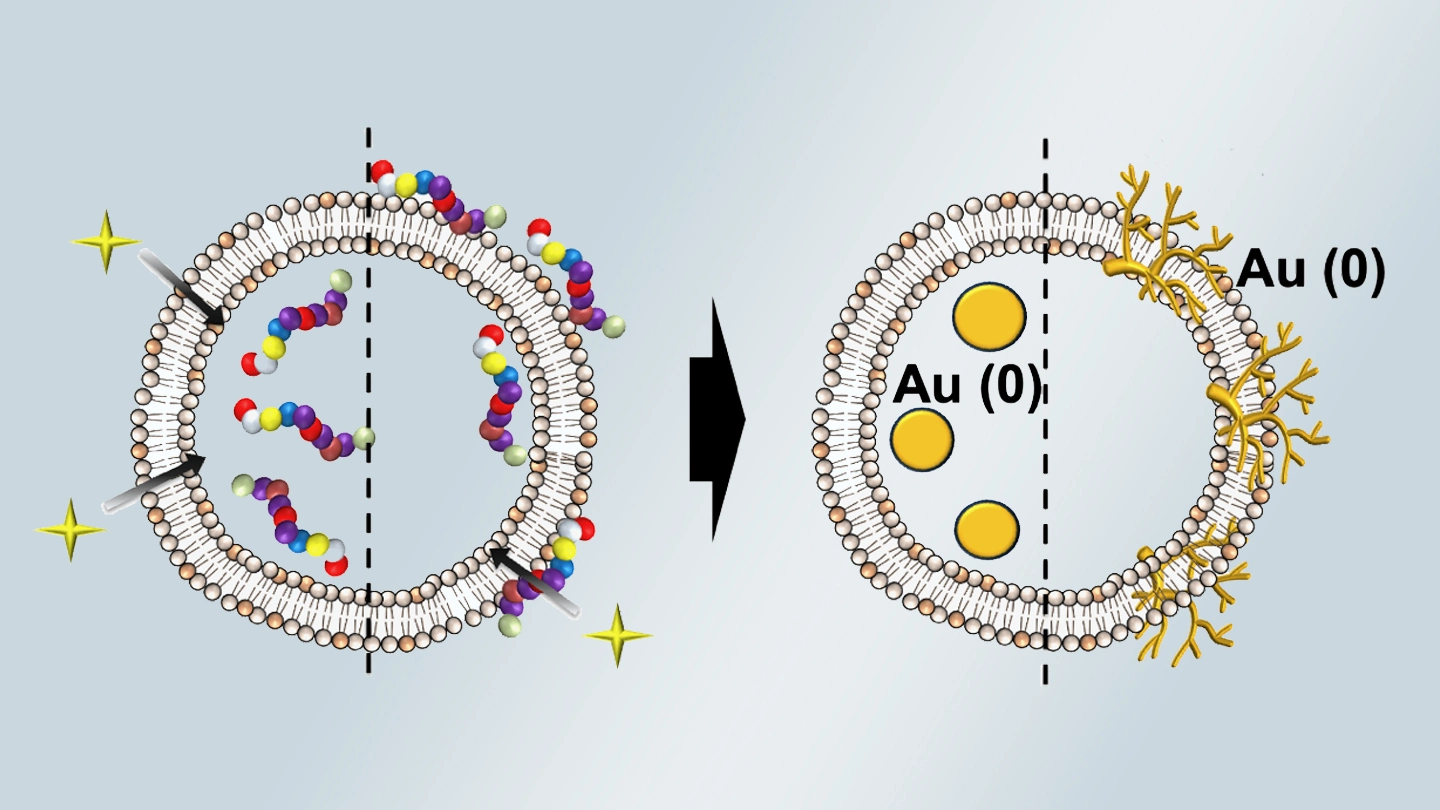
Summary of gold nanoparticle growth programming in liposome based on localization of biomineralization peptide The position of biomineralization peptides within liposomes can influence how gold nanoparticles grow, reports a research team from Institute of Science Tokyo. Peptides localized at the membrane interface promote branched structures, while those confined to the liposome interior favor spherical nanoparticles. The findings offer a new strategy for controlling nanoscale reaction...
