Technical University of Denmark
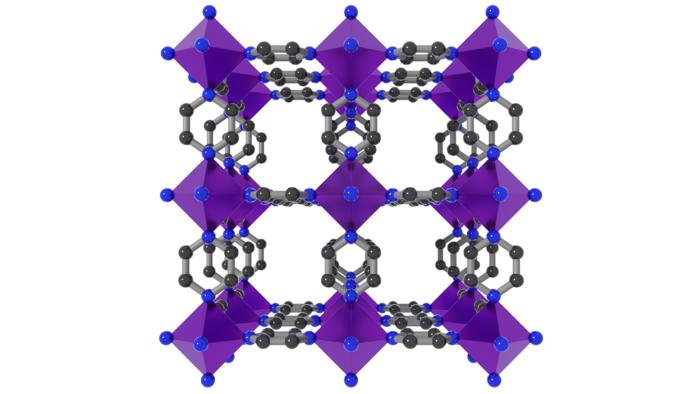
An international research team led by DTU has developed a new magnetic material that features a stable internal magnetic structure, almost no external magnetic field, and retains these properties above room temperature.
These characteristics may be important for future generations of electronic technologies, for example within fields where magnetic properties are used instead of electrical charge to process information—so‑called spintronics. The results have been published in the prestigious scientific journal Nature Chemistry.
The material belongs to a rare class known as compensated ferrimagnets. In such materials, the magnetic moments inside the structure point in different directions. Internally, magnetism is very strong, but the magnetic moments almost cancel each other out. As a result, the material exhibits only a very weak external magnetic field. This sets it apart from conventional magnets, which generate unwanted magnetic interference or “noise” that makes them difficult to integrate into electronic circuits.
“We now have a material with a very well‑ordered magnetic structure, but without the magnetic field that usually causes problems in electronics,” says Professor Kasper Steen Pedersen from DTU Chemistry, who led the development of the new material in collaboration with researchers from DTU Chemistry, the European Synchrotron Radiation Facility (France), Institut Laue‑Langevin (France), the University of Copenhagen, Jagiellonian University (Poland), and Universidad Andrés Bello (Chile).
Less disruptive magnetism
In today’s electronic components, information is mainly carried by electrical charge. In spintronics, by contrast, information is carried by the spin of electrons, which in principle can enable faster components and significantly lower energy consumption. One of the major challenges addressed by the researchers behind the present study has been the need for magnetic materials that do not simultaneously disturb their surroundings.
“Magnetic materials are difficult to work with when you want to pack many functions closely together. But when a material emits almost no magnetic field, it becomes possible, in principle, to place components much closer together without unwanted interference,” says Kasper Steen Pedersen.
“This opens an entirely new level of control. When magnetism is embedded in a molecular material, we can use chemistry to tune both magnetic and electronic properties.”
The new material is built as a metal–organic network in which metallic centres are connected by organic molecules. This molecular structure makes it possible to design and adjust the material’s properties chemically. This approach differs from the metal alloys and oxides that currently dominate magnetic electronics.
More specifically, the material consists of chromium atoms linked by the organic molecule pyrazine, which is well suited for binding metal atoms together. In this case, the pyrazine occurs as a radical with one unpaired electron, allowing it to contribute directly to the material’s magnetism.
Fundamental research with wide-ranging potential
Experiments show that the near‑perfect magnetic compensation remains stable over a wide temperature range and persists well above room temperature. This makes the material particularly interesting, as almost all related materials only exhibit such a balance at specific temperatures. As a result, the new material may potentially be applicable in a much broader range of contexts.
The researchers emphasise that the work represents fundamental research and that the material’s functionality has not yet been tested in concrete components or for any specific application. Nevertheless, the technological perspective of the discovery is clear.
“We have not created a finished technology, but we have shown that it is possible to achieve a combination of properties that many researchers have been looking for over many years,” says Kasper Steen Pedersen.
“That makes the material interesting as a platform for future development.”
The next step will be to investigate whether the material can be chemically tuned towards other properties like electrical conductivity, and whether it can be fabricated as thin films suitable for integration into electronic components.
Reference
Persistent compensated ferrimagnetism in the molecular framework Cr(pyrazine)3
Frédéric Aribot, Maja A. Dunstan, Nathan J. Yutronkie, Mariusz Kubus, Luis Leyva-Parra, Anton Viborg, Susanne Mossin, Fabrice Wilhelm, Vivian Nassif, Dawid Pinkowicz, Wiktor Wolański, Lukas B. Woodcock, Stergios Piligkos, Jesper Bendix, Sebastian E. Reyes-Lillo, Andrei Rogalev & Kasper S. Pedersen

Researchers at The University of Osaka have developed a novel method for generating ultrahigh magnetic fields via laser-driven implosions of blade-structured microtubes. This method achieves field strengths approaching one megatesla—a breakthrough in compact, high-field plasma science.
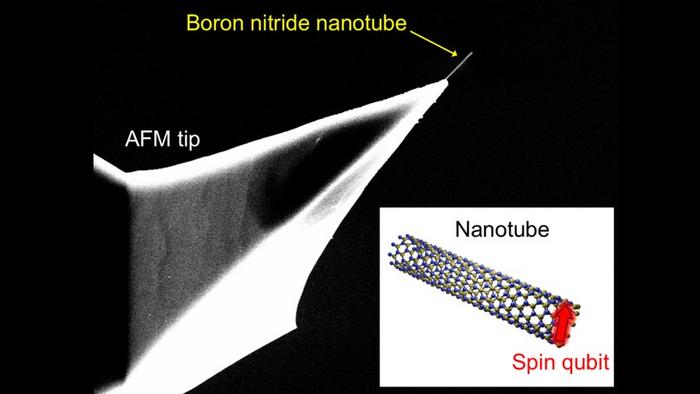
Purdue University researchers have developed patent-pending one-dimensional boron nitride nanotubes (BNNTs) containing spin qubits, or spin
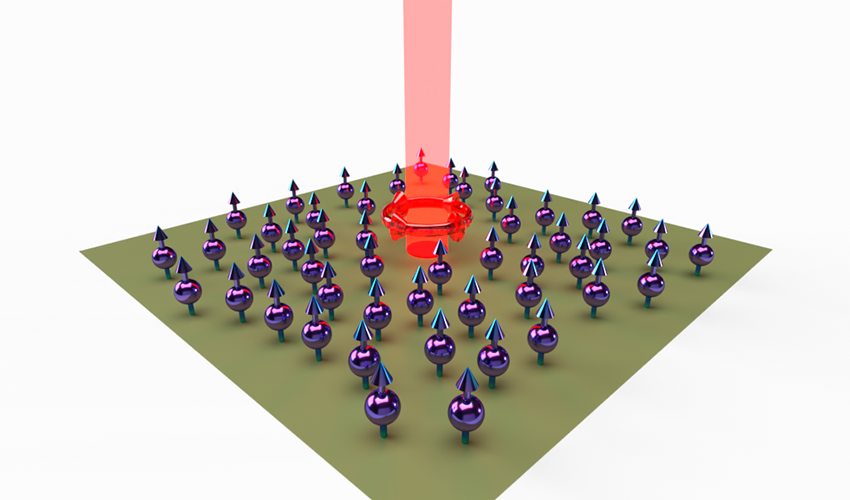
In thin, two-dimensional semiconductors, electrons move, spin and synchronize in unusual ways. For researchers, understanding the way...
This week in nanotech
$281.1M raised
6 funding rounds · 36 deals tracked
New products
 Nion-compatible In Situ STEM Holders for Electrical BiasingHummingbird Scientific Featured
 Orion Sputtering Deposition SystemsAJA International Featured
 Talphene™ Graphene AdditivesTalga Group
Market insights
Last 30 days: Quantum Technologies drew the most money: $3.17B.
Money raised per month