Researchers at the University of Bristol have discovered an alloy that shows increased strength at over -250°C, making it the toughest material on record.
The findings, published in Science, show that chromium-cobalt-nickel alloy displays a high fracture toughness in cryogenic temperatures paving the way for its use in extreme environments on Earth and in space.
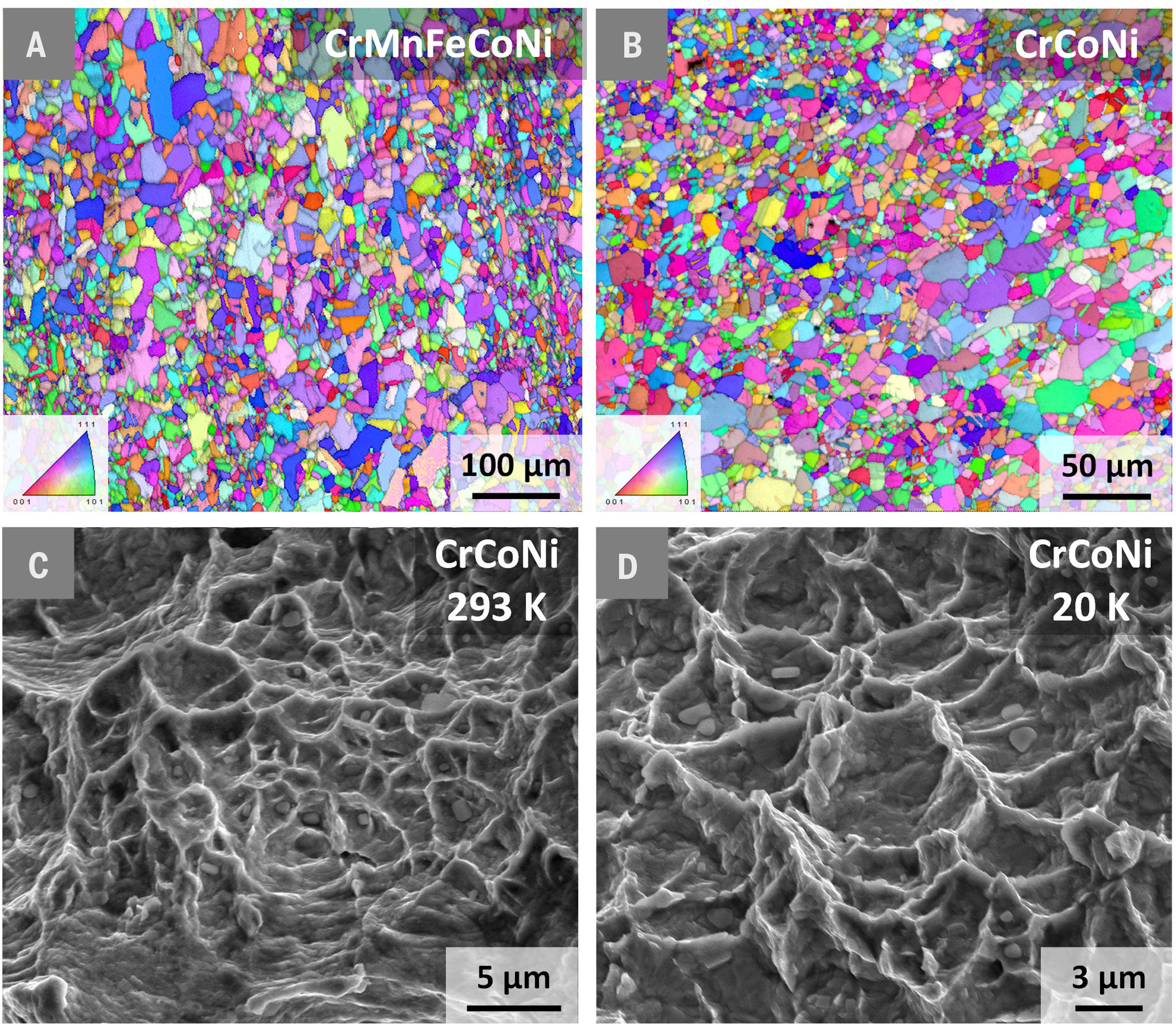
The behaviour of this particular combination of metals is caused by a phase transformation that, when combined with other nano-scale mechanisms, prevents crack formation and propagation.
Lead author Dr Dong Liu of Bristol’s School of Physics, explained: “This is very interesting because most alloys become more brittle with a decrease in temperature. I reference the sinking of liberty ships in WWII and Titanic which were due to the metals losing its ductility at low temperatures.”
“People often mix the concept of strength and toughness. If you Google, ‘what is the toughest materials on earth?’ ‘Diamond’ will jump out on the top line. Diamond is the hardest known material to date, but hardness is usually related to strength of a material - diamond is indeed very hard and strong but it is not tough.”
Structures such as nuclear pressure vessels require metals which are less hard but have good ductility and toughness to tolerate damage. These metals give warning before they finally fracture, which is necessary, particularly for life-critical applications.
Dr Liu added: “As this CrCoNi material does not decrease in strength and toughness as it becomes as cold as 20 Kelvin, it can be potentially used as structural or load-bearing components for many potential applications in space and cold regions on earth and other planets.’’
“Also, as we have discovered the mechanisms that are responsible for the improved strength and toughness. This means these processes can be used as a design guide for scientists and engineers to design better materials.”
Now Dr Liu and her team plan to further untangle fundamental causes for the sequence of toughening mechanisms in this material at 20 Kelvin using novel experimental and modelling methods. They also want to look at other types of high entropy alloys to see if they will show similar behaviours.
Dr Liu said: “The experimental testing the toughness of this material at 20K was not a trivial effort, it took us a few years to design and complete. The success of the experiment was based on our rich experience and strong expertise in testing materials under extreme conditions.”
Reference
Exceptional fracture toughness of CrCoNi-based medium- and high-entropy alloys at 20 kelvin
Dong Liu, Qin Yu, Saurabh Kabra, Ming Jiang, Paul Forna-Kreutzer, Ruopeng Zhang, Madelyn Payne, Flynn Walsh, Bernd Gludovatz, Mark Asta, Andrew M. Minor, Easo P. George, Robert O. Ritchie
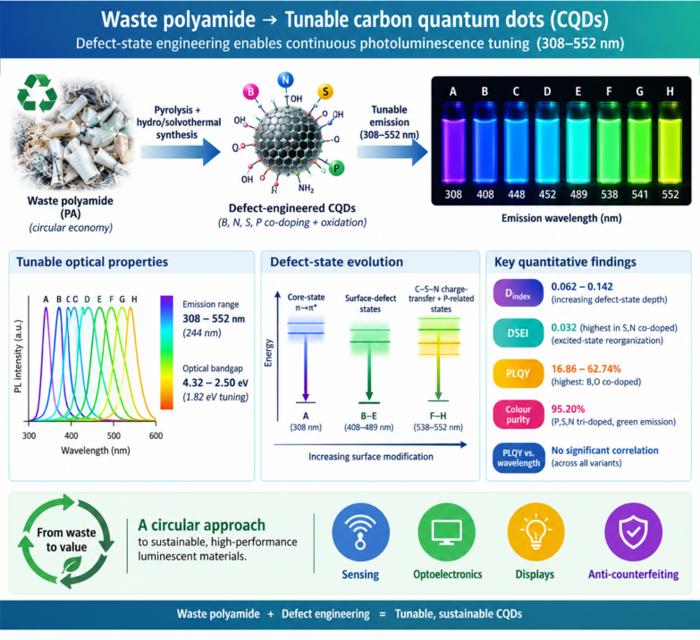
Waste polyamide-derived CQDs show continuous photoluminescence tuning from 308 to 552 nm through sequential defect-state engineering, with optical transition energies decreasing from 4.32 to 2.50 eV. @Christian Ebere Enyoh from Saitama University Carbon quantum dots (CQDs) are fluorescent carbon nanomaterials with potential applications in sensing, optoelectronics, displays, anti-counterfeiting, and environmental technologies. Their optical properties can be adjusted by modifying the carbon...
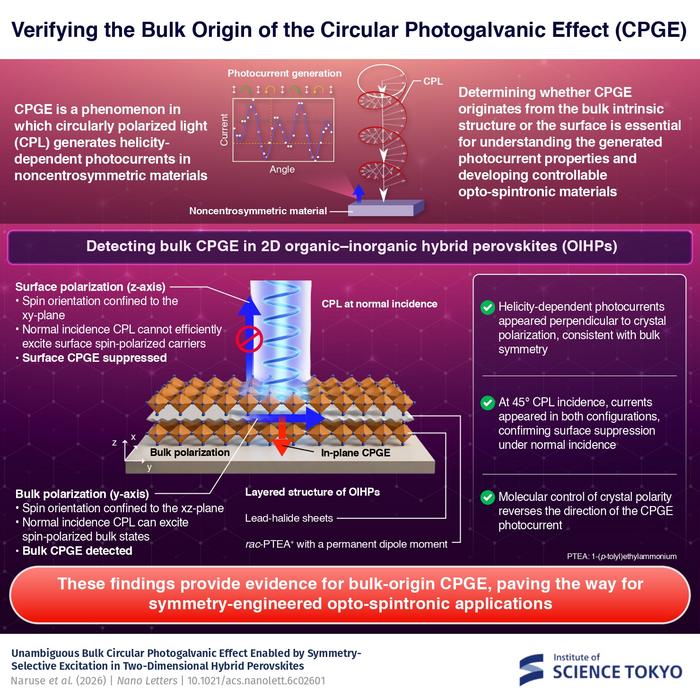
The researchers used circularly polarized light at normal incidence and found that helicity-dependent photocurrents appeared perpendicular to the crystal’s polarization but vanished when measured parallel to it, supporting a bulk origin of CPGE. @Institute of Science Tokyo The circular photogalvanic effect (CPGE), a phenomenon that generates helicity-dependent photocurrents in noncentrosymmetric materials, can originate purely from a crystal's internal structure without contribution from the...
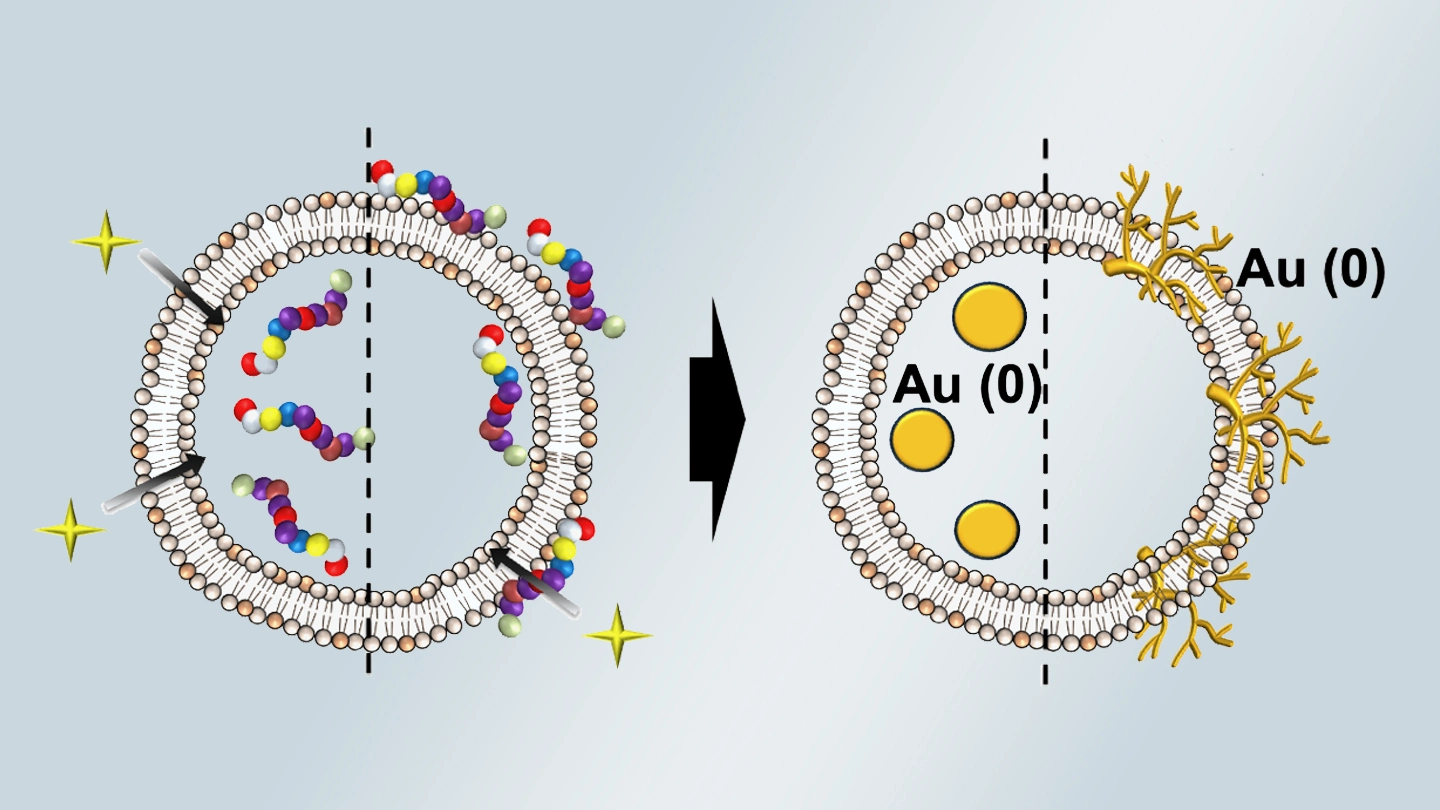
Summary of gold nanoparticle growth programming in liposome based on localization of biomineralization peptide The position of biomineralization peptides within liposomes can influence how gold nanoparticles grow, reports a research team from Institute of Science Tokyo. Peptides localized at the membrane interface promote branched structures, while those confined to the liposome interior favor spherical nanoparticles. The findings offer a new strategy for controlling nanoscale reaction...
