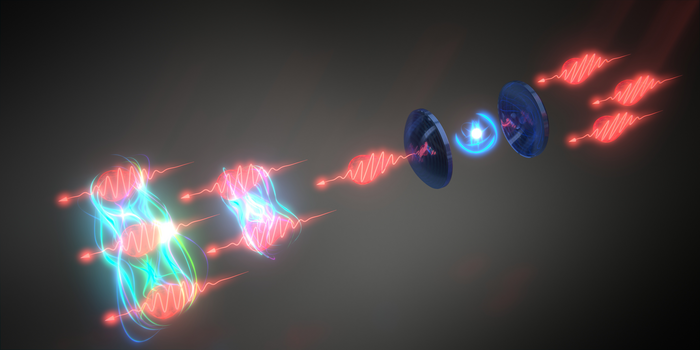
For the first time, scientists at the University of Sydney and the University of Basel in Switzerland have demonstrated the ability to manipulate and identify small numbers of interacting photons – packets of light energy – with high correlation.
This unprecedented achievement represents an important landmark in the development of quantum technologies. It is published today in Nature Physics.
Stimulated light emission, postulated by Einstein in 1916, is widely observed for large numbers of photons and laid the basis for the invention of the laser. With this research, stimulated emission has now been observed for single photons.
Specifically, the scientists could measure the direct time delay between one photon and a pair of bound photons scattering off a single quantum dot, a type of artificially created atom.
“This opens the door to the manipulation of what we can call ‘quantum light’,” Dr Sahand Mahmoodian from the University of Sydney School of Physics and joint lead author of the research said.
Dr Mahmoodian said: “This fundamental science opens the pathway for advances in quantum-enhanced measurement techniques and photonic quantum computing.”
By observing how light interacted with matter more than a century ago, scientists discovered light was not a beam of particles, nor a wave pattern of energy – but exhibited both characteristics, known as wave-particle duality.
The way light interacts with matter continues to enthral scientists and the human imagination, both for its theoretical beauty and its powerful practical application.
Whether it be how light traverses the vast spaces of the interstellar medium or the development of the laser, research into light is a vital science with important practical uses. Without these theoretical underpinnings, practically all modern technology would be impossible. No mobile phones, no global communication network, no computers, no GPS, no modern medical imaging.
One advantage of using light in communication – through optic fibres – is that packets of light energy, photons, do not easily interact with each other. This creates near distortion-free transfer of information at light speed.
However, we sometimes want light to interact. And here, things get tricky.
For instance, light is used to measure small changes in distance using instruments called interferometers. These measuring tools are now commonplace, whether it be in advanced medical imaging, for important but perhaps more prosaic tasks like performing quality control on milk, or in the form of sophisticated instruments such as LIGO, which first measured gravitational waves in 2015.
The laws of quantum mechanics set limits as to the sensitivity of such devices.
This limit is set between how sensitive a measurement can be and the average number of photons in the measuring device. For classical laser light this is different to quantum light.
Joint lead author, Dr Natasha Tomm from the University of Basel, said: “The device we built induced such strong interactions between photons that we were able to observe the difference between one photon interacting with it compared to two.
“We observed that one photon was delayed by a longer time compared to two photons. With this really strong photon-photon interaction, the two photons become entangled in the form of what is called a two-photon bound state.”
Quantum light like this has an advantage in that it can, in principle, make more sensitive measurements with better resolution using fewer photons. This can be important for applications in biological microscopy when large light intensities can damage samples and where the features to be observed are particularly small.
“By demonstrating that we can identify and manipulate photon-bound states, we have taken a vital first step towards harnessing quantum light for practical use,” Dr Mahmoodian said.
“The next steps in my research are to see how this approach can be used to generate states of light that are useful for fault-tolerant quantum computing, which is being pursued by multimillion dollar companies, such as PsiQuantum and Xanadu.”
Dr Tomm said: “This experiment is beautiful, not only because it validates a fundamental effect – stimulated emission – at its ultimate limit, but it also represents a huge technological step towards advanced applications.
“We can apply the same principles to develop more-efficient devices that give us photon bound states. This is very promising for applications in a wide range of areas: from biology to advanced manufacturing and quantum information processing.”
The research was a collaboration between the University of Basel, Leibniz University Hannover, the University of Sydney and Ruhr University Bochum.
The lead authors are Dr Natasha Tomm from the University of Basel and Dr Sahand Mahmoodian at the University of Sydney, where he is an Australian Research Council Future Fellow and Senior Lecturer.
The artificial atoms (quantum dots) were fabricated at Bochum and used in experiment performed in the Nano-Photonics Group at the University of Basel. Theoretical work on the discovery was carried out by Dr Mahmoodian at the University of Sydney and Leibniz University Hannover.
Reference
Photon bound state dynamics from a single artificial atom
Natasha Tomm, Sahand Mahmoodian, Nadia O. Antoniadis, Rüdiger Schott, Sascha R. Valentin, Andreas D. Wieck, Arne Ludwig, Alisa Javadi & Richard J. Warburton
https://www.nature.com/articles/s41567-023-01997-6
University of Sydney
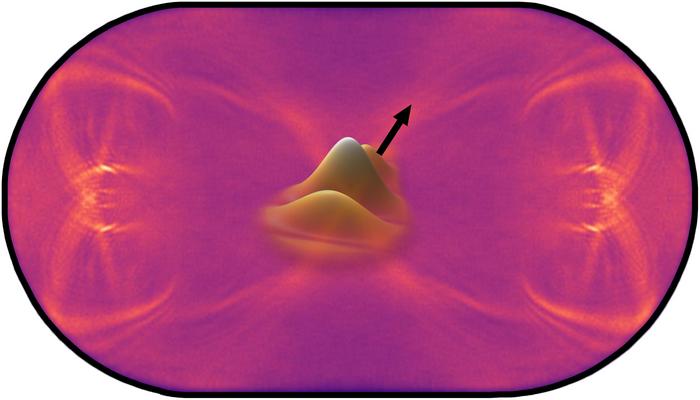
A quantum "wave packet" (in the middle) launched from the same kind of starting point behaves differently. Even after bouncing around for a very long time, faint filament-like patterns (bright glow) are still visible, a tattoo tracing back to its early history. This lingering imprint is the "quantum birthmark" described in the study. Credit: Joonas Keski-Rahkonen, Tampere University Even the most chaotic quantum systems keep a permanent mark of their own past – a "quantum birthmark" – that...
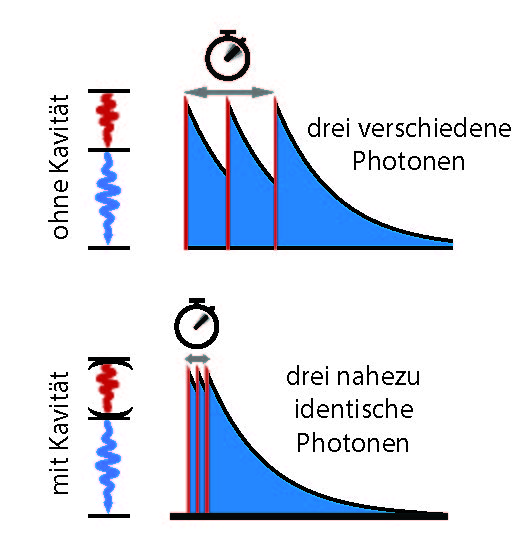
Illustration (University of Basel, Timon Baltisberger): Biexziton decay can generate photons of very high quality if the system is specifically controlled using an optical cavity. Under these conditions, 90 per cent of the photons are indistinguishable. Working in close collaboration, researchers from Paderborn University, the University of Basel and Ruhr University Bochum have made a significant breakthrough in the field of quantum communication. In their recently published paper in the...
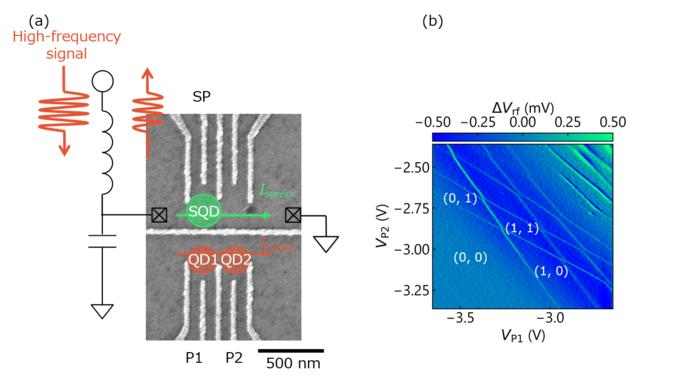
(a) The structure of the gate electrodes on the ZnO device used in the experiment in this paper. (b) The charge stability diagram indicating the formation of ZnO double quantum dot in few-electron regime. Researchers at Tohoku University, in collaboration with the National Institute for Materials Science (NIMS) and the University of Tokyo, have taken an important step toward semiconductor quantum computing using zinc oxide (ZnO). The team successfully demonstrated charge sensing,...
