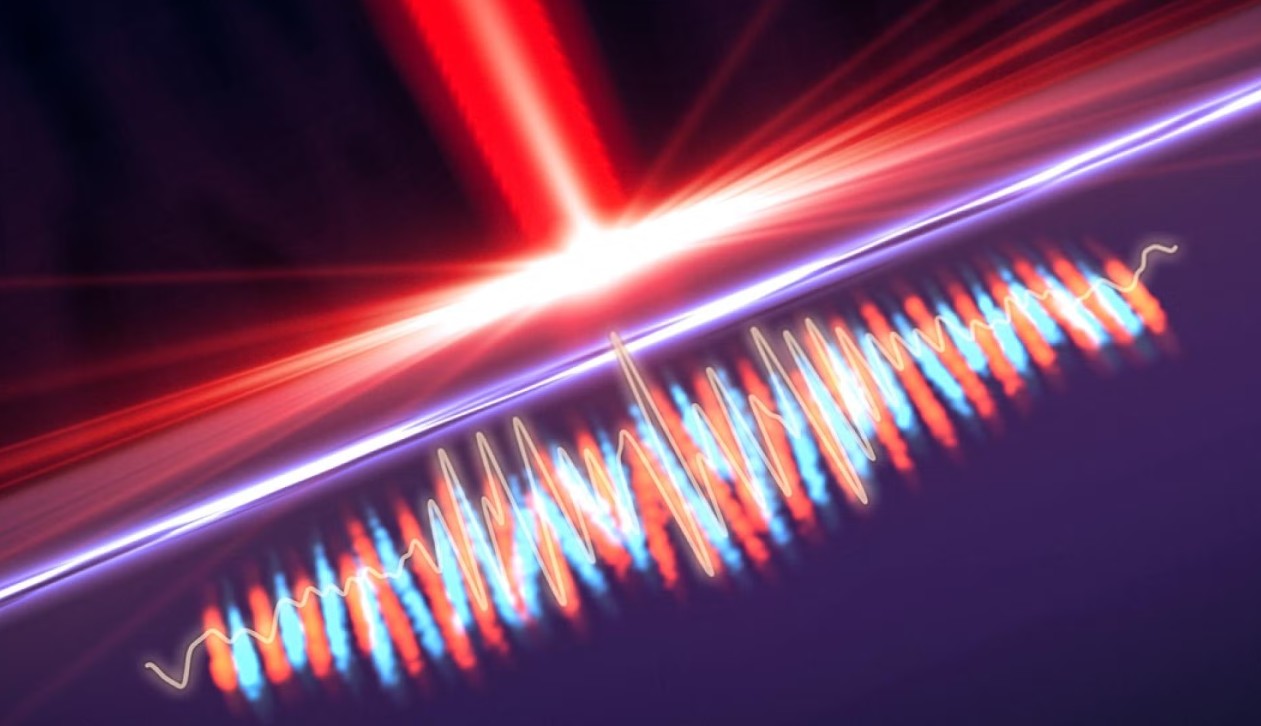
The team developed a platform that uses powerful X-rays from the lab’s LCLS X-ray laser to resolve for the first time the evolution of instabilities in high-density plasmas.
Key takeaways:
Harnessing the power of the sun holds the promise of providing future societies with energy abundance. To make this a reality, fusion researchers need to address many technological challenges. For example, fusion reactions occur within a superheated state of matter, called plasma, which can form unstable structures that reduce the efficiency of those reactions. Characterizing different instabilities could help researchers prevent or make use of them. One particular instability, known as current filamentation, is also relevant to understanding astrophysical phenomena.
Now, for the first time, a team led by researchers at the Department of Energy’s SLAC National Accelerator Laboratory imaged how the current filamentation instability evolves in real time in high-density plasma. Their work, reported in Nature Communications, demonstrates a new way to study instabilities in plasmas using SLAC’s Linac Coherent Light Source (LCLS) X-ray laser.
Our understanding of instabilities – when they grow, how they grow – is important to making fusion work.
Siegfried Glenzer
High Energy Density Division Director, Professor for Photon Science, SLAC
“This is the most detailed description of this instability yet,” said Christopher Schoenwaelder, project scientist at SLAC and first author of the paper. “We actually image the evolution of the instability and then combine that with state-of-the-art simulations to try to make constraints on existing theoretical models of it.”
Co-author Siegfried Glenzer, High Energy Density Division director and professor for photon science at SLAC, said, “Our understanding of instabilities – when they grow, how they grow – is important to making fusion work.”
Energetic X-rays yield unprecedented resolution
In the current filamentation instability, a laser accelerates electrons in a plasma to very high energies, producing a current of hot electrons. This current interacts with a return current of cold electrons streaming in the opposite direction, which gives rise to the filament-shaped instability.
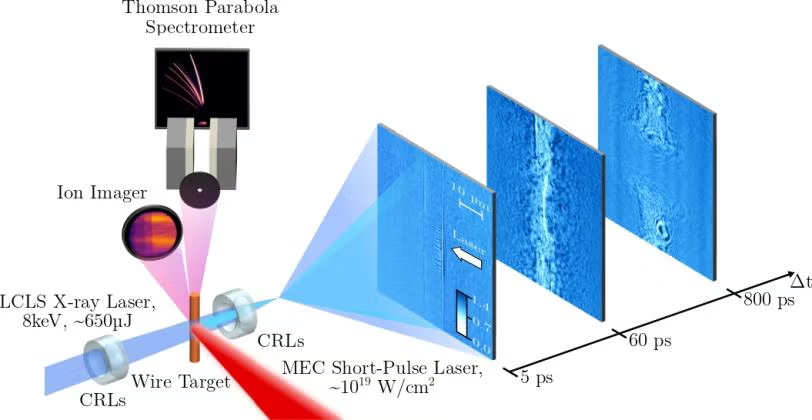
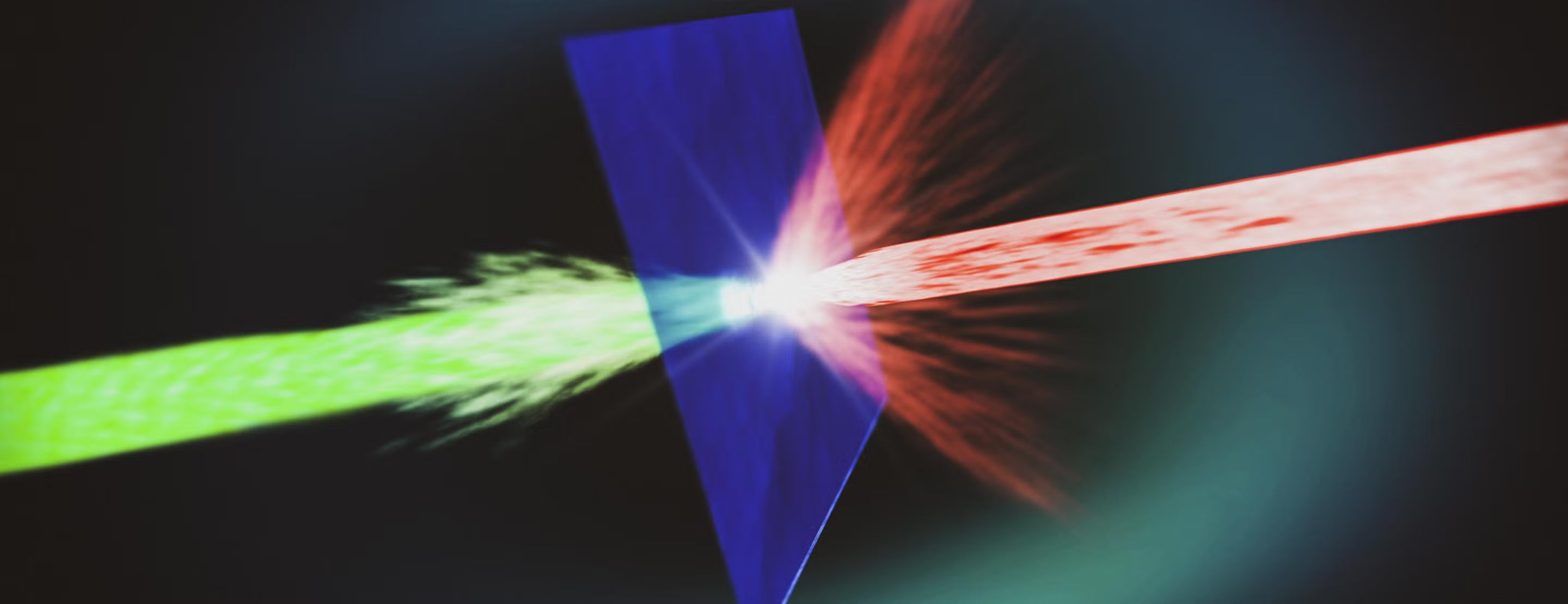
While this instability has been imaged in low-density plasmas, it’s more challenging to study in high-density plasmas, which conventional imaging methods cannot penetrate. However, studying denser plasmas is important for understanding inertial fusion plasmas, which have very high densities. The high-intensity X-rays from the LCLS carry enough energy to pass through a high-density plasma and produce an image of the instability forming within, which the team induced with a powerful laser at the Matter in Extreme Conditions (MEC) instrument.
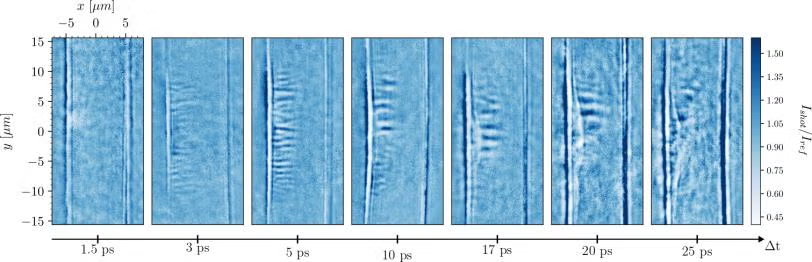
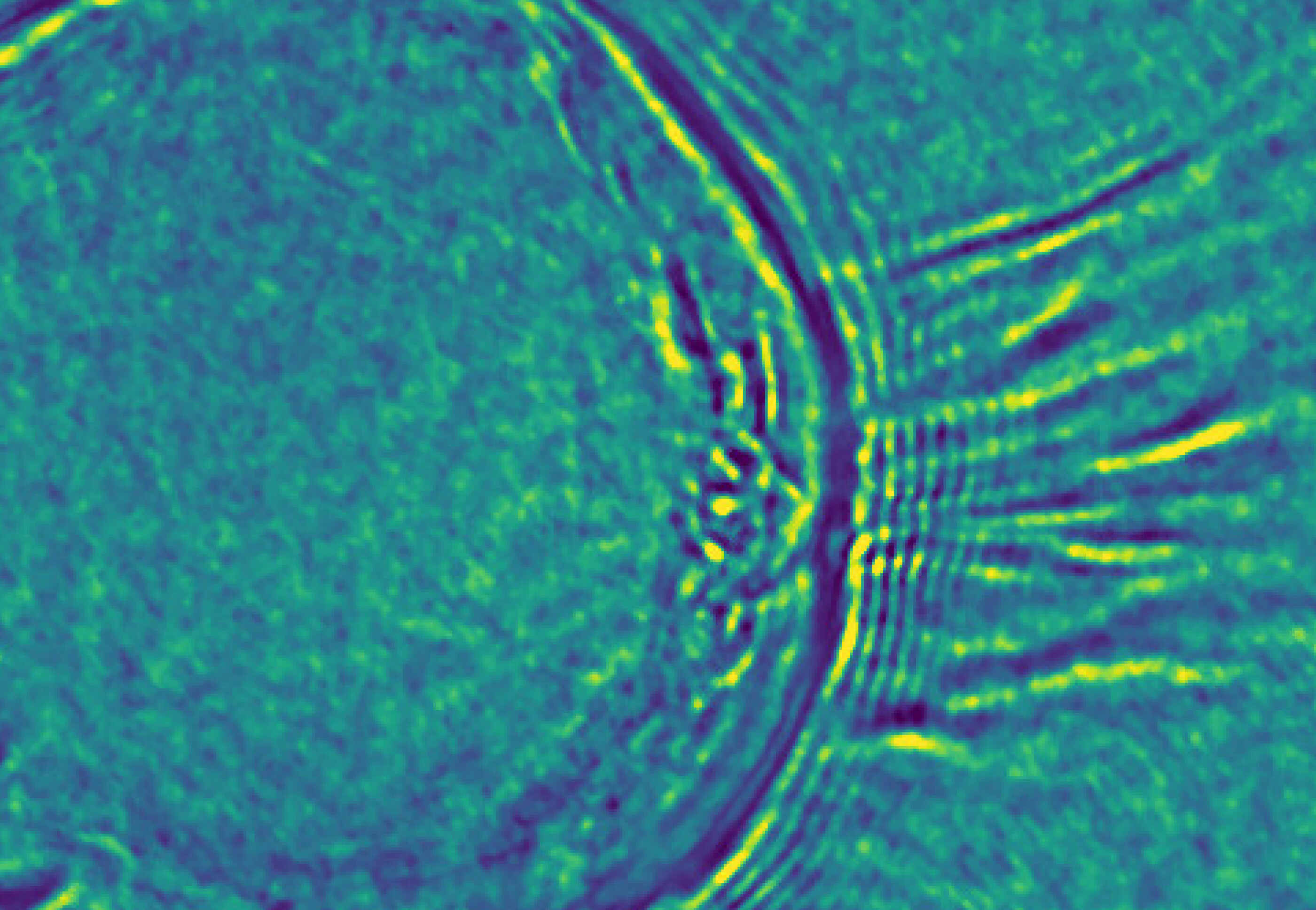
The resultant images showed the formation of the micrometer-scale filamentary structures over a tiny fraction of second, providing unprecedented spatial and temporal resolution of this instability.
“Every 500 femtoseconds [quadrillionths of a second], we took snapshots to get a true image of what was happening at that moment in time, showing details like never before,” Glenzer said.
A new way to study plasma instabilities
Schoenwaelder and Maxence Gauthier, associate staff scientist at SLAC, spearheaded the experimental aspects of this work. Alexis Marret, research associate at SLAC, and Frederico Fiúza, a professor of physics at the University of Lisbon, Portugal, and visiting professor of photon science at SLAC, focused on the simulation side. By comparing cutting-edge simulations of the experiment with the data and theory, they identified mechanisms that shape the evolution of this instability.
The analysis also showed that, during the experiment, the instability produced a 1,000-Tesla magnetic field, which is about 100,000 times stronger than that of a typical refrigerator magnet. In plasmas in astrophysical phenomena, such as exploding stars, this strong magnetic field amplification is thought to enable the acceleration of high-energy particles known as cosmic rays. Eventually, a better understanding of this instability could allow scientists to use plasma experiments in the lab to learn about events happening light-years away.
The platform developed in this work could also be extended to study other types of plasma instabilities, including those that take energy away from fusion reactions.
The international research team also included members from Stanford University; University of Alberta, Canada; University of Erlangen-Nuremberg, Helmholtz Center Dresden-Rossendorf, Technical University Dresden, European X-ray Free-Electron Laser, and Technical University Darmstadt, all in Germany. LCLS scientists made key contributions to the experiment, including the development of the general experimental concept and of the diagnostic that made it possible. Large parts of this work were funded by the Department of Energy’s Office of Science and were supported by SLAC’s Laboratory Directed Research & Development (LDRD) Program. LCLS is an Office of Science user facility.
Source: SLAC
Reference
Time-resolved X-ray imaging of the current filamentation instability in solid-density plasmas
Christopher Schoenwaelder, Alexis Marret, Stefan Assenbaum, Chandra B. Curry, Eric Cunningham, Gilliss Dyer, Stefan Funk, Griffin D. Glenn, Sebastian Goede, Dimitri Khaghani, Martin Rehwald, Ulrich Schramm, Franziska Treffert, Milenko Vescovi, Karl Zeil, Siegfried H. Glenzer, Frederico Fiuza & Maxence Gauthier
Nature Communications volume 17, Article number: 467 (2026)
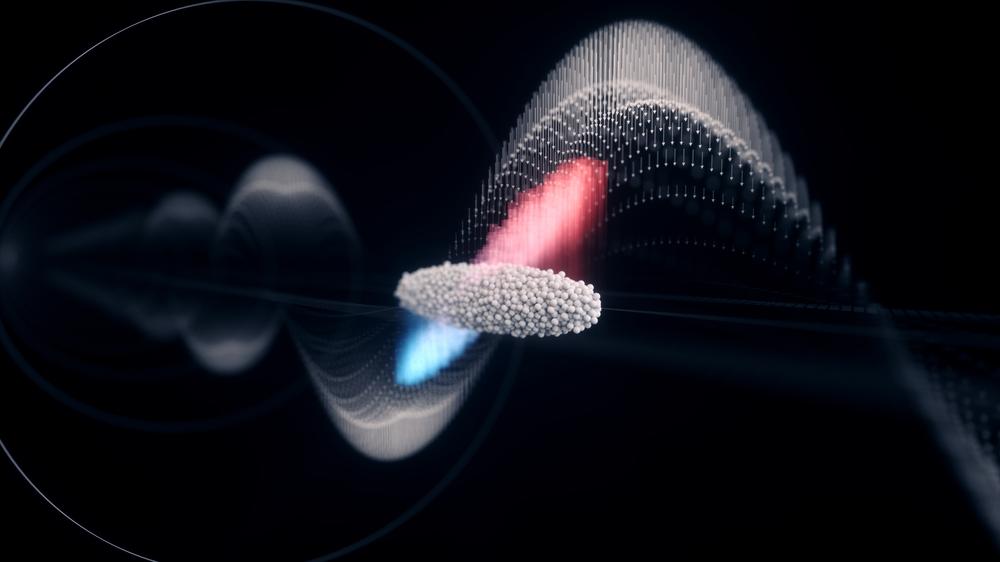
Using a clever correction system, a research team was able to significantly improve the quality of electron bunches accelerated by a laser plasma accelerator. This brings the technology a step closer to concrete applications, such as a plasma-based injector for a synchrotron storage ring.
Researchers studying laser-driven proton acceleration introduced an innovative, self-replenishing water sheet target to address the...
Plasma is a super-hot mixture of charged particles, such as ions and electrons, which can conduct electricity and are influenced by magne...
