Max Planck Institute for Polymer Research (MPI-P)
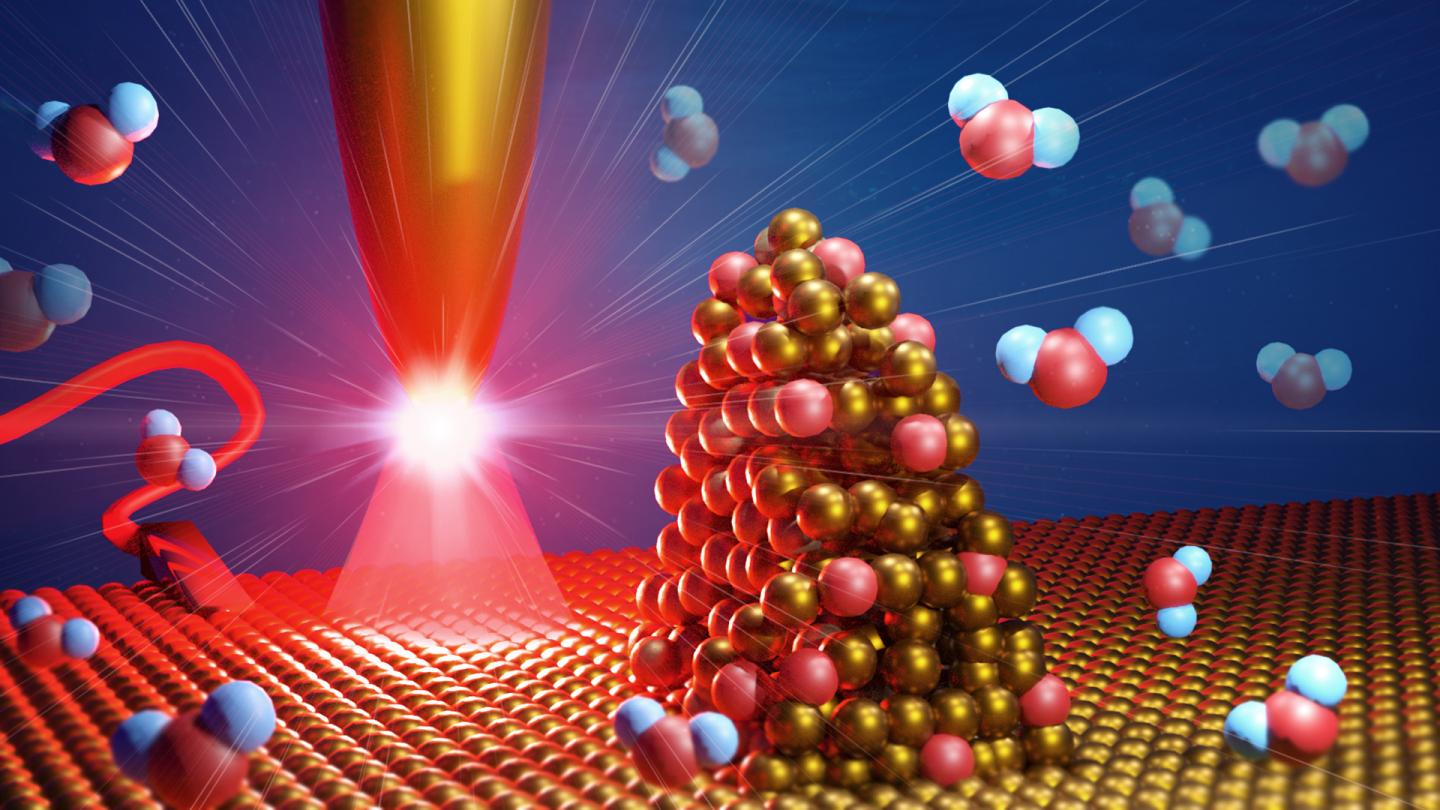
It is a well-known school experiment: When a voltage is applied between two electrodes inserted in water, molecular hydrogen and oxygen are produced. To further the industrial use of this process, it is indispensable to make water splitting as energy-efficient as possible. In addition to the material of the electrode, its surface quality is a crucial aspect for the splitting efficiency. In particular, rough spots of only few nanometers - i.e. millionths of a millimeter – in size that are called reactive centers determine the electrochemical reactivity of an electrode.
Previous investigation methods were not accurate enough to follow chemical reactions taking place at such reactive centers on the electrode surface with sufficient spatial resolution under real operating conditions, i.e. in electrolyte solution at room temperature and with an applied voltage. A team of scientists led by Dr. Katrin Domke, independent Boehringer Ingelheim "Plus 3" group leader at the MPI-P, has now developed a new method with which the initial steps electrocatalytic water splitting on a gold surface could be studied for the first time with a spatial resolution of less than 10 nm under operating conditions.
"We were able to show experimentally that surfaces with protrusions in the nanometer range split water in a more energy efficient way than flat surfaces," says Katrin Domke. "With our images, we can follow the catalytic activity of the reactive centers during the initial steps of water splitting".
For their method, they have combined different techniques: In Raman spectroscopy, molecules are illuminated with light that they scatter. The scattered light spectrum contains information that provides a chemical fingerprint of the molecule, enabling the identification of chemical species. However, Raman spectroscopy is typically a technique that produces only very weak and, moreover, only spatially averaged signals over hundreds or thousands of nanometers.
For this reason, the researchers have combined the Raman technique with scanning tunneling microscopy: by scanning a nanometer-thin gold tip illuminated with laser light over the surface under investigation, the Raman signal is amplified by many orders of magnitude directly at the tip apex that acts like an antenna. This strong enhancement effect enables the investigation of very few molecules at a time. Furthermore, the tight focusing of the light by the tip leads to a spatial optical resolution of less than ten nanometer. The distinctive feature of the apparatus is that it can be operated under realistic electrocatalytic operating conditions.
"We were able to show that during water splitting at nanometer rough spots - i.e. a reactive centers - two different gold oxides are formed, which could represent important intermediates in the separation of the oxygen atom from the hydrogen atoms," says Domke. With their investigations, it is now possible to gain a more precise insight into the processes taking place on the nanometer scale on reactive surfaces and facilitate the design of more efficient electrocatalysts in the future, where less energy is needed to split water into hydrogen and oxygen.
The scientists have published their results in the renowned journal "Nature Communications".
Reactivity mapping of nanoscale defect chemistry under electrochemical reaction conditions
Jonas H. K. Pfisterer, Masoud Baghernejad, Giovanni Giuzio & Katrin F. Domke
Nature Communications volume 10, Article number: 5702 (2019)
DOI: 10.1038/s41467-019-13692-3
Contact information:
Katrin F. Domke
MPI-P Group Leader
domke@mpip-mainz.mpg.de
Phone: +49 6131 379-476

Researchers led by Professor Jaeyune Ryu at Seoul National University identified local pH near electrodes as a decisive variable in organic electrosynthesis. By designing a reactor that narrows electrode spacing and flows electrolyte to counterbalance acidic and alkaline zones, they raised selectivity for lactones and epoxides, feedstocks for biodegradable plastics, polyurethanes, adhesives, and epoxy resins, from about 16% to 97% using only oxygen and electricity, eliminating added peroxide…

Silver nanoparticles with diameters of ~10 nm deliver the best performance as electrocatalysts. The silver particles are sprayed onto the electrode together with a conductive carbon powder. The ideal mixture consists of 20 per cent by mass silver and 80 per cent by mass carbon powder. This image was taken using a transmission electron microscope (TEM). © HZB Via electrolysis, CO₂ can be reduced to CO, a raw material for further chemical products such as fuels. Within the GreenQuest Project,...

A flexible metal–organic framework developed by researchers from Institute of Science Tokyo enables the structural determination of large "beyond rule of 5" molecules from microgram-scale samples. Using APF-40 as a crystalline sponge, the researchers determined the structures of 12 pharmaceutical-related molecules, including the 899 Da drug molecule doramectin and trace ivermectin derivatives. The method could aid drug discovery, natural products research, and the characterization of rare...






