
Control of Light with DNA-Nanoparticle Crystals
- Jun 11, 2015
- 2 min read
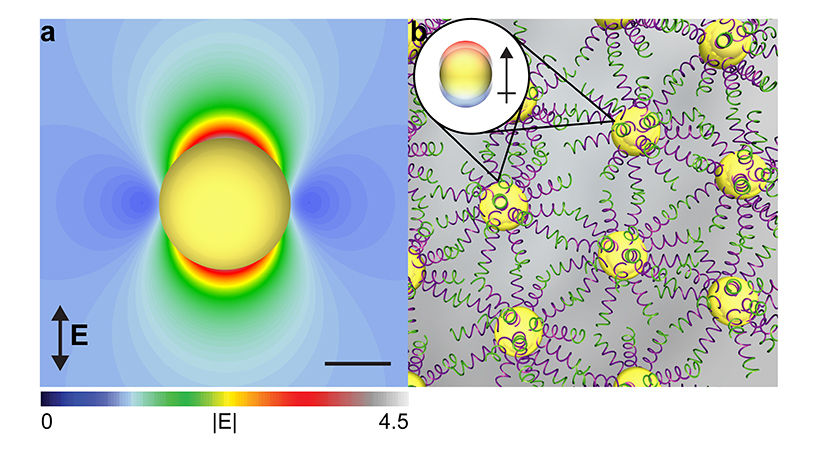
DNA enables one to precisely place nanoparticles into periodic structures (called “superlattices”) in two or three dimensions as either large films or near-perfect single crystals. By constructing the superlattices from gold nanoparticles, a Northwestern University research group, carrying out studies at the U.S. Department of Energy’s Advanced Photon Source (APS), reported in Nature Nanotechnology that they can precisely control how light flows though and interacts with these materials. Control over nanoparticle arrangement, crystal size, and crystal shape provides a way for making new types of optical materials.
The interdisciplinary team of researchers utilized detailed x-ray measurements obtained at DuPont-Northwestern-Dow Collaborative Access Team (DND-CAT) beamline 5-ID-B,C,D and the X-ray Science Division (XSD) beamline 12-ID-B, both at the APS (which is an Office of Science user facility) to explore the structural properties of nanoparticle superlattices that intimately control light-matter interactions.
A major advantage of using nanoparticles to build new materials is that their properties can change depending on how they are arranged. Here, the researchers demonstrated that by carefully controlling how the nanoparticles are positioned across multiple length scales, their optical response can be rationally designed to absorb or scatter light.
Structural measurements at the APS provided detailed information about the symmetry and spacing of the nanoparticles in the superlattices, which influences their optical properties. Theoretical results by the same team last year reported that by independently changing the spacing between nanoparticles in addition to the larger-scale crystal shape, one could control how light flows through the superlattices. The modification of nanoparticles with DNA allows them to act as “programmable atom equivalents” that can be assembled into over 30 different crystal symmetries. This control, combined with the recent advance enabling the synthesis of large single crystals,
provided a means for testing these theoretical predictions. Small-angle x-ray scattering measurements performed at the DND-CAT beamline and grazing incidence small-angle x-ray scattering studies at the XSD beamline provided detailed information about the crystalline nanoparticle arrangement, which ultimately dictates their properties.
These results advance the scientific community’s understanding of what happens to nanoparticles as one arranges them into larger, more complex structures with well-defined shapes. In the future, the research team aims to incorporate new types of nanoparticles, including other metals, semiconductors such as quantum dots that fluoresce, and metal oxides with unusual magnetic or catalytic properties. The team is excited about using superlattice crystalline materials for photonic and energy applications that require the precise control over light flow and confinement, for example in new classes of batteries and photovoltaics.





Comments