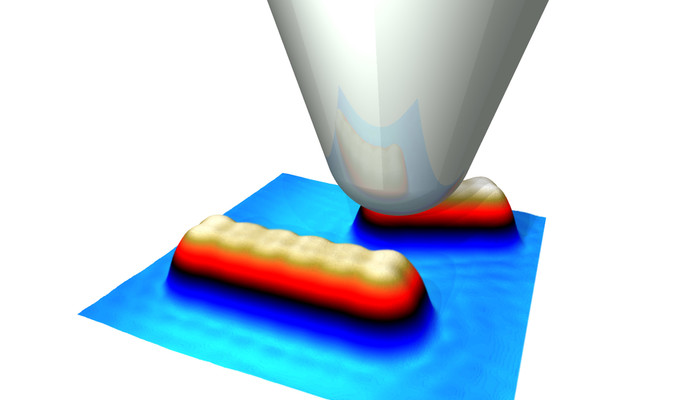
Researchers at Aalto University have succeeded in experimentally realizing metallic graphene nanoribbons that are only 5 carbon atoms wide.
The results suggest that these extremely narrow and single-atom-thick ribbons could be used as metallic interconnects in future microprocessors. In their article published in Nature Communications, the research team demonstrated fabrication of the graphene nanoribbons (GNR) and measured their electronic structure.
Graphene nanoribbons have been suggested as ideal wires for use in future nanoelectronics: when the size of the wire is reduced to the atomic scale, graphene is expected to outperform copper in terms of conductance and resistance to electromigration, which is the typical breakdown mechanism in thin metallic wires. However, all demonstrated graphene nanoribbons have been semiconducting, which hampers their use as interconnects. Headed by Prof. Peter Liljeroth, researchers from the Atomic Scale Physics and Surface Science groups have now shown experimentally that certain atomically precise graphene nanoribbon widths are nearly metallic, in accordance with earlier predictions based on theoretical calculations.
The team used state-of-the-art scanning tunneling microscopy (STM) that allows them to probe the material’s structure and properties with atomic resolution.
– With this technique, we measured the properties of individual ribbons and showed that ribbons longer than 5 nanometers exhibit metallic behaviour, says Dr Amina Kimouche, the lead author of the study.
The nanoribbon fabrication is based on a chemical reaction on a surface.
– The cool thing about the fabrication procedure is that the precursor molecule exactly determines the width of the ribbon. If you want one-carbon-atom-wide ribbons, you simply have to pick a different molecule, explains Dr Pekka Joensuu, who oversaw the synthesis of the precursor molecules for the ribbons.
The experimental findings were complemented by theoretical calculations by the Quantum Many-Body Physics group headed by Dr Ari Harju. The theory predicts that when the width of the ribbons is increased atom-by-atom, every third width should be (nearly) metallic with a very small band gap.
– According to quantum mechanics, normally when you make your system smaller, it increases the band gap. Graphene can work differently due to its extraordinary electronic properties, says Harju’s doctoral student Mikko Ervasti, who performed the calculations.
These results pave the way for using graphene in future electronic devices, where these ultra-narrow ribbons could replace copper as the interconnect material. Future studies will focus on all-graphene devices combining both metallic and semiconducting graphene nanostructures.
– While we are far from real applications, it is an extremely exciting concept to build useful devices from these tiny structures and to achieve graphene circuits with controlled junctions between GNRs, says Liljeroth.
The research “Ultra-narrow metallic armchair graphene nanoribbons” was published in Nature Communications Science publication.
The study was performed at Aalto University’s Department of Applied Physics and Department of Chemistry. The groups are part of the Academy of Finland’s Centres of Excellence in Low Temperature Quantum Phenomena and Devices (LTQ) and Computational Nanosciences (COMP). The Academy of Finland and the European Research Council ERC funded the research.
Aalto University
#Graphene #Nanoelectronics
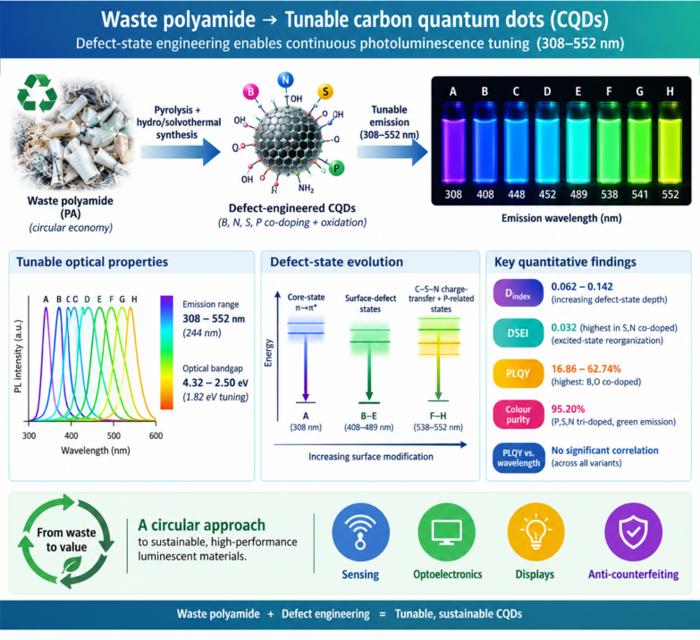
Waste polyamide-derived CQDs show continuous photoluminescence tuning from 308 to 552 nm through sequential defect-state engineering, with optical transition energies decreasing from 4.32 to 2.50 eV. @Christian Ebere Enyoh from Saitama University Carbon quantum dots (CQDs) are fluorescent carbon nanomaterials with potential applications in sensing, optoelectronics, displays, anti-counterfeiting, and environmental technologies. Their optical properties can be adjusted by modifying the carbon...
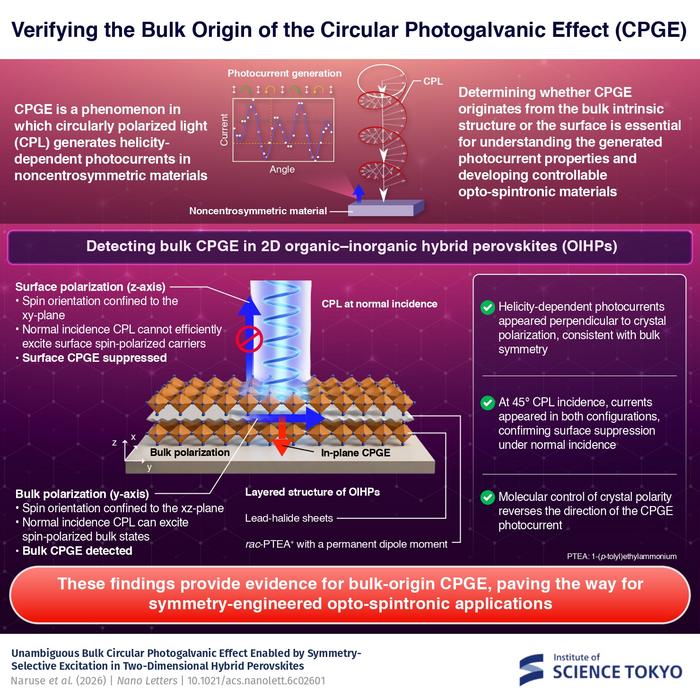
The researchers used circularly polarized light at normal incidence and found that helicity-dependent photocurrents appeared perpendicular to the crystal’s polarization but vanished when measured parallel to it, supporting a bulk origin of CPGE. @Institute of Science Tokyo The circular photogalvanic effect (CPGE), a phenomenon that generates helicity-dependent photocurrents in noncentrosymmetric materials, can originate purely from a crystal's internal structure without contribution from the...
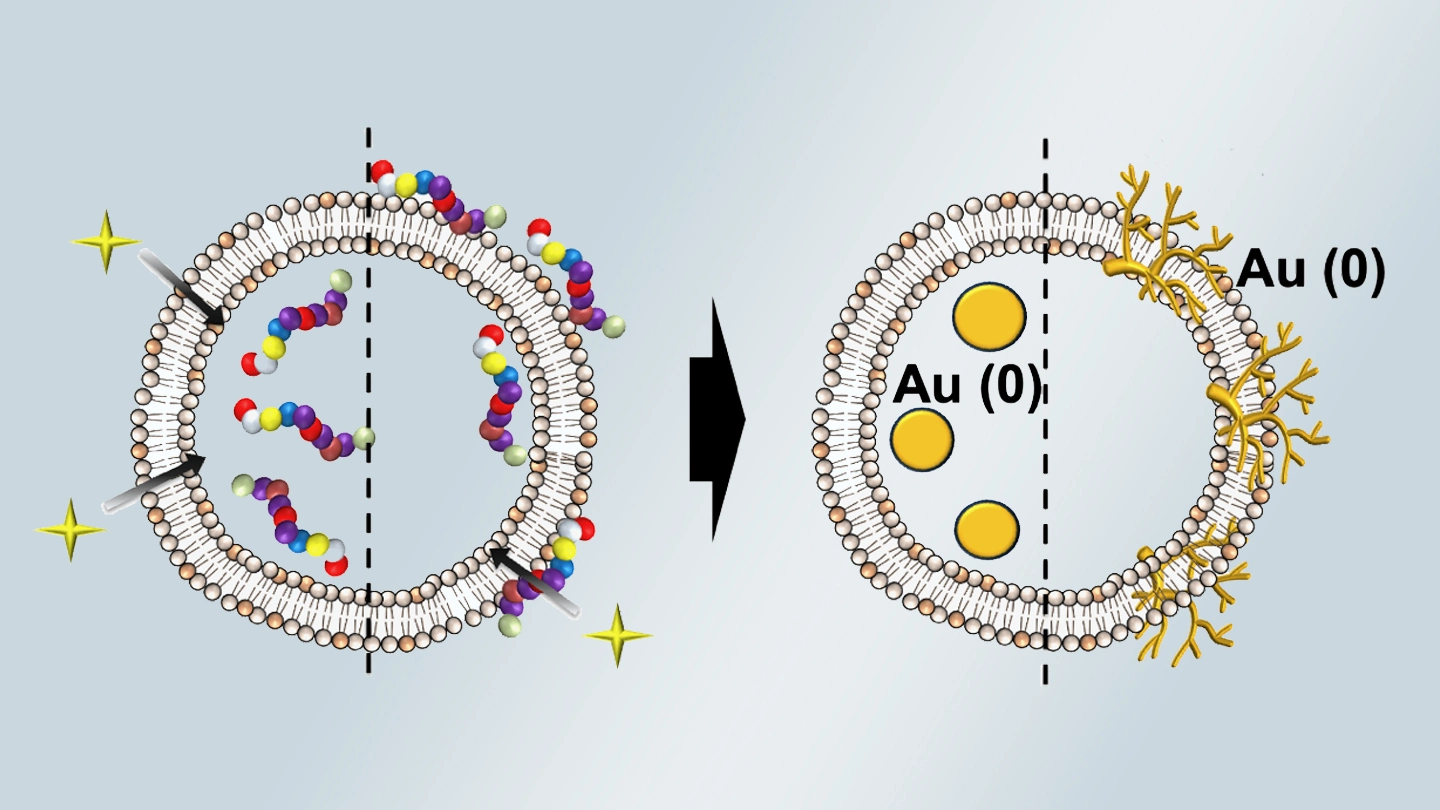
Summary of gold nanoparticle growth programming in liposome based on localization of biomineralization peptide The position of biomineralization peptides within liposomes can influence how gold nanoparticles grow, reports a research team from Institute of Science Tokyo. Peptides localized at the membrane interface promote branched structures, while those confined to the liposome interior favor spherical nanoparticles. The findings offer a new strategy for controlling nanoscale reaction...
