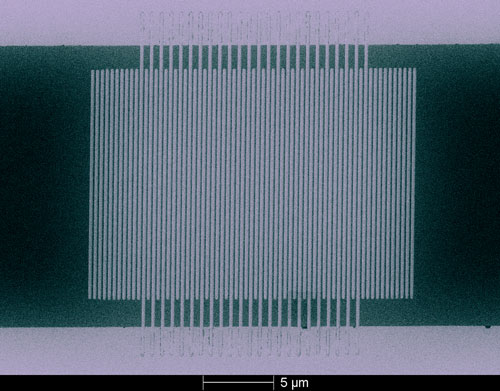
Detecting individual particles of light just got a bit more precise—by 74 picoseconds to be exact—thanks to advances in materials by National Institute of Standards and Technology (NIST) researchers and their colleagues in fabricating superconducting nanowires.
Although 74 picoseconds may not sound like much—a picosecond is a trillionth of a second—it is a big deal in the quantum world, where light particles, or photons, can carry valuable information. In this case it means that much less “jitter,” or uncertainty in the arrival time of a photon. Less jitter means that photons can be spaced more closely together but still be correctly detected. This enables communications at a higher bit rate, with more information transmitted in the same period.
Every little bit helps when trying to receive faint signals reliably. It helped, for example, in NIST’s recent quantum teleportation record and difficult tests of physics theories. In such experiments, researchers want to decode as much information as possible from the quantum properties of billions of photons, or determine if “entangled” photons have properties that are linked before—or only after—being measured.
NIST has made many advances in photon detector designs. In the latest work, described inOptics Express, NIST researchers used an electron beam to pattern nanowires into a thin film made of a heat-tolerant ceramic superconductor, molybdenum silicide. The tiny boost in energy that occurs when a single photon hits is enough to make the nanowires briefly lose their superconducting capability and become normal conductors, signaling the event.
Nanowire detectors are superfast, counting tens of millions of photons per second, and generating few “dark” (or false) counts. Originally they were inefficient—meaning they missed photons they should have counted—but NIST has been fine-tuning their properties, first by boosting efficiency and now reducing jitter.
The new design improves on NIST’s 2011 tungsten-silicon alloy material because it can operate at higher (though still cryogenic) temperatures and at a higher electrical current. The higher temperature simplifies refrigeration; the higher current cuts jitter in half, from about 150 picoseconds to 76 picoseconds. NIST researchers enhanced the detector’s light absorption and efficiency by embedding the chip in a cavity made of gold mirrors and layers of other unreactive materials.
Researchers demonstrated detector efficiencies of 87 percent at wavelengths that are useful in telecommunications. This was almost as efficient as tungsten-silicon devices (93 percent) but with significantly lower jitter.
The molybdenum-silicide material adds to NIST’s contributions in the competitive international field of quantum information science. Development of next-generation sensors offering high precision is a NIST priority. NIST single-photon detectors are used in a variety of experiments around the world.
The detectors were made in NIST Boulder’s microfabrication facility. Researchers from the University of Geneva in Switzerland and the Jet Propulsion Laboratory at the California Institute of Technology also contributed to the work.
NIST
#MaterialScience #QuantumInformation #Nanowires #Superconductivity