
The world’s first graphene-based electronic paper for use in both hard and flexible displays for electronic devices has been developed in China.
Electronic paper display company Guangzhou OED Technologies announced it has developed the graphene-based e-paper, which it described as being more pliable and having higher light transmittance than existing types of e-paper.
As a result, graphene-based displays would be brighter but also cheaper, as graphene is based on the abundant element carbon, the firm said. Conventional e-paper is made of the rather costly rare metal indium.
The new e-paper could be used in various types of devices, including wearables and e-readers.
Only 0.335 nanometres thick, graphene - a single layer of carbon atoms - would enable engineers to make displays that would be extremely thin, light-weight but also more durable thanks the wonder properties of the material.
Future graphene-based e-readers could theoretically look like an ordinary sheet of paper that displays information.
The firm said it plans to start commercial production next year. However, it has not publicly demonstrated the invention yet. No details have been given about possible partnerships or which manufacturers may be able to first use the technology, described by Guangzhou as a major breakthrough.
Graphene was first isolated in 2004 by Manchester University researchers Konstantin Novoselov and Professor Andre Geim. In 2010, the two received the Nobel Prize in Physics for the discovery.
The two-dimensional material, hailed for its exquisite properties across the board, has since been widely studied and experimented with by researchers all over the world. The first graphene-based commercial or near-commercial devices have started to appear recently, including a lightbulb developed in Manchester, various sensors and RFID tags.
However, large-scale production is still a major drawback. The current number one technique for graphene production is the so-called chemical vapour deposition, in which a layer of graphene is grown on a copper substrate. However, when transferring this one-atom thick graphene layer onto another substrate, problems frequently occur, with the material cracking or creasing easily.
OED Technologies
#Graphene #MaterialScience
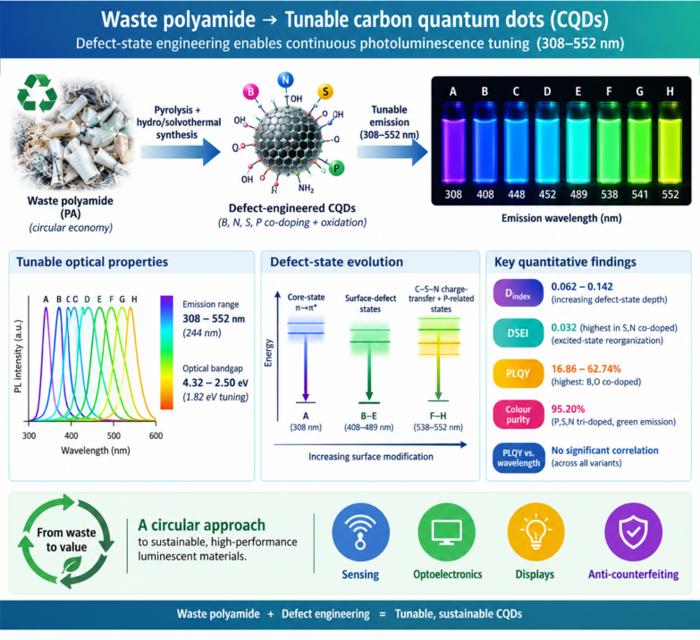
Waste polyamide-derived CQDs show continuous photoluminescence tuning from 308 to 552 nm through sequential defect-state engineering, with optical transition energies decreasing from 4.32 to 2.50 eV. @Christian Ebere Enyoh from Saitama University Carbon quantum dots (CQDs) are fluorescent carbon nanomaterials with potential applications in sensing, optoelectronics, displays, anti-counterfeiting, and environmental technologies. Their optical properties can be adjusted by modifying the carbon...
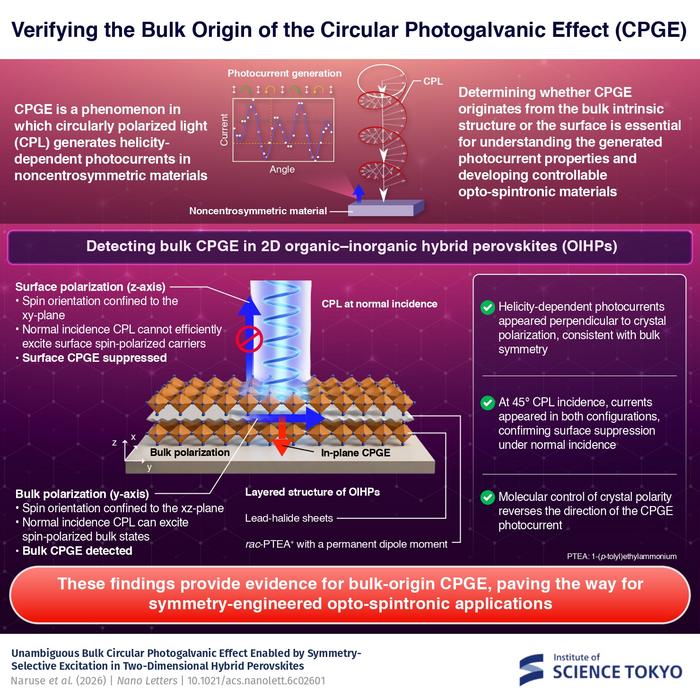
The researchers used circularly polarized light at normal incidence and found that helicity-dependent photocurrents appeared perpendicular to the crystal’s polarization but vanished when measured parallel to it, supporting a bulk origin of CPGE. @Institute of Science Tokyo The circular photogalvanic effect (CPGE), a phenomenon that generates helicity-dependent photocurrents in noncentrosymmetric materials, can originate purely from a crystal's internal structure without contribution from the...
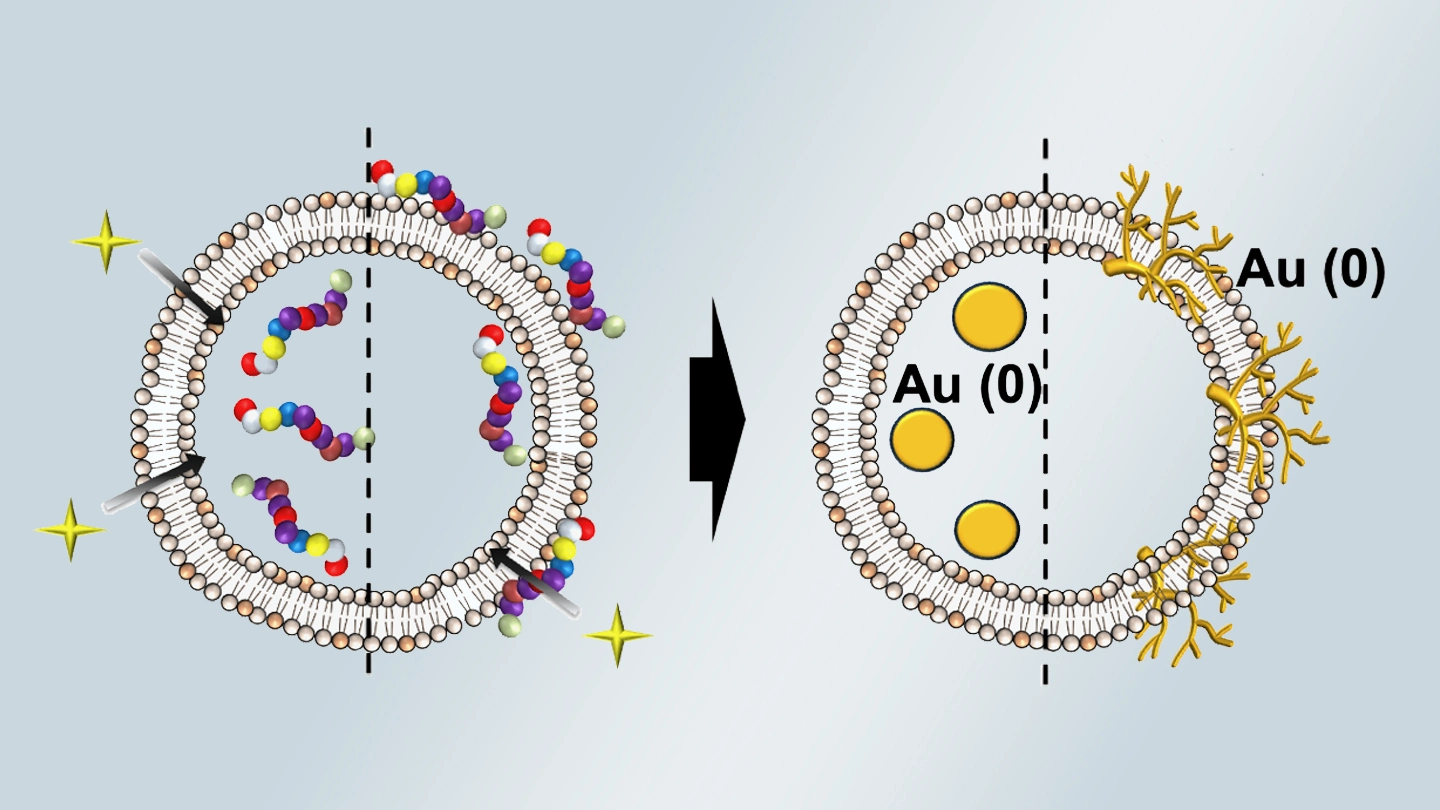
Summary of gold nanoparticle growth programming in liposome based on localization of biomineralization peptide The position of biomineralization peptides within liposomes can influence how gold nanoparticles grow, reports a research team from Institute of Science Tokyo. Peptides localized at the membrane interface promote branched structures, while those confined to the liposome interior favor spherical nanoparticles. The findings offer a new strategy for controlling nanoscale reaction...
