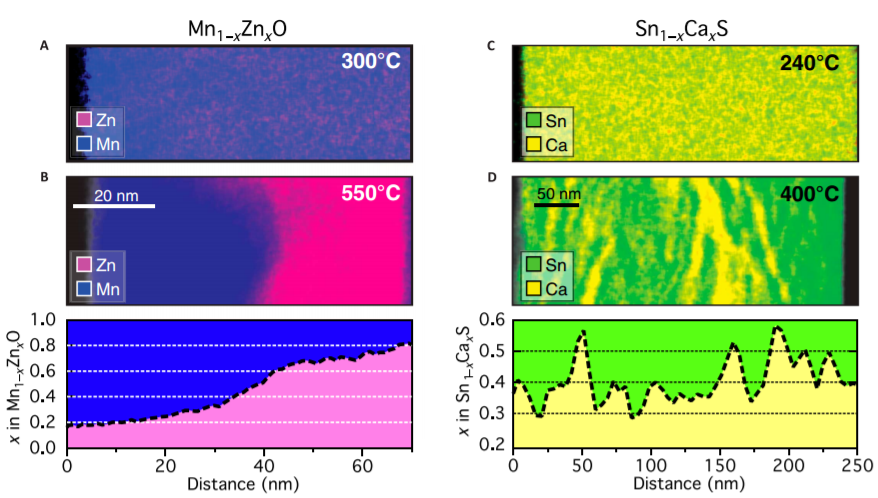
New research into the largely unstudied area of heterostructural alloys could lead to greater materials control and in turn better semiconductors, advances in nanotechnology for pharmaceuticals and improved metallic glasses for industrial applications.
Heterostructural alloys are blends of compounds made from materials that don't share the same atom arrangement. Conventional alloys are isostructural, meaning the compounds they consist of, known as the end members, have the same crystal structure.
"Alloys are all around us," said study co-author Janet Tate, a physicist at Oregon State University. "An example of an istostructural alloy is an LED; you have a semiconductor like aluminum gallium arsenide, dope it with a particular material and make it emit light, and change the color of the light by changing the relative concentration of aluminum and gallium."
Structure and composition are the two means of controlling the behavior of materials, Tate said. Combining materials gives the alloy properties between those that the end members have on their own.
"If two materials have different structures, as you mix them together it's not so clear which structure will win," said Tate, the Dr. Russ and Dolores Gorman Faculty Scholar in the College of Science. "The two together want to take different structures, and so this is an extra way of tuning an alloy's properties, a structural way. The transition between different crystal structures provides an additional degree of control."
Tate and collaborators from around the world, including the National Renewable Energy Laboratory, published their findings in Science Advances.
"This is a very interesting piece of materials science that represents a somewhat uncharted area and it may be the beginning something quite important," Tate said. "The heterostructural alloy concept had been known before, but it's different enough that it hadn't really been explored in a detailed phase diagram - the mapping of exactly how, at what temperature and what concentration, it goes from one structure to another.
"This paper is primarily the NERL's theoretical work being supported by other collaborators' experimental work," Tate said. "Our involvement at OSU was in making one of the kinds of heterostructural alloys used in the research, the combination of tin sulfide and calcium sulfide."
Tate and graduate student Bethany Matthews have been focusing on the semiconductor application.
"Tin sulfide is a solar cell absorber, and the addition of calcium sulfide changes the structure and therefore the electrical properties necessary for an absorber," Tate said "Combining tin sulfide with calcium sulfide makes it more isotropic - properties being the same regardless of orientation - and that's usually a useful thing in devices."
In this study, thin-film synthesis confirmed the metastable phases of the alloys that had been predicted theoretically.
"Many alloys are metastable, not stable - if you gave them enough time and temperature, they'd eventually separate," Tate said. "The way we make them, with pulsed laser deposition, we allow the unstable structure to form, then suppress the decomposition pathways that would allow them to separate; we don't give them enough time to equilibrate."
Metastable materials - those that are thermodynamically stable provided they are not subjected to large disturbances - are in general understudied, Tate said.
"When theorists predict properties, they tend to work with materials that are stable," she said. "In general the stable compounds are easier to attack. The idea here with heterostructural alloys is that they give us a new handle, a new knob to turn to change and control materials' properties."
Novel phase diagram behavior and materials design in heterostructural semiconductor alloys
Aaron M. Holder, Sebastian Siol, Paul F. Ndione, Haowei Peng, Ann M. Deml, Bethany E. Matthews, Laura T. Schelhas, Michael F. Toney, Roy G. Gordon, William Tumas, John D. Perkins, David S. Ginley, Brian P. Gorman, Janet Tate, Andriy Zakutayev and Stephan Lany1
Science Advances 07 Jun 2017: Vol. 3, no. 6, e1700270
DOI: 10.1126/sciadv.1700270
Oregon State University
#Nanostructures #MaterialScience
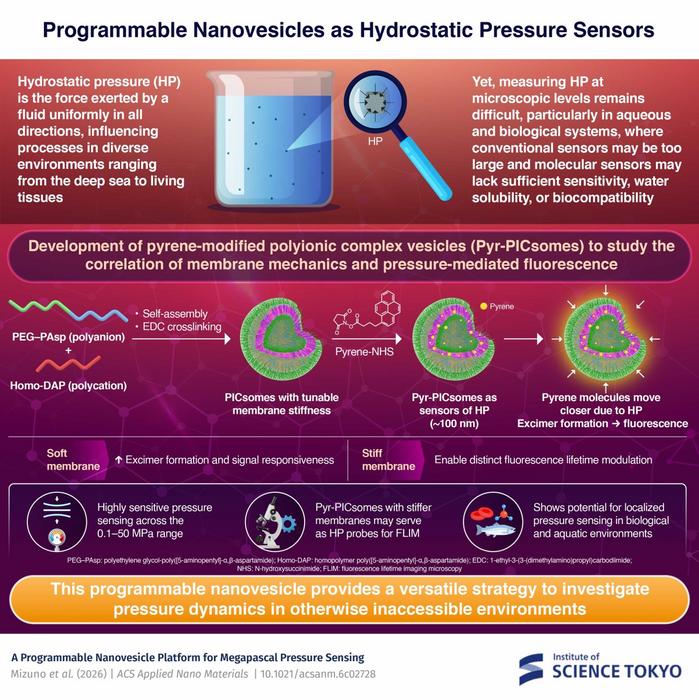
Pyrene-modified polyionic complex vesicles, or Pyr-PICsomes, convert hydrostatic pressure into measurable fluorescence. Crosslinking density tunes membrane stiffness, which governs sensing behavior: soft vesicles give strong excimer-to-monomer ratio changes from 0.1 to 50 MPa, while stiff membranes respond through fluorescence lifetime, suiting lifetime imaging.
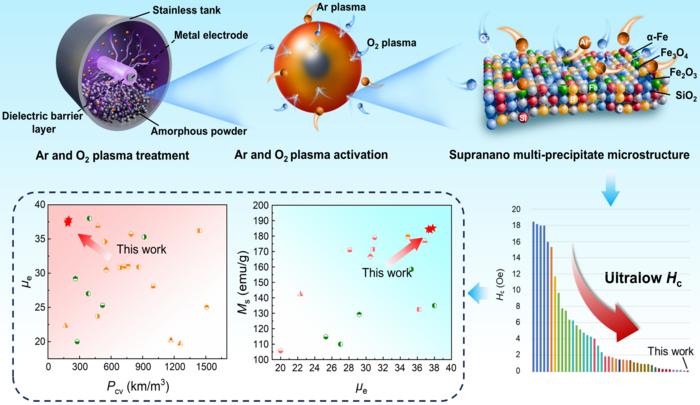
Ar/O₂ plasma treatment generates supranano α-Fe, Fe₃O₄, SiO₂ and Fe₂O₃ precipitates just 0.8–2.5 nm across amorphous powder surfaces, creating nucleation sites that ease magnetic-moment reversal. The resulting soft magnetic composite combines 0.13 Oe coercivity, 37.3 permeability, 185 emu g⁻¹ saturation magnetization and 191.18 kW m⁻³ core loss at 1 MHz and 20 mT. The surface route avoids bulk composition changes, aiding scale-up for high-frequency inductors and power chokes.
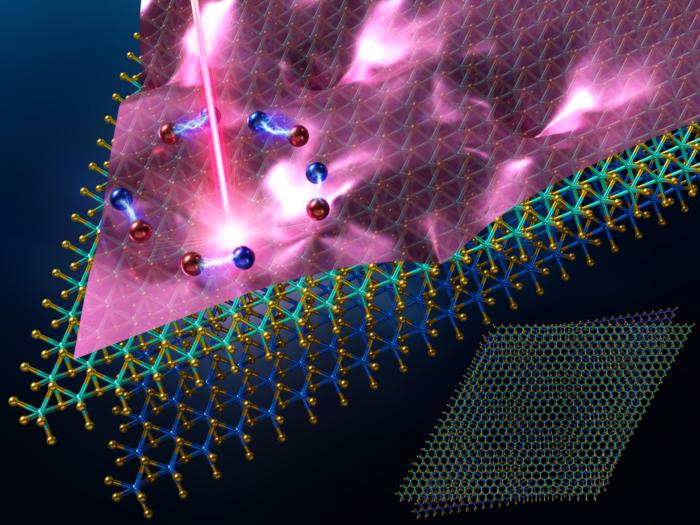
Researchers at MANA have introduced a theoretical framework that extracts hidden disorder from complex photoluminescence spectra in twisted MoSe2/WSe2 moiré heterostructures, bypassing unreliable peak-by-peak analysis. By tracking how simple descriptors like peak and average energy vary spatially, the work reveals a hierarchy of disorder, from micrometer-scale background variations to localized exciton-trapping defects.






