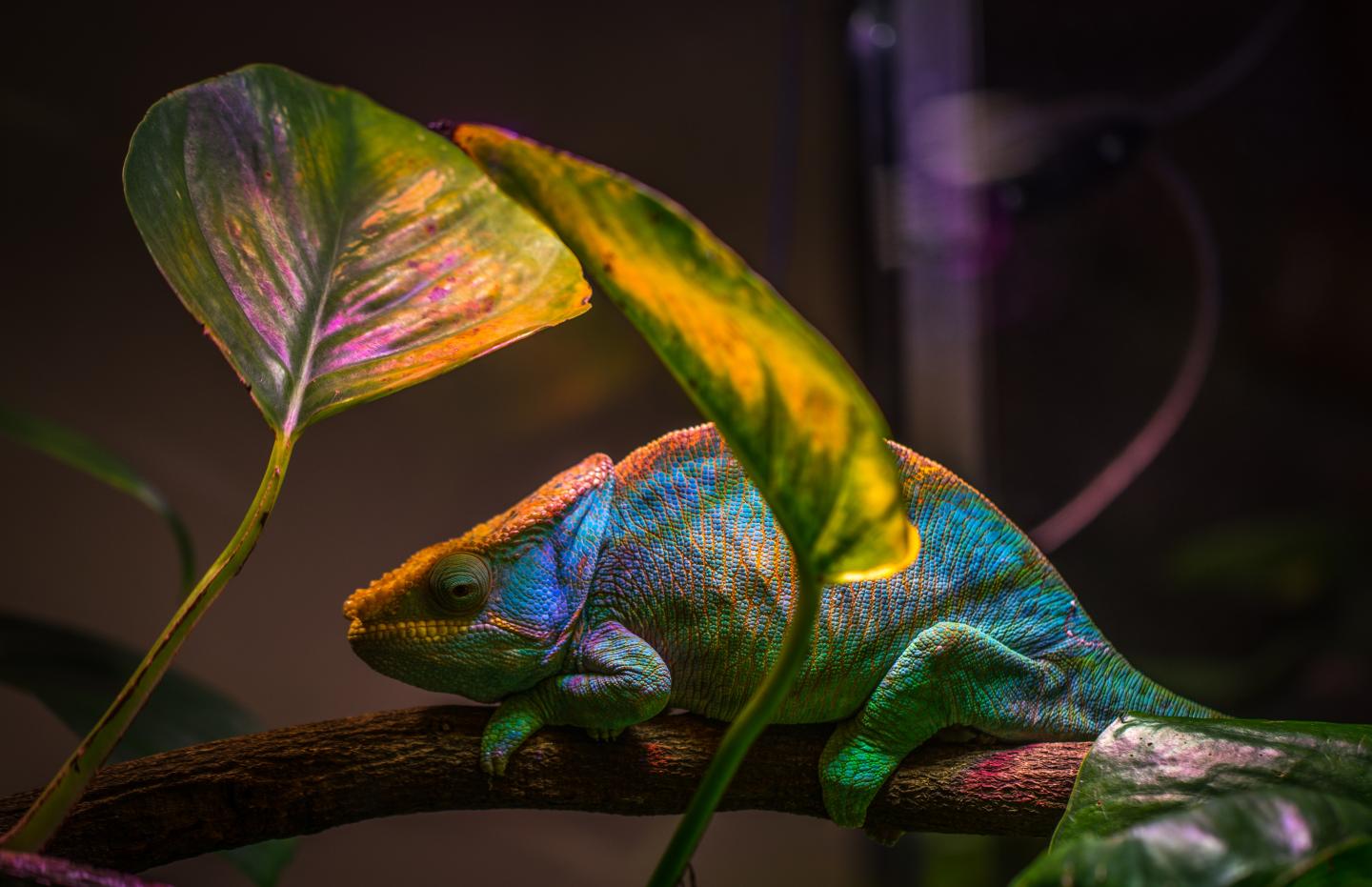
As a chameleon shifts its color from turquoise to pink to orange to green, nature's design principles are at play. Complex nano-mechanics are quietly and effortlessly working to camouflage the lizard's skin to match its environment.
Inspired by nature, a Northwestern University team has developed a novel nanolaser that changes colors using the same mechanism as chameleons. The work could open the door for advances in flexible optical displays in smartphones and televisions, wearable photonic devices and ultra-sensitive sensors that measure strain.
"Chameleons can easily change their colors by controlling the spacing among the nanocrystals on their skin, which determines the color we observe," said Teri W. Odom, Charles E. and Emma H. Morrison Professor of Chemistry in Northwestern's Weinberg College of Arts and Sciences. "This coloring based on surface structure is chemically stable and robust."
The research was published online yesterday in the journal Nano Letters. Odom, who is the associate director of Northwestern's International Institute of Nanotechnology, and George C. Schatz, Charles E. and Emma H. Morrison Professor of Chemistry in Weinberg, served as the paper's co-corresponding authors.
The same way a chameleon controls the spacing of nanocrystals on its skin, the Northwestern team's laser exploits periodic arrays of metal nanoparticles on a stretchable, polymer matrix. As the matrix either stretches to pull the nanoparticles farther apart or contracts to push them closer together, the wavelength emitted from the laser changes wavelength, which also changes its color.
"Hence, by stretching and releasing the elastomer substrate, we could select the emission color at will," Odom said.
The resulting laser is robust, tunable, reversible and has a high sensitivity to strain. These properties are critical for applications in responsive optical displays, on-chip photonic circuits and multiplexed optical communication.
Stretchable Nanolasing from Hybrid Quadrupole Plasmons
Danqing Wang, Marc R. Bourgeois, Won-Kyu Lee, Ran Li, Dhara Trivedi, Michael P. Knudson, Weijia Wang, George C. Schatz, and Teri W. Odom
Nano Lett., [2018]
DOI: 10.1021/acs.nanolett.8b01774
Northwestern University
#Plasmonics #Nanoparticles #Laser
This week in nanotech
$108.5M raised
7 funding rounds · 43 deals tracked
New products
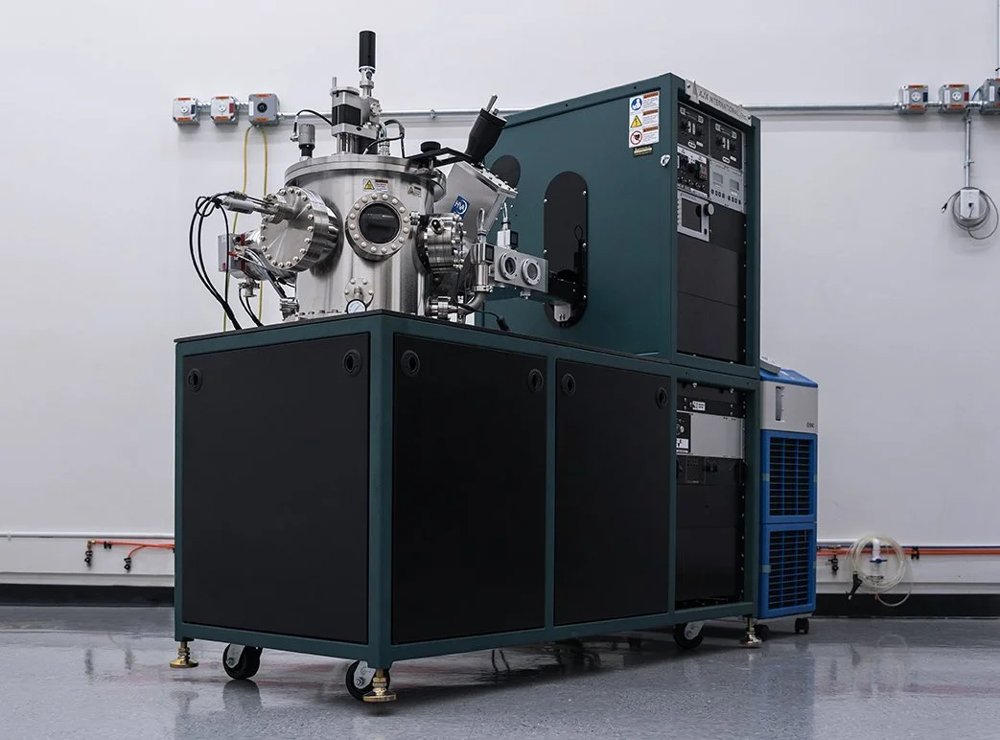 Orion Sputtering Deposition SystemsAJA International Featured
 DLS-1 Mass Spectrometer for Fusion Gas AnalysisHiden Analytical Featured
 SunscreenUnchained Labs
Market insights
Last 30 days: Quantum Technologies drew the most money: $3.17B.
Money raised per month