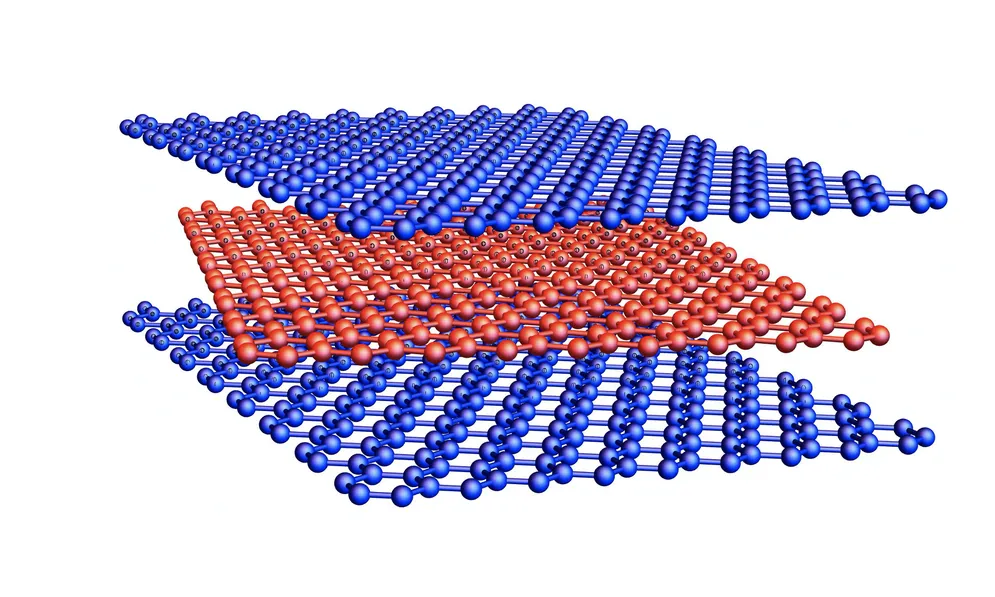
In the search for novel types of superconductors – phases of matter that that conduct electric current without loss – scientists are investigating materials that consist of multiple layers. A team led by theoretical physicist Mathias Scheurer from the University of Innsbruck, Austria, has studied in detail the properties of a system of three twisted graphene layers and gained important insights into its properties.
Since the first successful fabrication of a two-dimensional structure of carbon atoms about 20 years ago, graphene has fascinated scientists. A few years ago, researchers discovered that two layers of graphene, slightly twisted against each other, can conduct electric current without loss. In recent years, this discovery has prompted scientists to explore such layered materials in greater detail. A recent notable example is mirror-symmetric twisted trilayer graphene, where three layers of graphene are stacked with alternating twist angles. It is the first moiré system that can both be efficiently tuned with a perpendicular electric field and was demonstrated experimentally to exhibit robust superconductivity, alongside various other phases. “This establishes trilayer graphene as an exciting platform for complex many-body physics, but the nature of the observed interaction-induced insulators, semi-metals, and superconductivity remains unknown”, says Mathias Scheurer from the Department of Theoretical Physics of the University of Innsbruck.
In a paper published in Physical Review X, a team led by Scheurer numerically and analytically studied the phase diagram of this system for different numbers of electrons per moiré unit cell and as a function of electric field. “This is a very challenging problem as the system has both flat and highly dispersive bands”, says the theoretical physicist. “Nonetheless, we managed to show that the ground state of the system in the absence of a field decouples into a product of the ground state of graphene and the ground state of twisted bilayer graphene”, a property that has subsequently been confirmed by experiments. Their results further establish the dominance of insulating and semi-metallic phases in the presence of an electric field which are unique to the trilayer system, i.e., are not realized in twisted bilayer graphene. “We are able to use our resulting phase diagram for the correlated normal states to constrain the form of the superconductor”, says Scheurer. “Among other aspects, the resulting two superconducting candidate states we get are consistent with the unexpected stability of the superconductor in magnetic field seen in experiment.”
The relevance of the findings for the physics of twisted trilayer graphene is further attested by a subsequent collaboration with the group of Abhay Pasupathy from Columbia university. In a recent paper in Science, they report scanning tunneling microscopy (STM) data on this system. “We show that the measured tunneling spectra exhibit significant interaction effects that can be qualitatively captured by the numerics of our work”, says Mathias Scheurer.
Reference
Correlated Insulators, Semimetals, and Superconductivity in Twisted Trilayer Graphene
Maine Christos, Subir Sachdev, and Mathias S. Scheurer
https://journals.aps.org/prx/abstract/10.1103/PhysRevX.12.021018
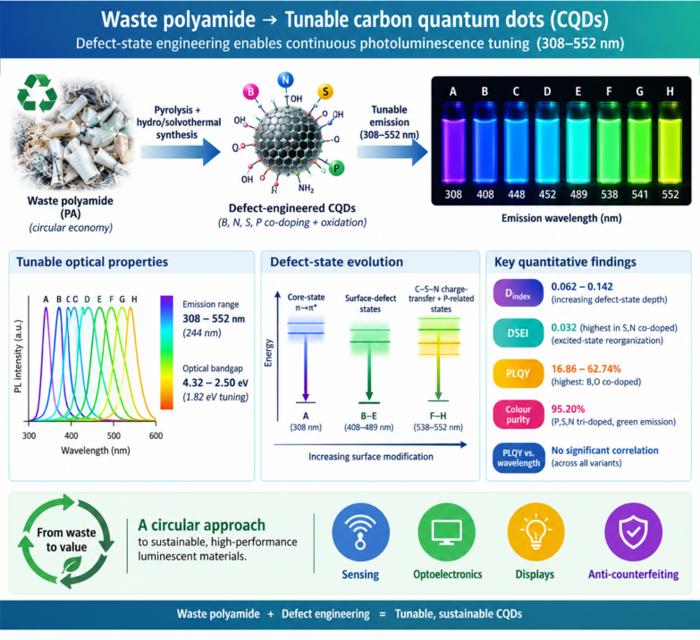
Waste polyamide-derived CQDs show continuous photoluminescence tuning from 308 to 552 nm through sequential defect-state engineering, with optical transition energies decreasing from 4.32 to 2.50 eV. @Christian Ebere Enyoh from Saitama University Carbon quantum dots (CQDs) are fluorescent carbon nanomaterials with potential applications in sensing, optoelectronics, displays, anti-counterfeiting, and environmental technologies. Their optical properties can be adjusted by modifying the carbon...
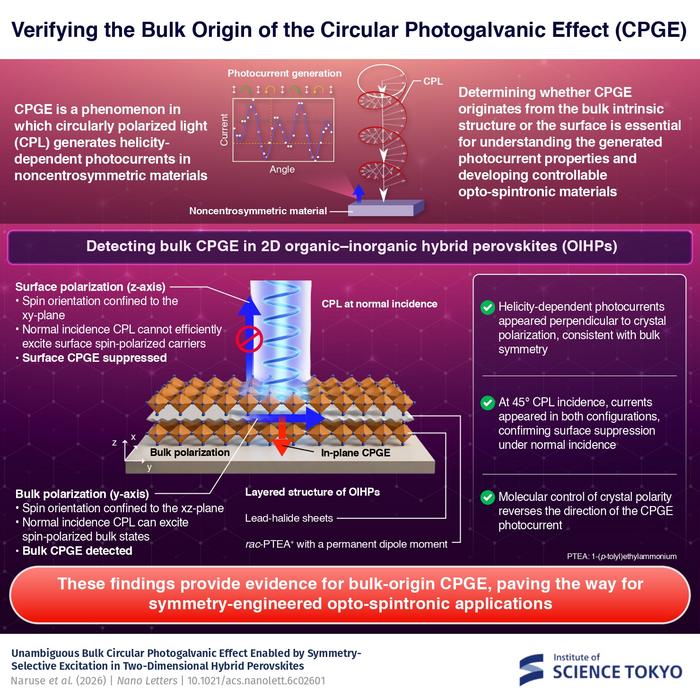
The researchers used circularly polarized light at normal incidence and found that helicity-dependent photocurrents appeared perpendicular to the crystal’s polarization but vanished when measured parallel to it, supporting a bulk origin of CPGE. @Institute of Science Tokyo The circular photogalvanic effect (CPGE), a phenomenon that generates helicity-dependent photocurrents in noncentrosymmetric materials, can originate purely from a crystal's internal structure without contribution from the...
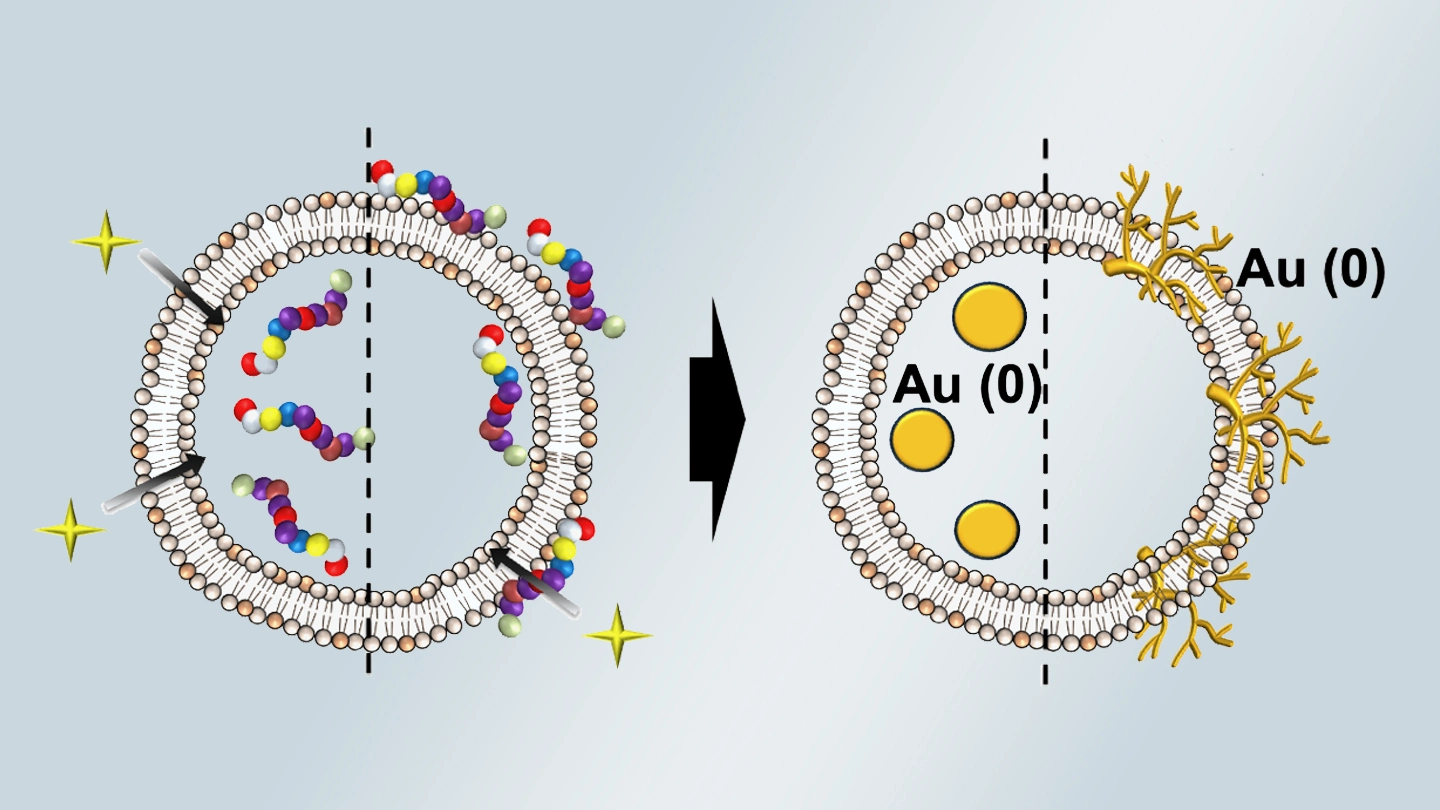
Summary of gold nanoparticle growth programming in liposome based on localization of biomineralization peptide The position of biomineralization peptides within liposomes can influence how gold nanoparticles grow, reports a research team from Institute of Science Tokyo. Peptides localized at the membrane interface promote branched structures, while those confined to the liposome interior favor spherical nanoparticles. The findings offer a new strategy for controlling nanoscale reaction...
