Nanyang Technological University (NTU)
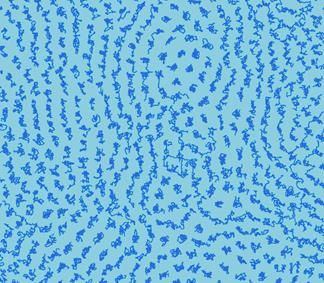
A 50-year-old puzzle in statistical mechanics has been solved by an international team of researchers who have proved that two-dimensional (2D) liquids have fundamentally different dynamical properties to three-dimensional (3D) liquids.
Researchers routinely use 2D experiments and simulations to represent 3D liquids, simply because studies in 2D are easier to do.
With these studies, physicists aim at rationalising familiar macroscopic fluid properties, such as the viscosity, in terms of the microscopic motion of the particles, which in 2D can be directly visualised.
The team led by Associate Professor Massimo Pica Ciamarra at Nanyang Technological University, Singapore (NTU Singapore) set out to understand the 'thermal motion' of atoms in 2D and 3D liquids.
Using a mix of pen-and-paper calculations and numerical simulations, they predicted that atoms in 2D liquids can travel for long distances before effectively 'forgetting' their initial positions. This behaviour gives rise to a subtle collective motion of the atoms, of a sort that had previously only been thought to occur in solids.
To confirm their theoretical findings, the researchers performed experiments that tracked the motions of colloidal particles under a microscope. In ordinary three-dimensional liquids, such particles execute a type of random motion known as Brownian motion.
But in two-dimensional liquids, the team was able to demonstrate that the Brownian motion is overlaid on large-scale collective motions. This collective motion was previously believed to only occur in 2D solids, as predicted in the 1960s by Mermin and Wagner.
The proof of the fundamental difference between 2D and 3D liquids was obtained by researchers at NTU Singapore, the Jawaharlal Nehru Centre for Advanced Scientific Research in India, the University of Science and Technology of China, and the University of California (Los Angeles) in the United States. Their work was published in November in the Proceedings of the National Academy of Sciences (PNAS).
"Our discovery shows that two-dimensional liquids and three-dimensional liquids are not just variants of each other, but fundamentally different types of matter," said Assoc Prof Pica Ciamarra.
"Our findings help to explain many puzzling differences between the dynamical properties of two- and three-dimensional liquids, which had been reported in the scientific literature," said Assoc Prof Pica Ciamarra. "It is only in 2D, not in 3D or higher dimensions, that the relaxation time is not inversely proportional to the diffusivity of the particles". "
"To extract relevant information on the dynamics of 3D liquids from the 2D investigations" added Dr. Y.-W. Li, co-author of this study, "researchers need to develop a way to selectively filter-out the effect of the observed collective particle oscillations".
Long-wavelength fluctuations and anomalous dynamics in 2-dimensional liquids
Yan-Wei Li, Chandan K. Mishra, Zhao-Yan Sun, Kun Zhao, Thomas G. Mason, Rajesh Ganapathy, and Massimo Pica Ciamarra
PNAS November 12, 2019 116 (46) 22977-22982
Contact information:
Massimo Pica Ciamarra
NTU Associate Professor, School of Physical & Mathematical Sciences
massimo@ntu.edu.sg
Phone: (+65)65922542
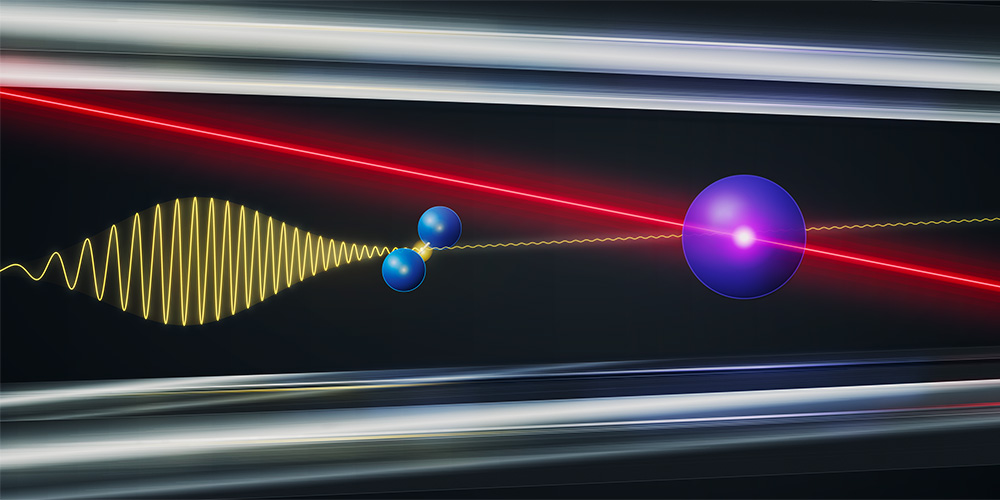
Researchers at the University of Basel have identified and coherently controlled so called forbidden vibrational transitions in individual trapped nitrogen molecular ions without destroying them. Using quantum logic spectroscopy, a single calcium ion served as messenger, letting the team probe the molecule repeatedly and determine its fundamental vibrational frequency ten times more precisely than before.
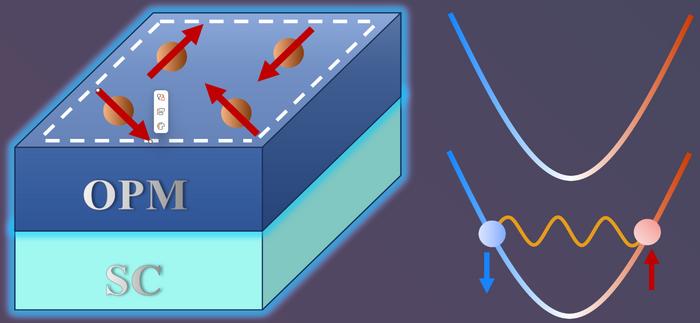
Odd-parity magnets host an intrinsic hidden Zeeman field that lifts Kramers degeneracy without any applied field, researchers report. Using an f-wave magnet model on a triangular lattice, the team shows how non-relativistic spin splitting and this hidden field combine to stabilize s-wave superconductivity far beyond the Pauli limit.
Rhombohedral hexalayer graphene, in which six carbon sheets are stacked with a slight lateral offset like staircase steps, hosts both superconductivity and electrically controllable orbital magnetism, researchers report in Nature Physics. The arrangement yields a rich collection of quantum states in a simple carbon-based material, positioning rhombohedral multilayer graphene as a platform for probing the fundamental mechanisms of superconductivity and magnetism and potentially for new ways of…
This week in nanotech
9 deals tracked
New products
 DLS-1 Mass Spectrometer for Fusion Gas AnalysisHiden Analytical Featured
 Nion-compatible In Situ STEM Holders for Electrical BiasingHummingbird Scientific Featured
 SunscreenUnchained Labs
Market insights
Last 30 days: Semiconductors & Electronics was the busiest vertical: 39 of 130 events (30%).
Money raised per month