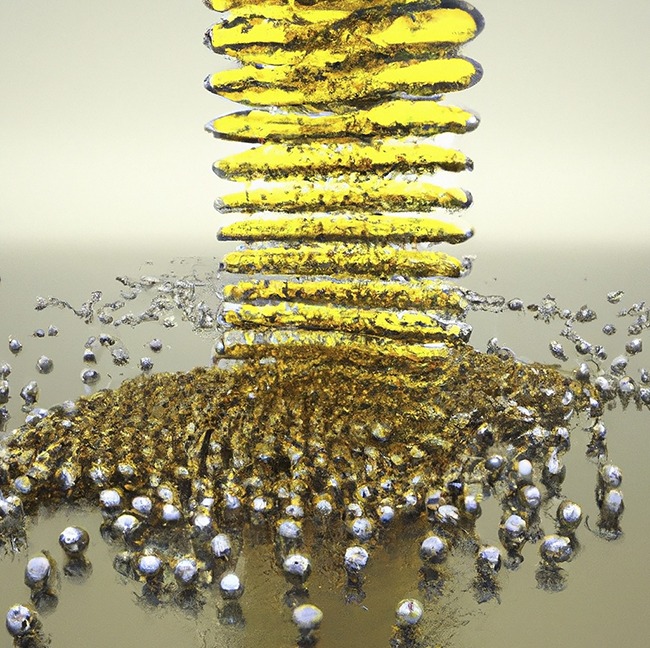
We all look in the mirror at least once a day to see our reflection. Mirrors are used not only in daily life but also in cutting-edge technologies such as semiconductor processing and high-resolution displays. Recently, a powerful Bragg reflection mirror based on high-index metamaterials has been developed that only reflects desired light.
A research team led by Professor Gi-Ra Yi (Department of Chemical Engineering) at POSTECH with the research team led by professors Seok Joon Kwon and Pil Jin Yoo (School of Chemical Engineering) at Sungkyunkwan University have together developed an ultrahigh refractive index metamaterial by closely packing gold nanospheres and a reflector that combines the metamaterial with a polymer.
Metamaterials – with properties that do not exist in nature – can be designed to have a negative (−) or ultrahigh refractive index. However, metamaterials with a high refractive index still have limitations from designing to manufacturing.
To overcome this issue, the research team developed a metamaterial that is uniformly arranged with the 1-nanometer-level gaps (nm, 1 billionth of a meter) by assembling spherical gold nanoparticles. This material, which maximizes light-matter interaction, recorded the highest refractive index in the visible and near-infrared regions. The 2D superstructures exhibited the highest-ever refractive index of 7.8
The distributed Bragg reflector (DBR), which is made by stacking these metamaterials and polymer layers with a low refractive index, strongly reflected specific wavelengths.
Furthermore, the research team established the theory of a plasmonic percolation model that can explain the extremely high refractive index. As it theoretically explains the ultrahigh refractive index of metamaterials that could not be explained in previous studies, the development of related research fields is anticipated in the future.
This study is also garnering attention from academic circles and industry for its applicability in precise semiconductor processes and high-resolution displays.
Reference
Percolated Plasmonic Superlattices of Nanospheres with 1 nm-Level Gap as High-Index Metamaterials
Dong-In Shin, Seong Soo Yoo, Seong Hun Park, Gaehang Lee, Wan Ki Bae, Seok Joon Kwon, Pil Jin Yoo, Gi-Ra Yi
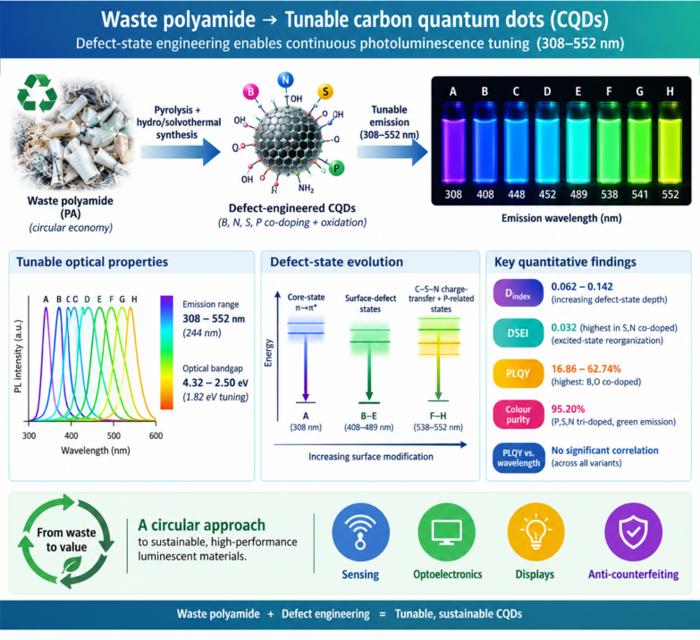
Waste polyamide-derived CQDs show continuous photoluminescence tuning from 308 to 552 nm through sequential defect-state engineering, with optical transition energies decreasing from 4.32 to 2.50 eV. @Christian Ebere Enyoh from Saitama University Carbon quantum dots (CQDs) are fluorescent carbon nanomaterials with potential applications in sensing, optoelectronics, displays, anti-counterfeiting, and environmental technologies. Their optical properties can be adjusted by modifying the carbon...
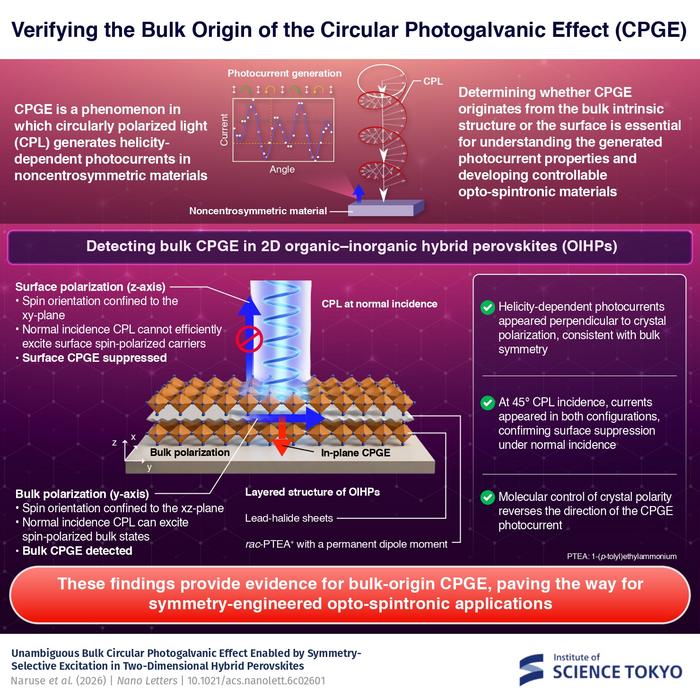
The researchers used circularly polarized light at normal incidence and found that helicity-dependent photocurrents appeared perpendicular to the crystal’s polarization but vanished when measured parallel to it, supporting a bulk origin of CPGE. @Institute of Science Tokyo The circular photogalvanic effect (CPGE), a phenomenon that generates helicity-dependent photocurrents in noncentrosymmetric materials, can originate purely from a crystal's internal structure without contribution from the...
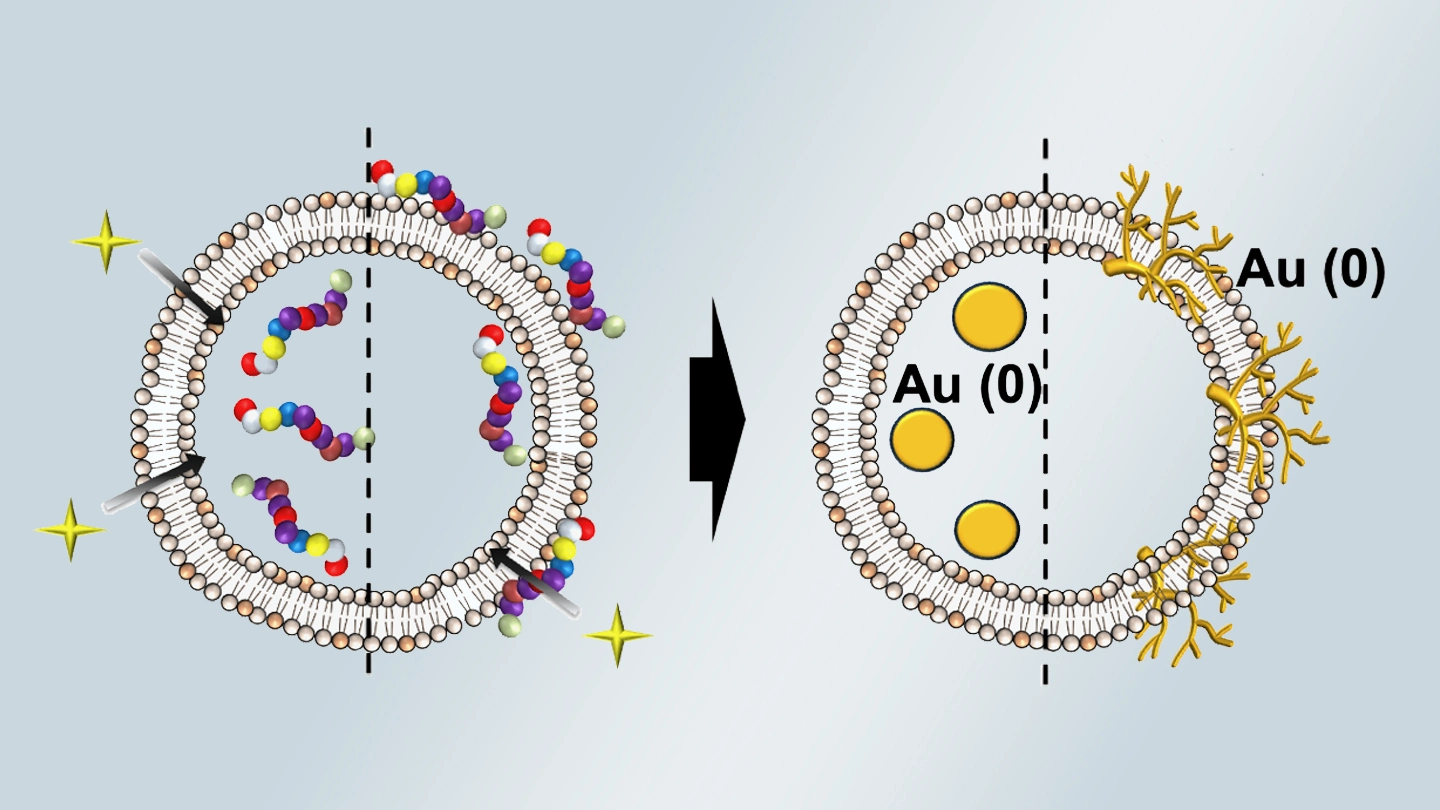
Summary of gold nanoparticle growth programming in liposome based on localization of biomineralization peptide The position of biomineralization peptides within liposomes can influence how gold nanoparticles grow, reports a research team from Institute of Science Tokyo. Peptides localized at the membrane interface promote branched structures, while those confined to the liposome interior favor spherical nanoparticles. The findings offer a new strategy for controlling nanoscale reaction...