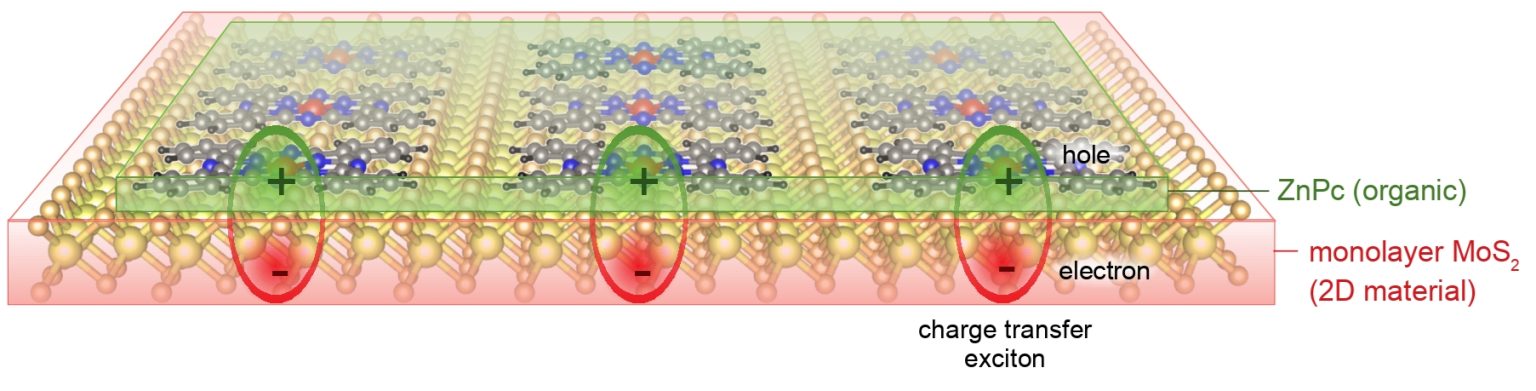
NUS researchers have predicted that an exotic state of matter, known as a Bose-Einstein condensate, can exist at relatively high temperatures (around 50 K to 100 K) in systems comprising organic molecules on two-dimensional (2D) semiconducting materials.
A Bose-Einstein condensate is a state of matter in which all particles have the same energy and are completely coordinated. From a physical viewpoint, these particles clump together and start to behave as though they are part of a single larger particle. The 2001 Nobel Prize in Physics was awarded for the realisation of Bose-Einstein condensation. This phenomenal breakthrough was first achieved in a collection of rubidium atoms, at an ultra-low temperature of 20 nK. This control of the state of matter is expected to lead to technological breakthroughs, and also enables the realisation of superfluidity.
In this work, Prof QUEK Su Ying from the Department of Physics, National University of Singapore, and her postdoctoral fellow, Dr ULMAN Kanchan, predicted that Bose-Einstein condensation (BEC) can take place at around 50 K to 100 K in organic 2D material systems (see Figure) through their computation. This BEC temperature is orders of magnitude higher than that previously achieved using atoms. The particles that condense in the organic-2D material systems are bound electron-hole pairs (excitons) that are induced in the system through irradiation with light. The electron resides in the 2D semiconductor (molybdenum disulphide, MoS2) and the hole in the organic molecule (zinc phthalocyanine, ZnPc), in what is called a “charge transfer exciton”. The spatial separation between the electron and hole, together with the strongly bound nature of the excitons in these low dimensional materials, results in long exciton lifetimes, which are critical for BEC to take place. Crucially, the predicted BEC temperature is much higher than that in atoms. This is because the BEC temperature is inversely proportional to the particle mass, and the exciton mass is much smaller than typical atomic masses.
Prior to this prediction, BEC of charge transfer excitons was observed at around 100 K in bilayers of 2D materials. However, one practical difficulty in the realisation of BEC in these systems was the need for careful alignment of the two layers of material. Misaligned bilayers host excitons with large momentum, which hinder the formation of the condensate. In the case of organic-2D material systems, the narrow bandwidth of the molecular states imply that the charge transfer excitons have very small momentum, thus favouring BEC formation.
Prof Quek said, “Organic molecules such as transition metal phthalocyanines readily form ordered, self-assembled monolayers on 2D materials. The prediction of high temperature BEC of excitons in organic-2D material systems is expected to lead to more practical realisations of this exotic state of matter, and paves the way for the study of intriguing applications related to Bose-Einstein condensates.”
Reference
Ulman K; Quek SY*, “Organic-2D Material Heterostructures: A Promising Platform for Exciton Condensation and Multiplication” NANO LETTERS Volume: 21 Issue: 20 Page: 8888-8894 DOI: 10.1021/acs.nanolett.1c03435 Published: 2021
