DOE/Los Alamos National Laboratory (LANL)
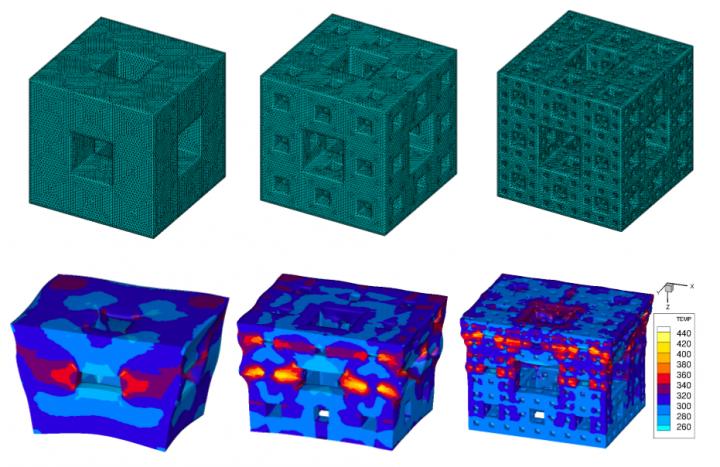
Tiny, 3D printed cubes of plastic, with intricate fractal voids built into them, have proven to be effective at dissipating shockwaves, potentially leading to new types of lightweight armor and structural materials effective against explosions and impacts.
"The goal of the work is to manipulate the wave interactions resulting from a shockwave," said Dana Dattelbaum, a scientist at Los Alamos National Laboratory and lead author on a paper to appear in the journal AIP Advances. "The guiding principles for how to do so have not been well defined, certainly less so compared to mechanical deformation of additively manufactured materials. We're defining those principles, due to advanced, mesoscale manufacturing and design."
Shockwave dispersing materials that take advantage of voids have been developed in the past, but they typically involved random distributions discovered through trial and error. Others have used layers to reverberate shock and release waves. Precisely controlling the location of holes in a material allows the researchers to design, model and test structures that perform as designed, in a reproducible way.
The researchers tested their fractal structures by firing an impactor into them at approximately 670 miles per hour. The structured cubes dissipated the shocks five times better than solid cubes of the same material.
Although effective, it's not clear that the fractal structure is the best shock-dissipating design. The researchers are investigating other void- or interface-based patterns in search of ideal structures to dissipate shocks. New optimization algorithms will guide their work to structures outside of those that consist of regular, repeating structures. Potential applications might include structural supports and protective layers for vehicles, helmets, or other human-wearable protection.
Shockwave dissipation by interface-dominated porous structures
Dana M. Dattelbaum, Axinte Ionita, Brian M. Patterson, Brittany A. Branch, Lindsay Kuettner
AIP Advances (2020)
Contact information:
R&D Scientist and Program Manager at LANL
danadat@lanl.gov
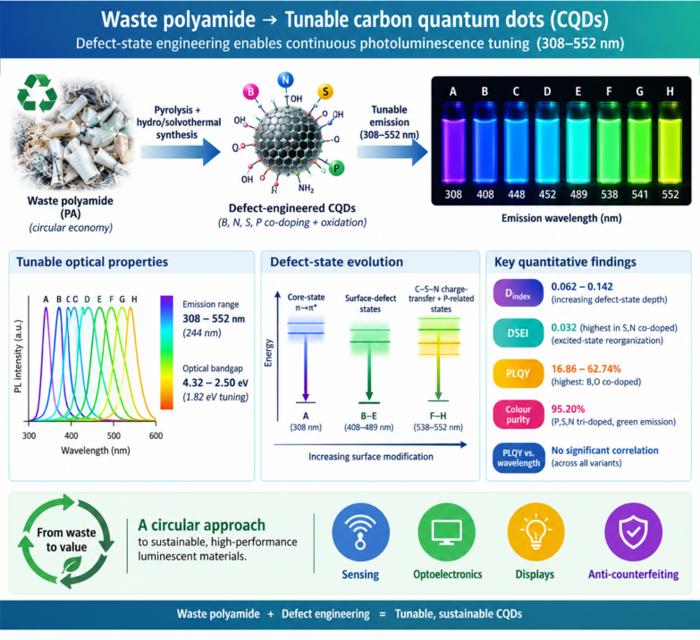
Waste polyamide-derived CQDs show continuous photoluminescence tuning from 308 to 552 nm through sequential defect-state engineering, with optical transition energies decreasing from 4.32 to 2.50 eV. @Christian Ebere Enyoh from Saitama University Carbon quantum dots (CQDs) are fluorescent carbon nanomaterials with potential applications in sensing, optoelectronics, displays, anti-counterfeiting, and environmental technologies. Their optical properties can be adjusted by modifying the carbon...
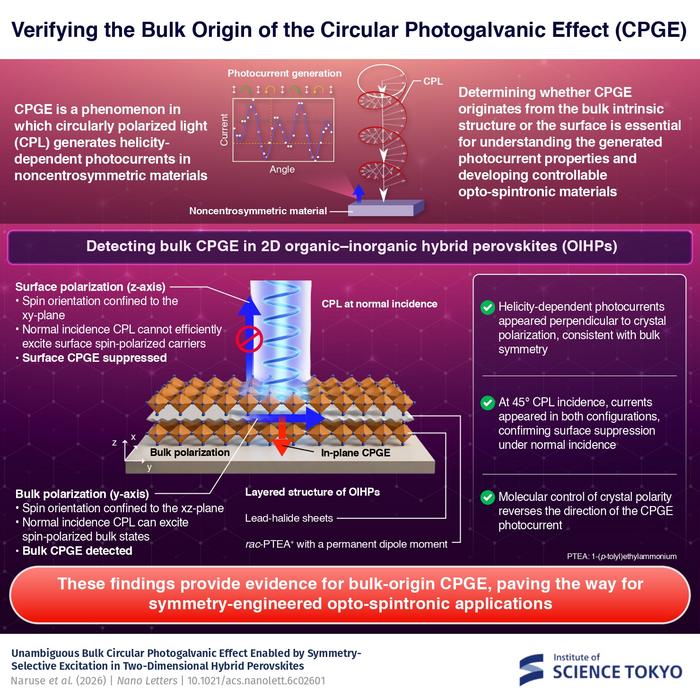
The researchers used circularly polarized light at normal incidence and found that helicity-dependent photocurrents appeared perpendicular to the crystal’s polarization but vanished when measured parallel to it, supporting a bulk origin of CPGE. @Institute of Science Tokyo The circular photogalvanic effect (CPGE), a phenomenon that generates helicity-dependent photocurrents in noncentrosymmetric materials, can originate purely from a crystal's internal structure without contribution from the...
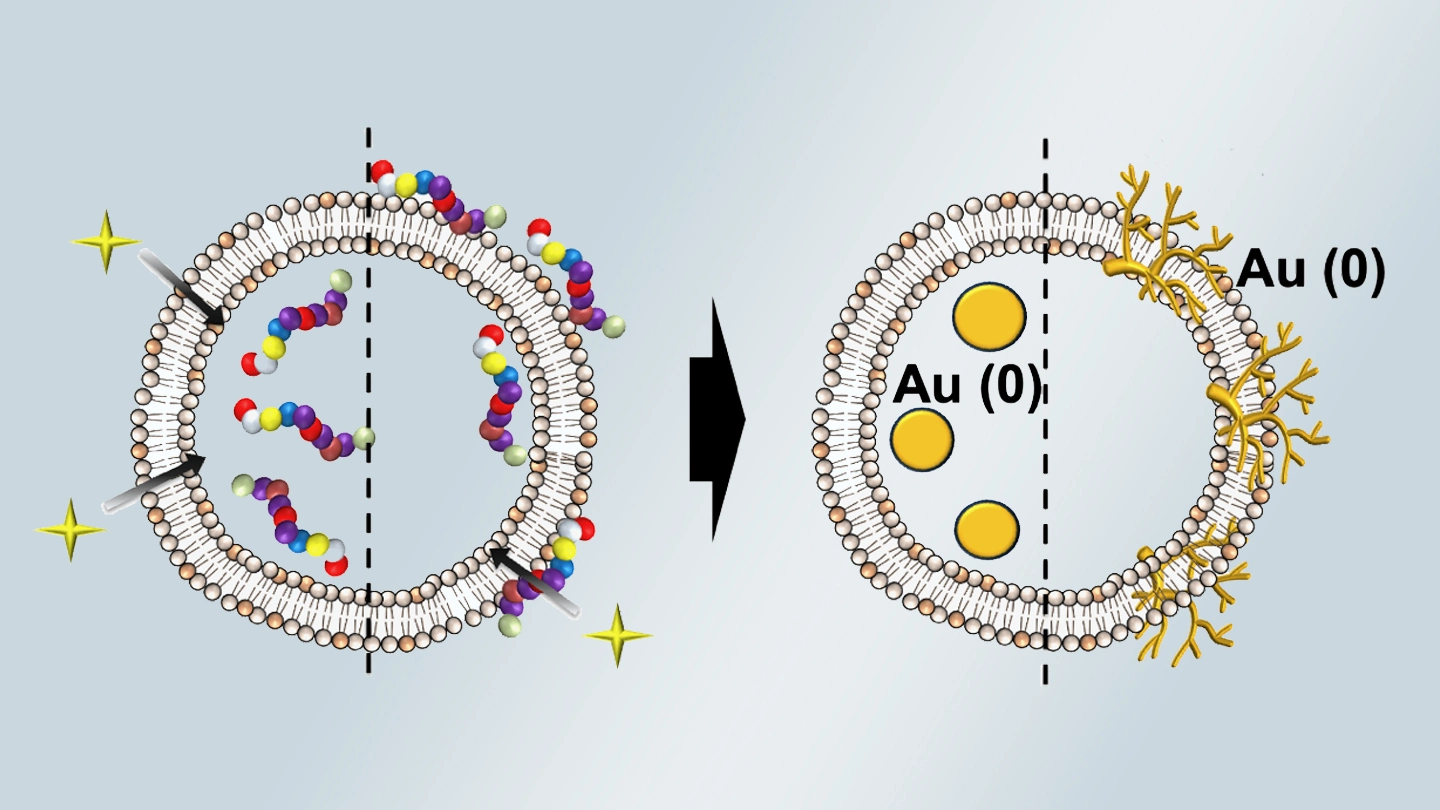
Summary of gold nanoparticle growth programming in liposome based on localization of biomineralization peptide The position of biomineralization peptides within liposomes can influence how gold nanoparticles grow, reports a research team from Institute of Science Tokyo. Peptides localized at the membrane interface promote branched structures, while those confined to the liposome interior favor spherical nanoparticles. The findings offer a new strategy for controlling nanoscale reaction...
