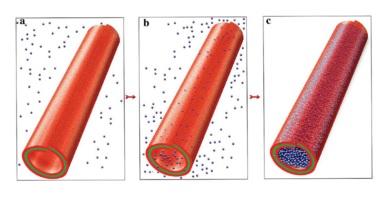
A research group of scientists from Kazan Federal University and Beijing University of Chemical Technology have recently presented a broad overview of halloysite clay tubes
Yuri Lvov and Rawil Fakhrullin of Bionanotechnology Lab, Kazan Federal University, in cooperation with Wencai Wang and Liqun Zhang of State Key Laboratory of Organic-Inorganic Composites, Beijing University of Chemical Technology have recently presented in Advanced Materials a broad scope of application of halloysite clay tubes.
Halloysite is a natural biocompatible nanomaterial available in thousands of tons at low price, which makes it a good candidate for nanoarchitectural composites. In chemical composition they are similar to kaolin and can be considered as rolled kaolin sheets with inner diameter of 10-20 nm, outer diameter of 40-70 nm and a length of 500-1500 nm. The internal side of halloysite is composed of Al2O3 while the external is mainly SiO2.
The inner lumen of halloysite may be adjusted by etching to 20-30% of the tube volume and used as natural nanocontainer for loading and sustained release of chemical agents. These ceramic nanotubes form a "skeleton" in the bulk polymers, enhancing the composite strength and adhesivity. These "skeleton bones" may be loaded with active compounds, like real bones are loaded with marrow, providing additional functionality for polymers (antimicrobial, anti-aging, anticorrosion, and flame-retardancy).
Halloysite tubes can encase enzymes for longer storage, higher temperature, and extended functionality, while the tube's opening allows for delivery of small substrate molecules into the tube interior for biocatalysis. Loading DNA into halloysite is another prospective research direction. As functional nanoblocks, halloysite tubes may be used for building on biological cells, like the formation of spore-like microbial shells providing microorganisms with additional functions.
In vitro and in vivo studies on biological cells and worms indicate the safety of halloysite, and furthermore, it can store and release molecules in a controllable manner, making these tiny containers attractive for applications in drug delivery, antimicrobial materials, self-healing polymeric composites, and regenerative medicine.
The material, however, is not biodegradable, as there are no biological mechanisms to degrade this alumosilicate clay in the body, and it cannot be injected in the blood intravenously, but rather may be used for external medical treatment with slow release of encapsulated drugs (e.g., in creams, implants, or wound treatment of tissues).
Kazan Federal University
#Nanomaterials #Bionano #Polymers #Nanomedicine
