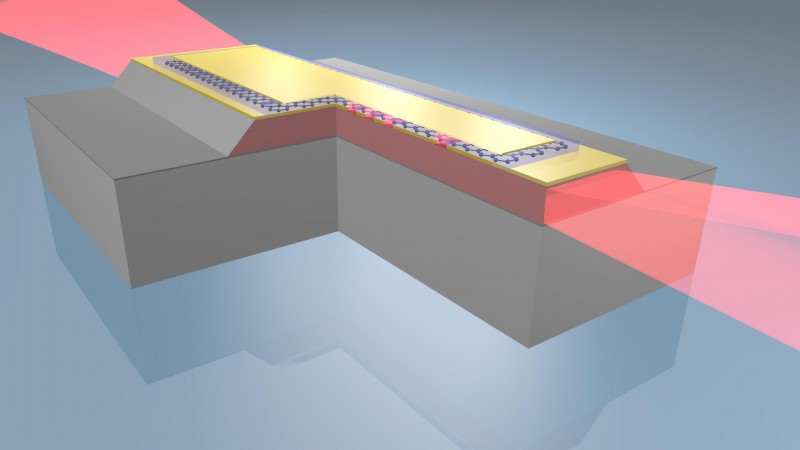
The fascinating electrical properties of graphene have allowed University of Manchester researchers to open up a new area of technology using terahertz lasers.
This could vastly improve scanning systems, replacing X-rays, and also dramatically increase internet bandwidth.
Terahertz technology exists on the electromagnetic spectrum between microwave and infrared frequencies. The benefit of using terahertz lasers instead of X-rays is that they can accurately scan materials without causing damage.
Highly-sensitive scanners for sensing minute defects in manufactured drugs, or detecting concealed weapons at airports could become more accurate and much safer for frequent use using the new technology.
Terahertz lasers are similar to X-rays in that they are invisible to the naked eye but are far safer in comparison by being non-destructive and non-invasive.
The team of researchers, led by Dr Subhasish Chakraborty and Sir Kostya Novoselov, reported in journal Science, that graphene could be used to control the frequency of terahertz lasers.
Dr Chakraborty said: “Terahertz technologies have been somewhat ignored by industry, partly due to the complexity of creating high-power tunable devices, as lots of different materials were necessary.
“Graphene can now fill in the gaps of this technology by creating a platform to electronically control devices and flexibly engineer device output”.
This new alternative method of scanning materials could dramatically improve the efficiency and accuracy of analysing materials in the pharmaceutical, security and agricultural industries.
Sir Kostya said: “Current terahertz devices do not allow for tuneable properties, a new device would have to be made each time requirements changed, making them unattractive on an industrial scale.
“Graphene however, can allow for terahertz devices to be switched on and off, as well as altering their state.”
The introduction of tuneable properties thanks to graphene could also potentially increase internet bandwidth capabilities up to and beyond one terabyte per second, a vast improvement on current internet speeds.
Graphene is the world’s first two-dimensional material. First isolated at The University of Manchester its unique material properties allow for improvements in existing technologies as well as allowing scientists to explore ideas which were previously limited to theory.
University of Manchester
#Graphene #Nanoelectronics
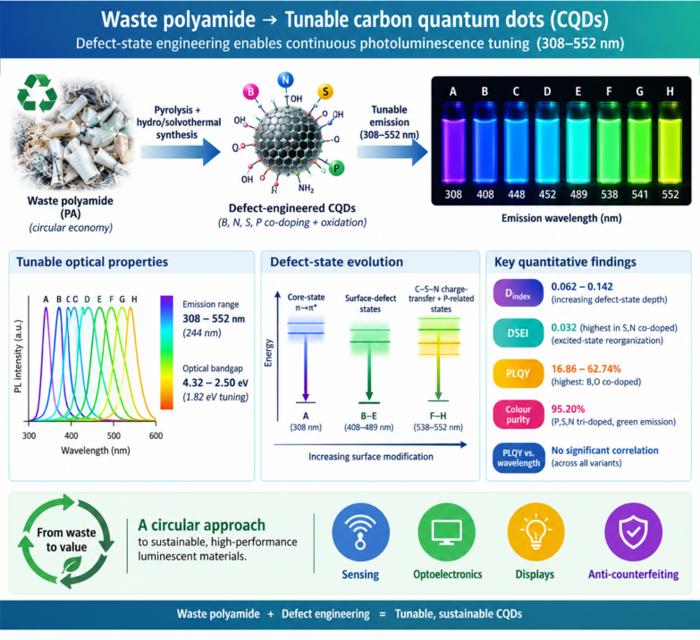
Waste polyamide-derived CQDs show continuous photoluminescence tuning from 308 to 552 nm through sequential defect-state engineering, with optical transition energies decreasing from 4.32 to 2.50 eV. @Christian Ebere Enyoh from Saitama University Carbon quantum dots (CQDs) are fluorescent carbon nanomaterials with potential applications in sensing, optoelectronics, displays, anti-counterfeiting, and environmental technologies. Their optical properties can be adjusted by modifying the carbon...
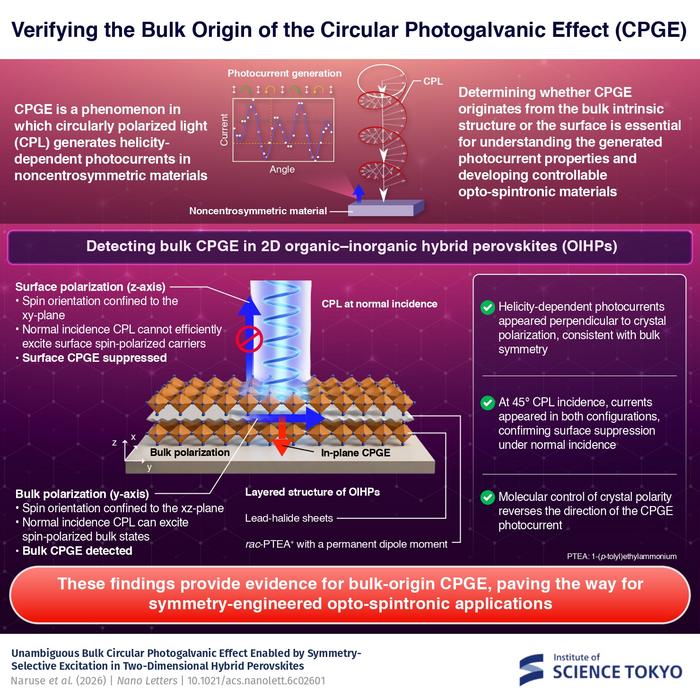
The researchers used circularly polarized light at normal incidence and found that helicity-dependent photocurrents appeared perpendicular to the crystal’s polarization but vanished when measured parallel to it, supporting a bulk origin of CPGE. @Institute of Science Tokyo The circular photogalvanic effect (CPGE), a phenomenon that generates helicity-dependent photocurrents in noncentrosymmetric materials, can originate purely from a crystal's internal structure without contribution from the...
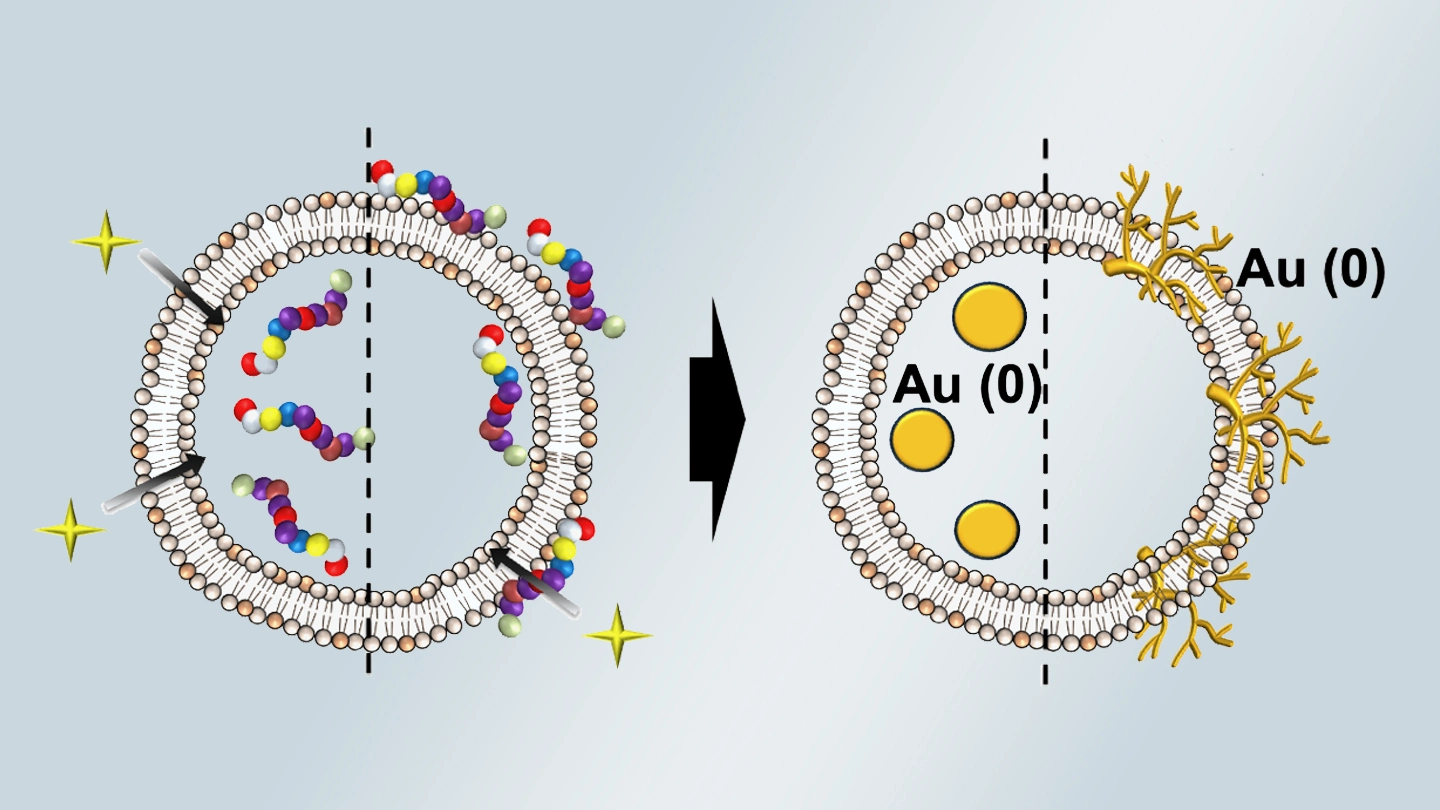
Summary of gold nanoparticle growth programming in liposome based on localization of biomineralization peptide The position of biomineralization peptides within liposomes can influence how gold nanoparticles grow, reports a research team from Institute of Science Tokyo. Peptides localized at the membrane interface promote branched structures, while those confined to the liposome interior favor spherical nanoparticles. The findings offer a new strategy for controlling nanoscale reaction...
