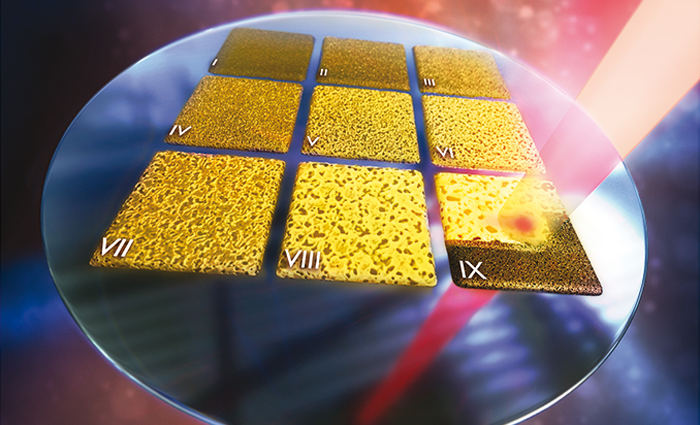
Lawrence Livermore National Laboratory researchers have created a library of nanoporous gold structures on a single chip that has direct applications for high-capacity lithium ion batteries as well as neural interfaces.
Nanoporous gold (np-Au), a porous metal used in energy and biomedical research, is produced through an alloy corrosion process known as dealloying that generates a characteristic three-dimensional nanoscale network of pores and ligaments.
In the cover article in the Jan. 14 issue of Nanoscale(link is external), a journal published by the Royal Society of Chemistry, LLNL researchers and their University of California, Davis(link is external) collaborators describe a method for creating a library of varying np-Au morphologies on a single chip via precise delivery of tunable laser energy. UC Davis professor Erkin Seker served as the principal investigator (PI) of the UC Fees project that primarily funded the work, along with co-PI Monika Biener of LLNL’s Materials Science Division.
Laser microprocessing (e.g. micromachining) provides spatial and temporal control while imposing energy near the surface of the material.
“Traditional heat application techniques for the modification of np-Au are bulk processes that cannot be used to generate a library of different pore sizes on a single chip,” said LLNL staff scientist Ibo Matthews, co-author of the paper. “Laser microprocessing offers an attractive solution to this problem by providing a means to apply energy with high spatial and temporal resolution.”
The researchers used multiphysics simulations to predict the effects of continuous wave vs. pulsed laser mode and varying thermal conductivity of the supporting substrate on the local np-Au film temperatures during photothermal annealing.
They were then able to fabricate an on-chip material library consisting of 81 np-Au samples of nine different morphologies for use in the parallel study of structure–property relationships.
“These libraries have the potential to drastically increase the throughput of morphology interaction studies for np-Au, specifically in applications such as high capacity lithium ion batteries, cell-material interaction studies for neural interfaces, analytical biosensors, as well as nanoscale material science studies,” said Biener, co-author of the paper.
This work sets the foundation for understanding laser-based annealing of porous thin film materials. The fabrication of single chip material libraries has the potential to increase the throughput of material interaction testing in many disciplines through easy single-chip material screening libraries.
LLNL’s Juergen Biener of the Material Sciences Division collaborated on the work along with UC Davis researchers Christopher Chapman (lead author) and Ling Wang.
Lawrence Livermore National Laboratory
#GoldNanoparticles #Nanoparticles #Bionano
This week in nanotech
$108.5M raised
8 funding rounds · 46 deals tracked
New products
 Ti-WCMBN Nanomaterialia Featured
 Orion Sputtering Deposition SystemsAJA International Featured
 SunscreenUnchained Labs
Market insights
Last 30 days: Quantum Technologies drew the most money: $3.17B.
Money raised per month