Myeloperoxidase - an enzyme naturally found in our lungs - can biodegrade pristine graphene, according to the latest discovery of Graphene Flagship partners in CNRS, University of Strasbourg (France), Karolinska Institute (Sweden) and University of Castilla-La Mancha (Spain). Among other projects, the Graphene Flagship designs flexible biomedical electronic devices that will interface with the human body. Such applications require graphene to be biodegradable, so it can be expelled from the body.
To test how graphene behaves within the body, researchers analysed how it was broken down with the addition of a common human enzyme - myeloperoxidase or MPO. If a foreign body or bacteria is detected, neutrophils surround it and secrete MPO, thereby destroying the threat. Previous work by Graphene Flagship partners found that MPO could successfully biodegrade graphene oxide.
However, the structure of non-functionalized graphene was thought to be more resistant to degradation. To test this, the team looked at the effects of MPO ex vivo on two graphene forms; single- and few-layer.
Alberto Bianco, researcher at Graphene Flagship Partner CNRS, explains: "We used two forms of graphene, single- and few-layer, prepared by two different methods in water. They were then taken and put in contact with myeloperoxidase in the presence of hydrogen peroxide. This peroxidase was able to degrade and oxidise them. This was really unexpected, because we thought that non-functionalized graphene was more resistant than graphene oxide."
Rajendra Kurapati, first author on the study and researcher at Graphene Flagship Partner CNRS, remarks how "the results emphasize that highly dispersible graphene could be degraded in the body by the action of neutrophils. This would open the new avenue for developing graphene-based materials."
With successful ex-vivo testing, in-vivo testing is the next stage. Bengt Fadeel, professor at Graphene Flagship Partner Karolinska Institute believes that "understanding whether graphene is biodegradable or not is important for biomedical and other applications of this material. The fact that cells of the immune system are capable of handling graphene is very promising."
Prof. Maurizio Prato, the Graphene Flagship leader for its Health and Environment Work Package said that "the enzymatic degradation of graphene is a very important topic, because in principle, graphene dispersed in the atmosphere could produce some harm. Instead, if there are microorganisms able to degrade graphene and related materials, the persistence of these materials in our environment will be strongly decreased. These types of studies are needed."
"What is also needed is to investigate the nature of degradation products," adds Prato. "Once graphene is digested by enzymes, it could produce harmful derivatives. We need to know the structure of these derivatives and study their impact on health and environment," he concludes.
Prof. Andrea C. Ferrari, Science and Technology Officer of the Graphene Flagship, and chair of its management panel added: "The report of a successful avenue for graphene biodegradation is a very important step forward to ensure the safe use of this material in applications. The Graphene Flagship has put the investigation of the health and environment effects of graphene at the centre of its programme since the start. These results strengthen our innovation and technology roadmap."
Degradation of Single‐Layer and Few‐Layer Graphene by Neutrophil Myeloperoxidase
Rajendra Kurapati, Sourav P. Mukherjee, Cristina Martín, George Bepete, Ester Vázquez, Alain Pénicaud, Bengt Fadeel, Alberto Bianco
Angewandte Chemie International Edition. First published: 13 July 2018
DOI: https://doi.org/10.1002/anie.201806906
Contact information:
Prof. Alberto Bianco
CNRS, Strasbourg, France
Institut de Biologie Moléculaire et Cellulaire
a.bianco@ibmc-cnrs.unistra.fr
http://www-ibmc.u-strasbg.fr/
Tel: +33 03 88 61 06 80
Prof. Andrea C. Ferrari
University of Cambridge, Cambridge Graphene Centre
acf26@eng.cam.ac.uk
Tel: +44 1223 748351 / +44 7795 580458
Prof. Prato Maurizio
University of Trieste, Dept. Chemical and Pharmaceutical Sciences
prato@units.it
Tel: 040 558 7883 / 040 558 3598
Prof. Bengt Fadeel
Karolinska Institute, Institute of Environmental Medicine
Bengt.Fadeel@ki.se
Tel: +46 (0) 8-524 877 37
Graphene Flagship
#Graphene
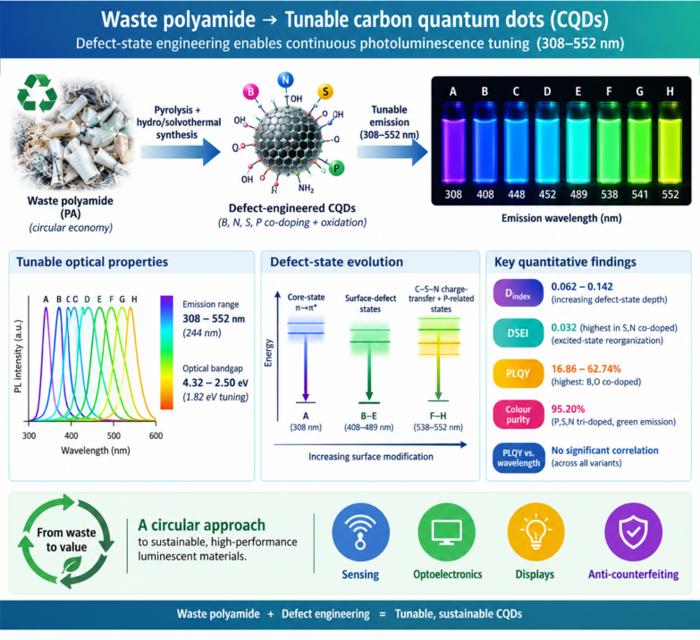
Waste polyamide-derived CQDs show continuous photoluminescence tuning from 308 to 552 nm through sequential defect-state engineering, with optical transition energies decreasing from 4.32 to 2.50 eV. @Christian Ebere Enyoh from Saitama University Carbon quantum dots (CQDs) are fluorescent carbon nanomaterials with potential applications in sensing, optoelectronics, displays, anti-counterfeiting, and environmental technologies. Their optical properties can be adjusted by modifying the carbon...
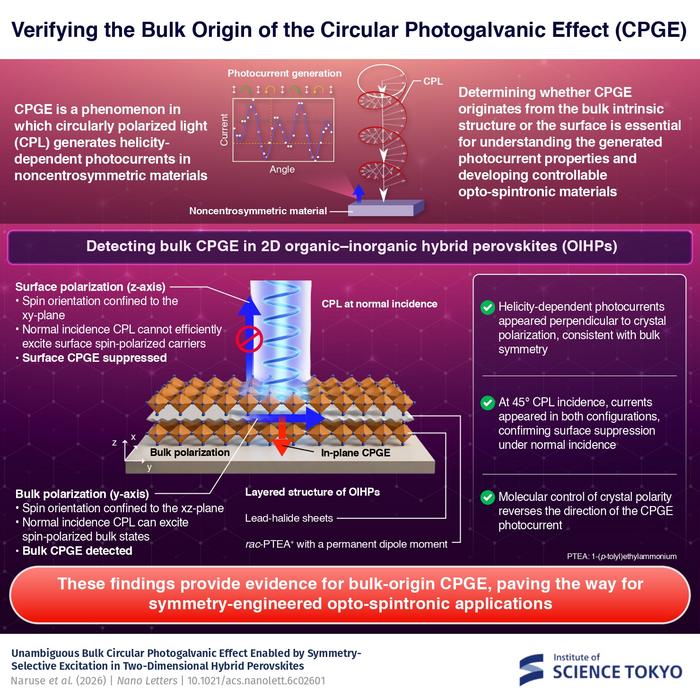
The researchers used circularly polarized light at normal incidence and found that helicity-dependent photocurrents appeared perpendicular to the crystal’s polarization but vanished when measured parallel to it, supporting a bulk origin of CPGE. @Institute of Science Tokyo The circular photogalvanic effect (CPGE), a phenomenon that generates helicity-dependent photocurrents in noncentrosymmetric materials, can originate purely from a crystal's internal structure without contribution from the...
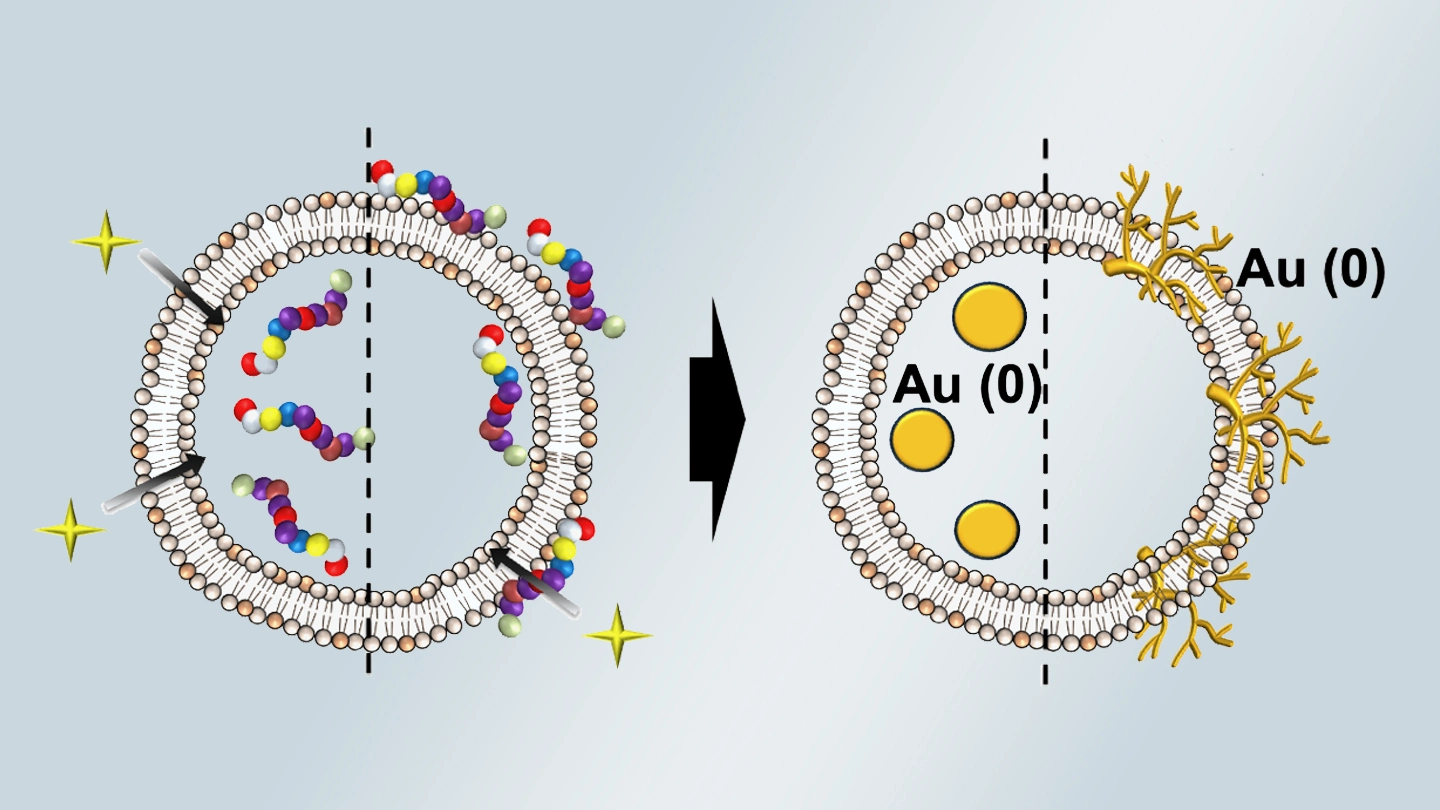
Summary of gold nanoparticle growth programming in liposome based on localization of biomineralization peptide The position of biomineralization peptides within liposomes can influence how gold nanoparticles grow, reports a research team from Institute of Science Tokyo. Peptides localized at the membrane interface promote branched structures, while those confined to the liposome interior favor spherical nanoparticles. The findings offer a new strategy for controlling nanoscale reaction...
