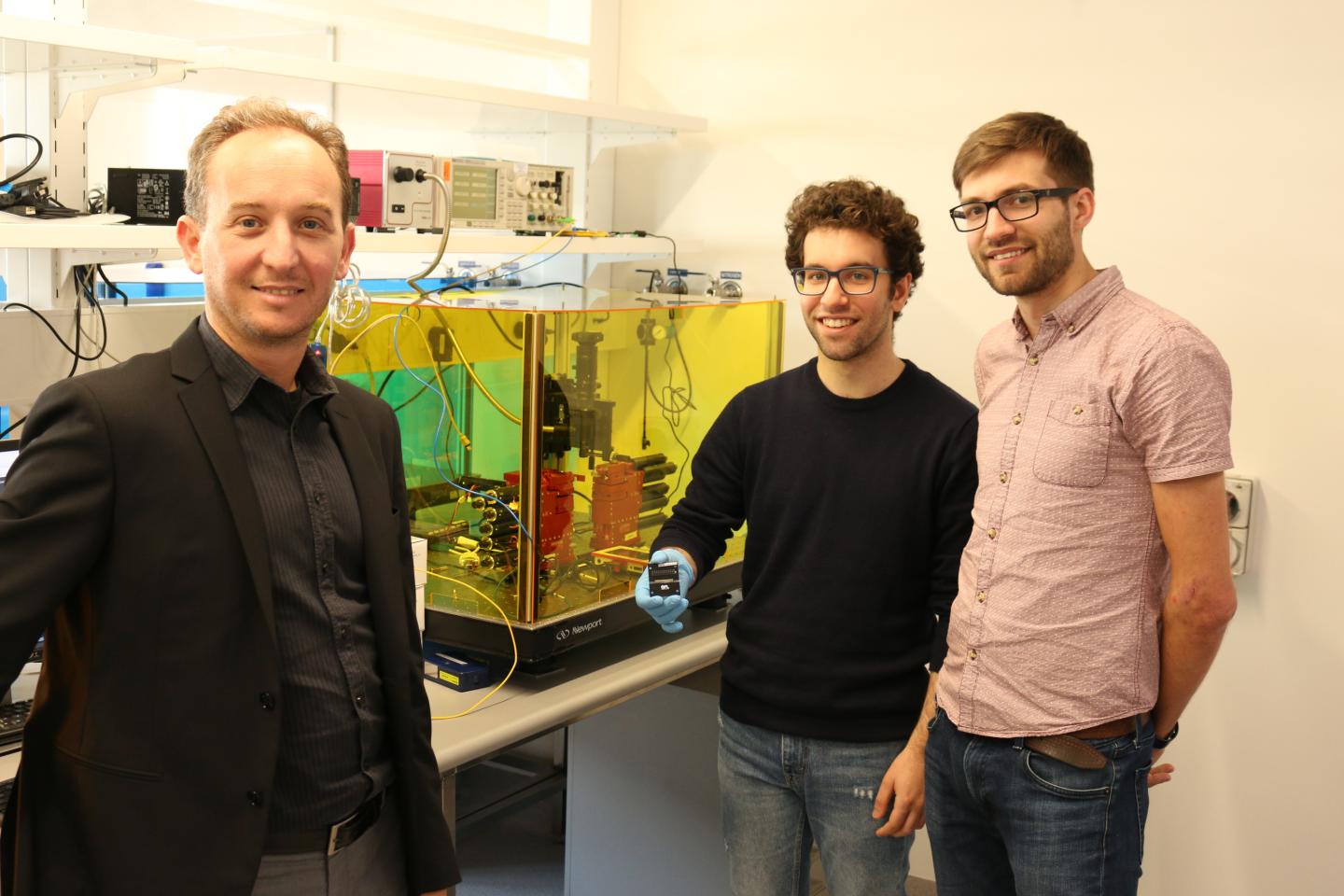
UCLA Samueli engineers have developed a new tool to model how magnetic materials, which are used in smartphones and other communications devices, interact with incoming radio signals that carry data. It accurately predicts these interactions down to the nanometer scales required to build state-of-the-art communications technologies.
The tool allows engineers to design new classes of radio frequency-based components that are able to transport large amounts of data more rapidly, and with less noise interference. Future use cases include smartphones to implantable health monitoring devices.
Magnetic materials can attract or repel each other based on their polar orientation--positive and negative ends attract each other, while two positives or two negatives repel. When an electromagnetic signal like a radio wave passes through such materials, a magnetic material acts like a gatekeeper, letting in the signals that are desired, but keeping out others. They can also amplify the signal, or dampen the speed and strength of the signal.
Engineers have used these gatekeeper-like effects, called "wave-material interactions," to make devices used in communications technologies for decades. For example, these include circulators that send signals in specific directions or frequency-selective limiters that reduce noise by suppressing the strength of unwanted signals.
Current design tools are not comprehensive and precise enough to capture the complete picture of magnetism in dynamic systems, such as implantable devices. The tools also have limits in the design of consumer electronics.
"Our new computational tool addresses these problems by giving electronics designers a clear path toward figuring out how potential materials would be best used in communications devices," said Yuanxun "Ethan" Wang, a professor of electrical and computer engineering who led the research. "Plug in the characteristics of the wave and the magnetic material, and users can easily model nanoscale effects quickly and accurately. To our knowledge, this set of models is the first to incorporate all the critical physics necessary to predict dynamic behavior."
The study was published in the June 2018 print issue of IEEE Transactions on Microwave Theory and Techniques.
The computational tool is based on a method that jointly solves well-known Maxwell's equations, which describe how electricity and magnetism work and the Landau-Lifshitz-Gilbert equation, which describes how magnetization moves inside a solid object.
The study's lead author Zhi Yao is a postdoctoral scholar in Wang's laboratory. Co-authors are Rustu Umut Tok, a postdoctoral scholar in Wang's laboratory, and Tatsuo Itoh, a distinguished professor of electrical and computer engineering at UCLA and the Northrop Grumman Chair in Electrical Engineering. Itoh is also Yao's co-advisor.
The team is working to improve the tool to account for multiple types of magnetic and non-magnetic materials. These improvements could lead it to become a "universal solver," able to account for any type of electromagnetic wave interacting with any type of material.
Wang's research group recently received a $2.4 million grant from the Defense Advanced Research Project Agency to expand the tool's modeling capacity to include additional material properties.
A Multiscale Unconditionally Stable Time-Domain (MUST) Solver Unifying Electrodynamics and Micromagnetics
Zhi Yao et. al.
IEEE Transactions on Microwave Theory and Techniques (vol.66, issue.6, pp.2683 - 2696, June 2018 )
DOI: 10.1109/TMTT.2018.2825373
UCLA Henry Samueli School of Engineering and Applied Science
#Physics #Magnetism
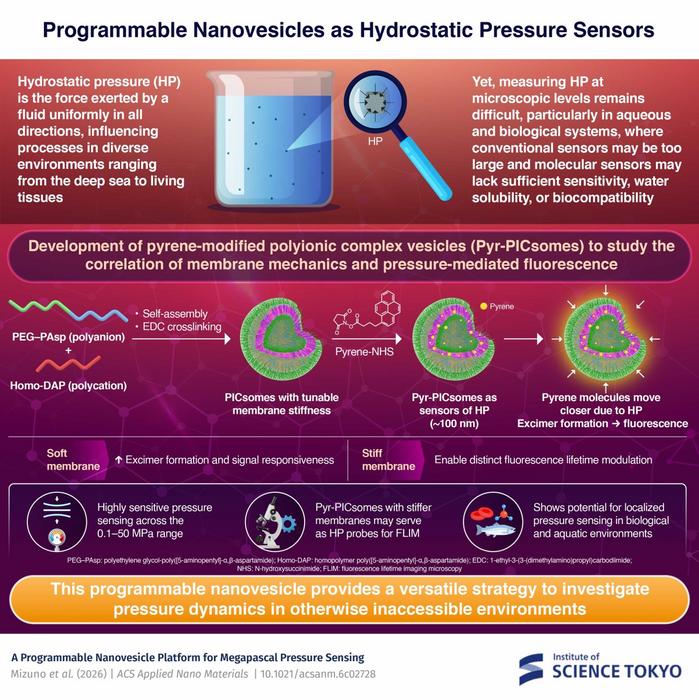
Pyrene-modified polyionic complex vesicles, or Pyr-PICsomes, convert hydrostatic pressure into measurable fluorescence. Crosslinking density tunes membrane stiffness, which governs sensing behavior: soft vesicles give strong excimer-to-monomer ratio changes from 0.1 to 50 MPa, while stiff membranes respond through fluorescence lifetime, suiting lifetime imaging.
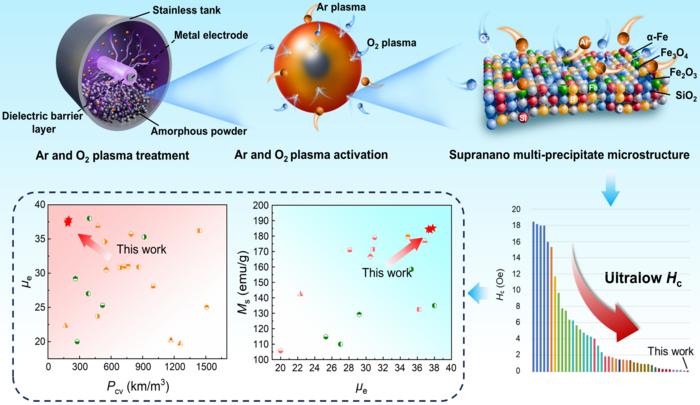
Ar/O₂ plasma treatment generates supranano α-Fe, Fe₃O₄, SiO₂ and Fe₂O₃ precipitates just 0.8–2.5 nm across amorphous powder surfaces, creating nucleation sites that ease magnetic-moment reversal. The resulting soft magnetic composite combines 0.13 Oe coercivity, 37.3 permeability, 185 emu g⁻¹ saturation magnetization and 191.18 kW m⁻³ core loss at 1 MHz and 20 mT. The surface route avoids bulk composition changes, aiding scale-up for high-frequency inductors and power chokes.
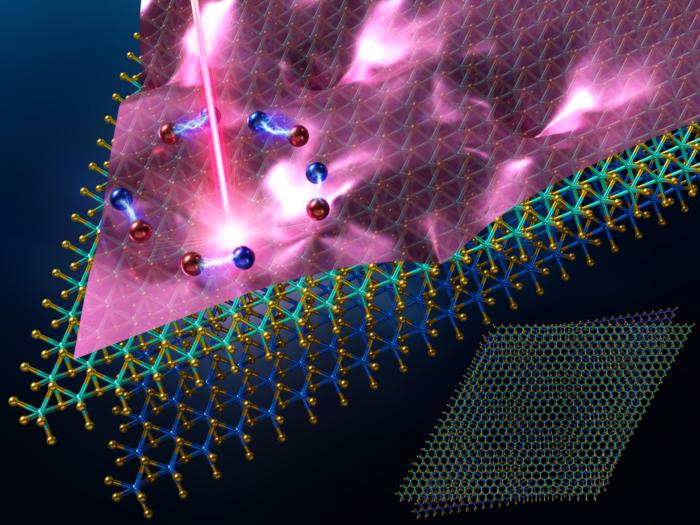
Researchers at MANA have introduced a theoretical framework that extracts hidden disorder from complex photoluminescence spectra in twisted MoSe2/WSe2 moiré heterostructures, bypassing unreliable peak-by-peak analysis. By tracking how simple descriptors like peak and average energy vary spatially, the work reveals a hierarchy of disorder, from micrometer-scale background variations to localized exciton-trapping defects.






