Quantum technology promises to address global challenges including cybersecurity and energy, and it could supercharge AI
The quantum revolution could introduce computers that operate a million times faster, quantum internet to distribute information more securely, and quantum engineering approaches that yield sustainability innovations such as carbon capture and energy harvesting.
Now, with a $55 million investment in people and lab space, the University of Michigan will help drive these developments.
The newly launched Quantum Research Institute will recruit up to eight new faculty and bring together existing quantum expertise at U-M—from physics to electrical engineering and computer science, materials science and more.
The institute is designed to strengthen research collaborations among U-M faculty, government and industry partners. QRI will appoint 20 U-M faculty fellows who, over the next six months, will identify and implement a strategic plan to bolster quantum research across disciplines. It is a joint venture led by the Office of the Vice President for Research, the College of Engineering and the College of Literature, Science, and the Arts, with support from the Office of the Provost.
“Quantum science and technology will remain a key national research priority for many years to come, and through this new institute, the University of Michigan has a tremendous opportunity to leverage its breadth of expertise to accelerate and translate quantum knowledge and discoveries for the benefit of society,” said Rebecca Cunningham, vice president for research.
Steven Cundiff, the Harrison M. Randall Collegiate Professor of Physics, and Mack Kira, a professor of electrical engineering and computer science, will serve as co-directors of the institute. Between them, they have authored multiple books and more than 300 scholarly publications on semiconductor quantum science and technology. They also played leading roles in the 2022 formation of the Midwest Quantum Collaboratory, which has increased collaboration among quantum researchers at U-M, Michigan State University and Purdue University.
The institute builds upon the university’s strengths in quantum materials and quantum light research. QRI will operate a research incubator designed to provide faculty with services and resources, including seed funding, so they can compete for large-scale external grants that advance bold research ideas.
Since the 2018 passage of the National Quantum Initiative Act, the federal government has prioritized quantum research funding to help enhance national security, drive economic growth and reinforce the United States’ position as a global leader in quantum engineering, science and technology. And as part of the CHIPS and Science Act of 2022, the National Quantum Initiative Act was amended to support the future of semiconductors beyond classical information technology, to expand quantum networking infrastructures and to integrate quantum awareness into academic curriculums across all education levels.
“Advances in quantum science, engineering and technology could yield new ways of addressing some of society’s most pressing challenges in areas such as sensing, information transmission and security, computing and AI. Building on U-M’s expertise in quantum photonics and materials, this institute will help accelerate the fundamental discoveries, develop the technological applications, and educate the talented workforce that will enable quantum technology to reach its potential,” said Alec D. Gallimore, the Robert J. Vlasic Dean of Engineering.
Beyond research, the institute will identify opportunities to expand the academic curriculum to incorporate new courses that help prepare students for the future quantum workforce. Through QRI fellowships, U-M also aims to recruit talented and diverse graduate students and postdoctoral research fellows to the Ann Arbor campus so they can collaborate with faculty on multidisciplinary research projects.
“We are very excited to partner with the College of Engineering and OVPR in the launch of the Quantum Research Institute,” said Anne Curzan, dean of the College of Literature, Science, and the Arts and the Geneva Smitherman Collegiate Professor of English Language and Literature, Linguistics and Education.
“Through this cross-college collaboration, the University of Michigan can continue to lead in this cutting-edge research space, building on our long history of research excellence in photonics, quantum theory, as well as quantum materials. The promise of quantum science and technology is stunning in its implications and applications, and the QRI represents our investment in this fast-moving field in support of our research and educational mission.”
Cundiff is also a professor of electrical and computer engineering, and Kira is also a professor of physics. Gallimore is also the Richard F. and Eleanor A. Towner Professor of Engineering, an Arthur F. Thurnau Professor and professor of aerospace engineering. Curzan is also an Arthur F. Thurnau Professor and a professor of English language and literature and linguistics.
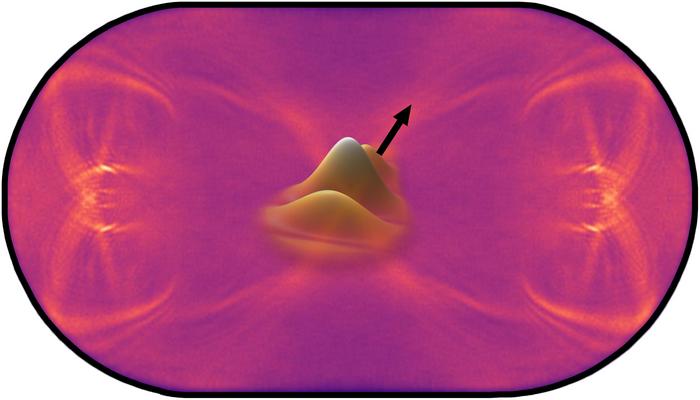
A quantum "wave packet" (in the middle) launched from the same kind of starting point behaves differently. Even after bouncing around for a very long time, faint filament-like patterns (bright glow) are still visible, a tattoo tracing back to its early history. This lingering imprint is the "quantum birthmark" described in the study. Credit: Joonas Keski-Rahkonen, Tampere University Even the most chaotic quantum systems keep a permanent mark of their own past – a "quantum birthmark" – that...
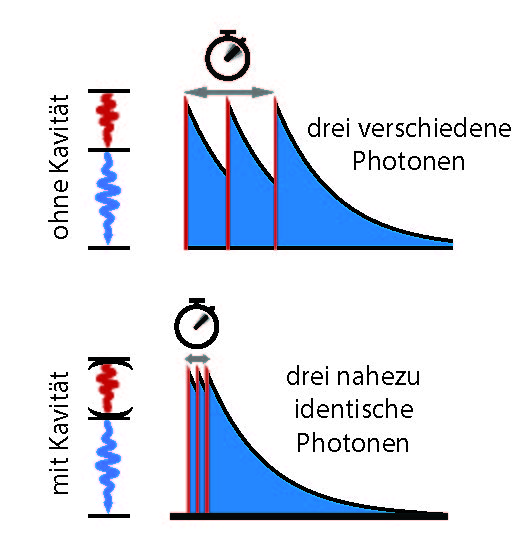
Illustration (University of Basel, Timon Baltisberger): Biexziton decay can generate photons of very high quality if the system is specifically controlled using an optical cavity. Under these conditions, 90 per cent of the photons are indistinguishable. Working in close collaboration, researchers from Paderborn University, the University of Basel and Ruhr University Bochum have made a significant breakthrough in the field of quantum communication. In their recently published paper in the...
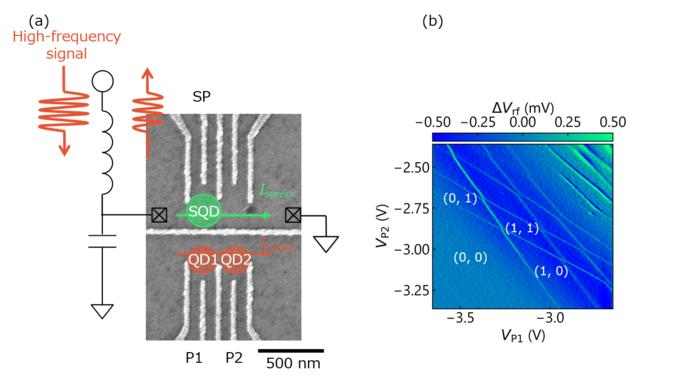
(a) The structure of the gate electrodes on the ZnO device used in the experiment in this paper. (b) The charge stability diagram indicating the formation of ZnO double quantum dot in few-electron regime. Researchers at Tohoku University, in collaboration with the National Institute for Materials Science (NIMS) and the University of Tokyo, have taken an important step toward semiconductor quantum computing using zinc oxide (ZnO). The team successfully demonstrated charge sensing,...