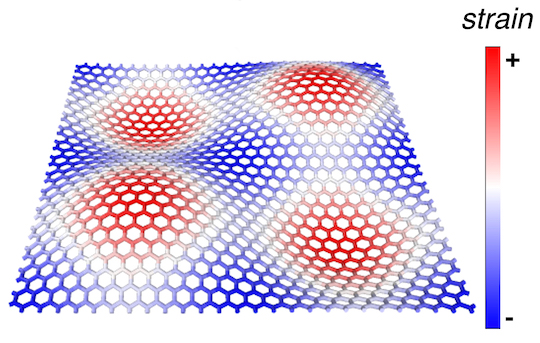
Atoms do weird things when forced out of their comfort zones. Rice University engineers have thought up a new way to give them a nudge.
Materials theorist Boris Yakobson and his team at Rice’s George R. Brown School of Engineering have a theory that changing the contour of a layer of 2D material, thus changing the relationships between its atoms, might be simpler to do than previously thought.
While others twist 2D bilayers -- two layers stacked together -- of graphene and the like to change their topology, the Rice researchers suggest through computational models that growing or stamping single-layer 2D materials on a carefully designed undulating surface would achieve “an unprecedented level of control” over their magnetic and electronic properties.
They say the discovery opens a path to explore many-body effects, the interactions between multiple microscopic particles, including quantum systems.
The paper by Yakobson and two alumni, co-lead author Sunny Gupta and Henry Yu, of his lab appears in Nature Communications.
The researchers were inspired by recent discoveries that twisting or otherwise deforming 2D materials bilayers like bilayer graphene into “magic angles” induced interesting electronic and magnetic phenomena, including superconductivity.
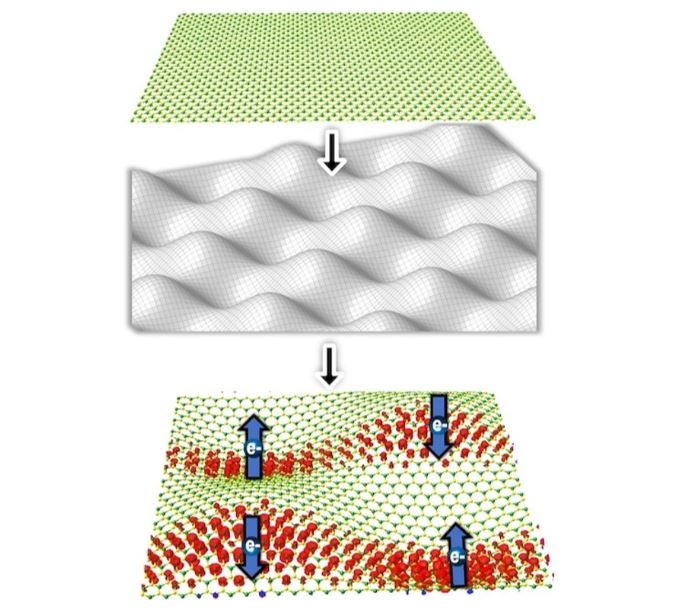
Their models show that rather than twisting, simply stamping or growing a 2D material like hexagonal boron nitride (hBN) onto a bumpy surface naturally strains the material’s lattice, allowing it to form pseudo-electric and pseudo-magnetic fields and possibly exhibit rich physical effects similar to those found in twisted materials.
Flat hBN is an insulator, but the researchers found that straining the atoms in their model created band structures, effectively making it a semiconductor.
The advantage to their strategy, Gupta said, is that the deformation would be highly controllable through the surface bumps, as substrates could be accurately patterned using electron-beam lithography. “This will also allow one to controllably change the electronic states and quantum effects by designing substrates with different topography,” he said.
Because the charge can be manipulated to flow in one direction, the path it follows is a model for 1D systems. Yakobson said that can be used to explore properties of 1D quantum systems that can’t be accessed through twisted graphene.
“Imagine a road with a single lane such that the cars are allowed to move in only one direction,” Gupta said. “A car cannot overtake the one in front, so traffic will move only when all cars move collectively.
“This is not the case in 2D or when you have multiple lanes, where the cars -- or electrons -- can pass,” he said. “Like cars, electrons in a 1D system will flow collectively and not individually. This makes 1D systems special with rich, unexplored physics.”
Gupta said it would be much easier to form a bumpy substrate with an electron beam than it currently is to twist 2D bilayers of graphene or other heterostructures like hBN to less than a single degree of accuracy.
“Moreover, one can realize 1D quantum states, which are not typically accessible by twisting 2D bilayers,” he said. “This will allow for the exploration of physical effects in 1D that have remained largely elusive until now.”
Reference
Designing 1D correlated-electron states by non-Euclidean topography of 2D monolayers
Sunny Gupta, Henry Yu & Boris I. Yakobson
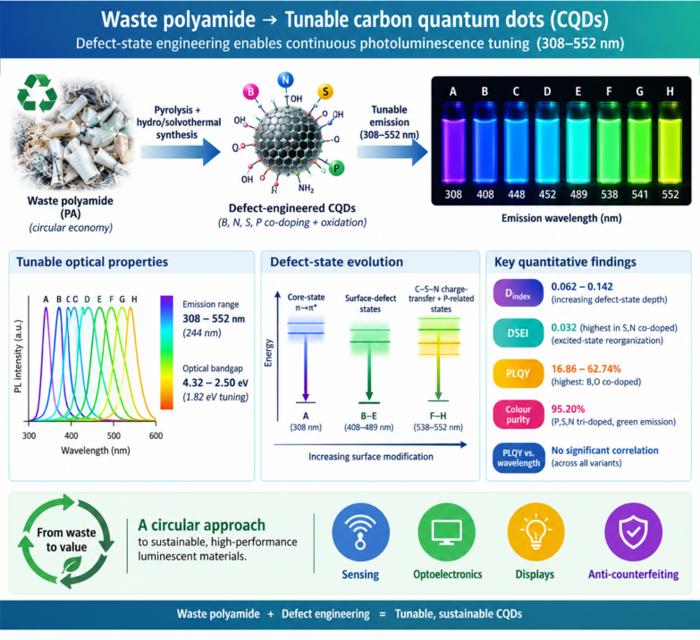
Waste polyamide-derived CQDs show continuous photoluminescence tuning from 308 to 552 nm through sequential defect-state engineering, with optical transition energies decreasing from 4.32 to 2.50 eV. @Christian Ebere Enyoh from Saitama University Carbon quantum dots (CQDs) are fluorescent carbon nanomaterials with potential applications in sensing, optoelectronics, displays, anti-counterfeiting, and environmental technologies. Their optical properties can be adjusted by modifying the carbon...
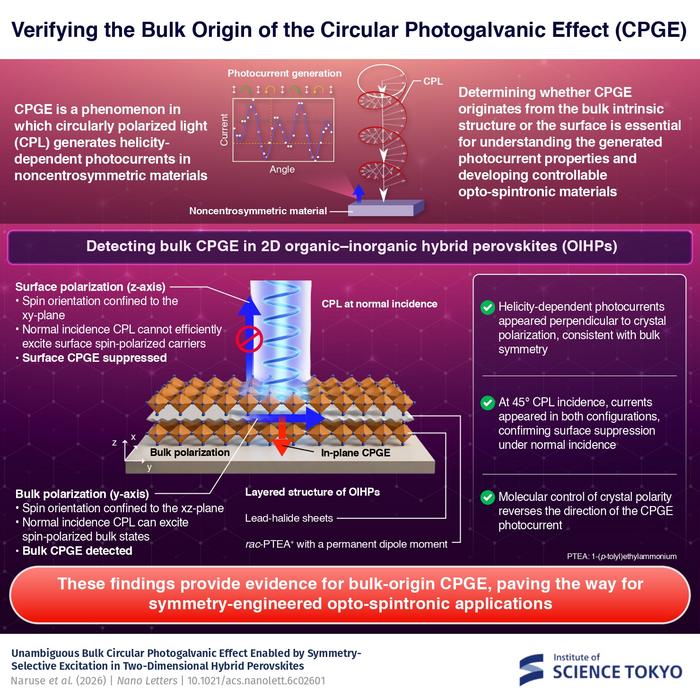
The researchers used circularly polarized light at normal incidence and found that helicity-dependent photocurrents appeared perpendicular to the crystal’s polarization but vanished when measured parallel to it, supporting a bulk origin of CPGE. @Institute of Science Tokyo The circular photogalvanic effect (CPGE), a phenomenon that generates helicity-dependent photocurrents in noncentrosymmetric materials, can originate purely from a crystal's internal structure without contribution from the...
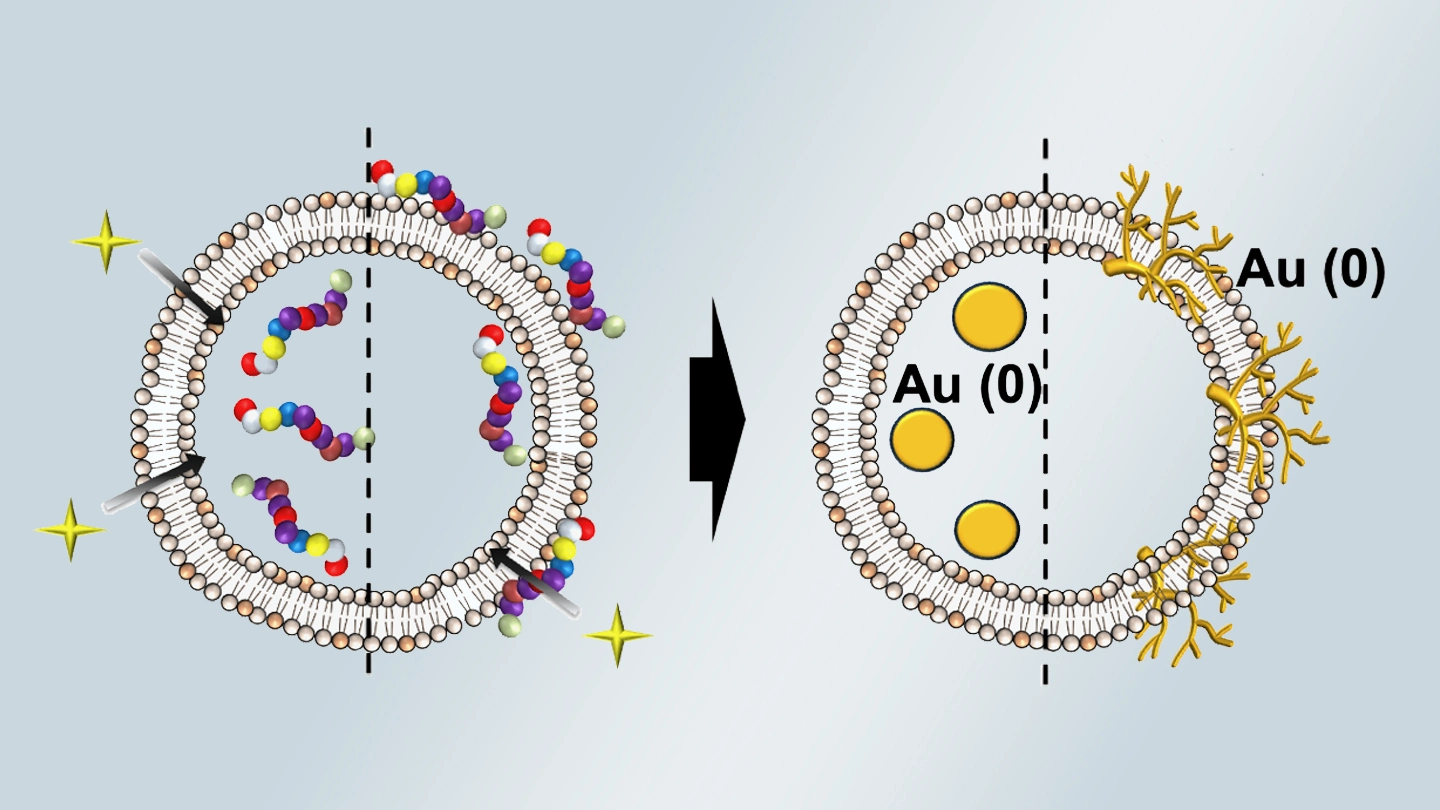
Summary of gold nanoparticle growth programming in liposome based on localization of biomineralization peptide The position of biomineralization peptides within liposomes can influence how gold nanoparticles grow, reports a research team from Institute of Science Tokyo. Peptides localized at the membrane interface promote branched structures, while those confined to the liposome interior favor spherical nanoparticles. The findings offer a new strategy for controlling nanoscale reaction...
