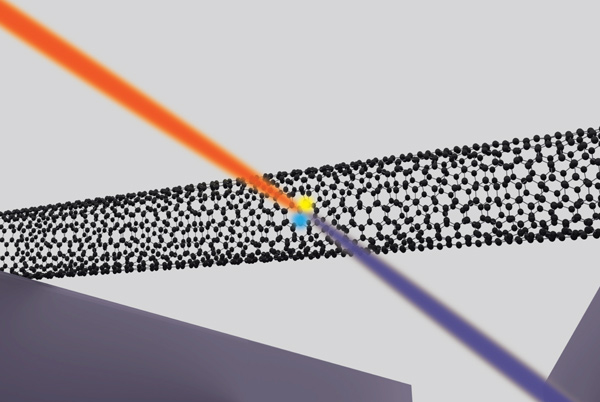
Three RIKEN physicists have discovered how tiny tubes of carbon spit out light that is more energetic than the light shone on them1. This finding could help to exploit the process in applications such as solar power and biological imaging.
Some special paints glow when you shine ultraviolet light on them. They are classical examples of conventional photoluminescence: when illuminated by high-energy light (ultraviolet light), they emit lower energy light (visible light).
But surprisingly, certain materials exhibit the opposite effect—shine light on them and they emit higher energy light. This curious phenomenon is called up-conversion photoluminescence (UCPL). It could boost the efficiency of solar cells, for example, by converting low-energy light into higher-energy wavelengths suitable for generating electricity.
In regular photoluminescence, light hits a material and kicks an electron into a higher energy level, leaving behind a positively charged ‘hole’.
Initially, the electron–hole pair sticks together in a state known as an exciton. But eventually, the electron and hole recombine, emitting light in the process.
In normal photoluminescence, the exciton loses energy to the material, and hence the emitted light carries away less energy than the incoming light brought in. In UCPL, however, the exciton receives an energy boost from the material by interacting with vibrations in it known as phonons.
Now, Yuichiro Kato and two colleagues, all at the RIKEN Center for Advanced Photonics, have pinned down exactly how UCPL works in single-walled carbon nanotubes—drinking-straw-like cylinders of carbon just a few billionths of a meter wide.
Previous theories had suggested that UCPL could only happen in single-walled carbon nanotubes if excitons were temporarily trapped by defects in the nanotube’s structure. But the researchers found that UCPL occurred with high efficiency even in defect-free nanotubes, suggesting that an alternative mechanism was at work.
The trio discovered that when an electron is excited by light, it gets a simultaneous energy boost from a phonon to form a ‘dark exciton’ state. After losing a little energy, the exciton finally emits light with more energy than the incoming laser.
Raising the temperature produced a stronger UCPL effect, confirming predictions made by their model. “Phonons are more abundant at higher temperatures, enhancing the likelihood of phonon-mediated transitions,” says Kato.
The researchers plan to study the possibility of cooling a nanotube using laser illumination to remove thermal energy by UCPL and explore energy-harvesting opportunities to create a nanotube-based device.
“By establishing an intrinsic model of UCPL in single-walled carbon nanotubes, we hope to open up new possibilities for designing advanced optoelectronic and photonic devices,” says Kato.
Reference
Intrinsic process for upconversion photoluminescence via 𝐾-momentum–phonon coupling in carbon nanotubes
Daichi Kozawa, Shun Fujii, and Yuichiro K. Kato
https://journals.aps.org/prb/abstract/10.1103/PhysRevB.110.155418
RIKEN
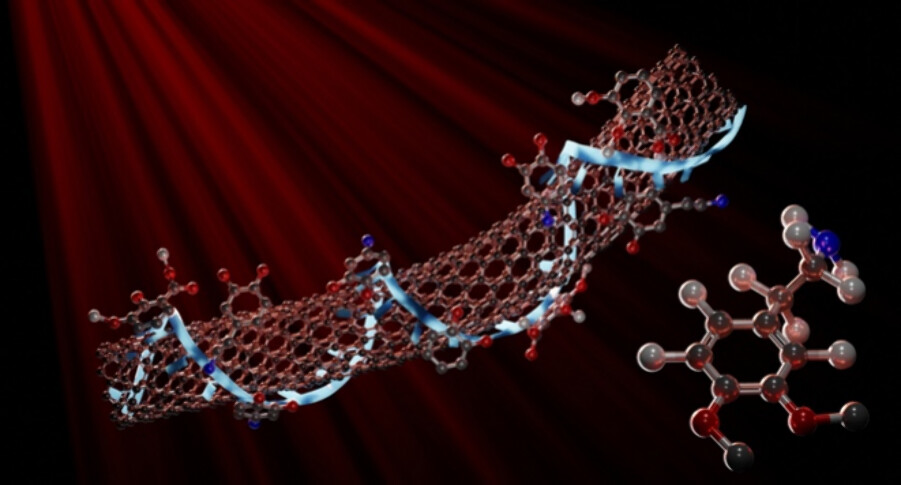
@ ACS Nano 2025, https://pubs.acs.org/doi/10.1021/acsnano.4c13814 Scrutinizing the underpinnings of optical modulation at the molecular...
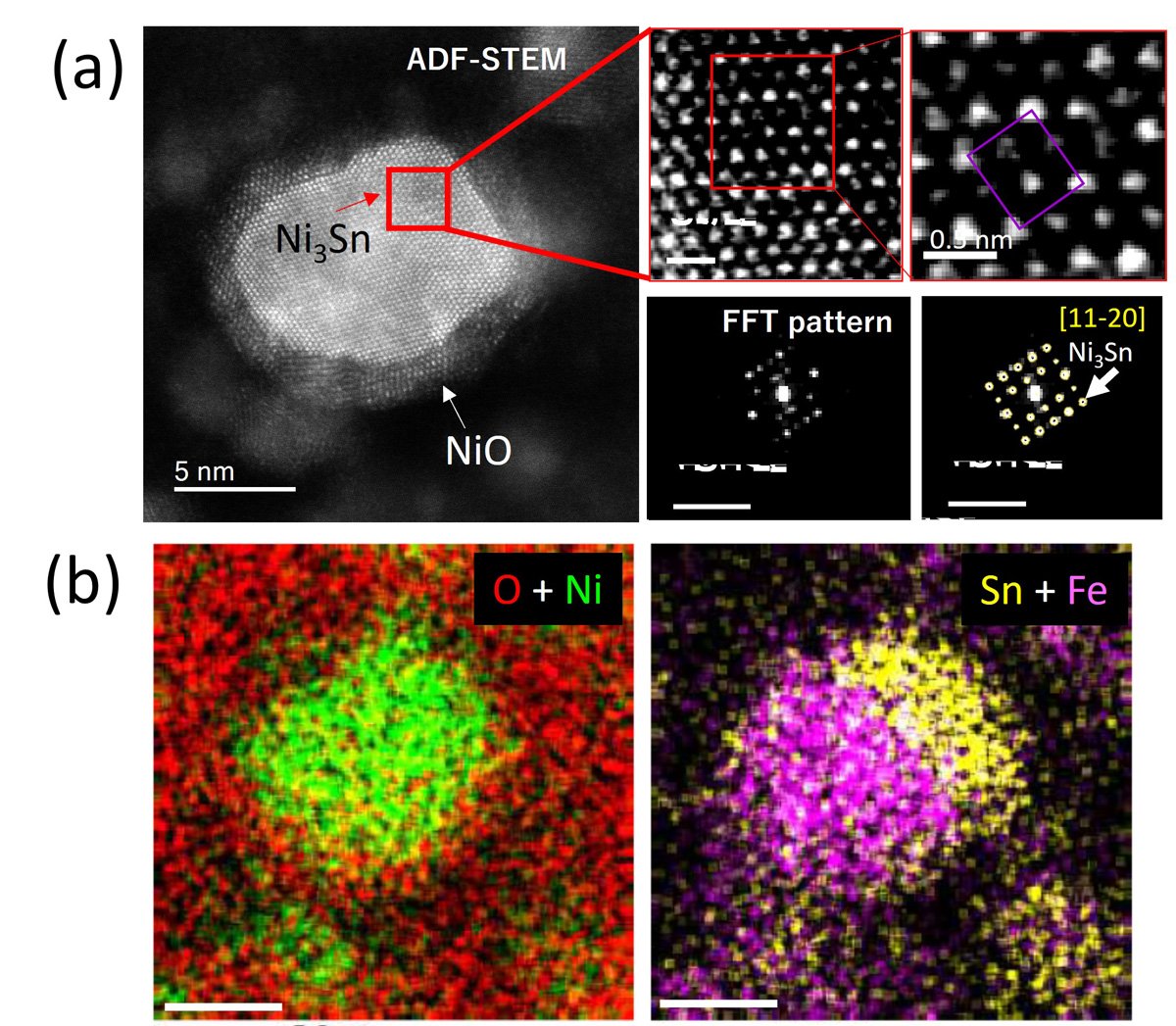
Researchers have achieved a significant breakthrough in the synthesis of carbon nanotubes (CNTs) by developing a novel catalyst that...
