Tokyo Institute of Technology (Tokyo Tech)
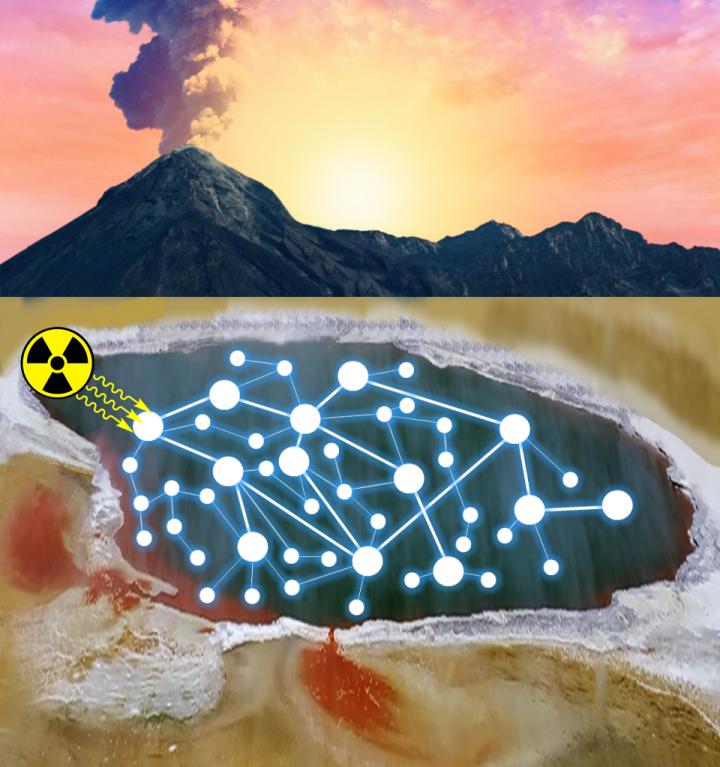
Chemists have long sought to understand the origins of life, with one popular model suggesting life began when simple RNA molecules capable of copying themselves formed spontaneously in the primitive environment. How this happened exactly is fraught with difficulties. New research by a team of chemists led by Ruiqin Yi of the Earth-Life Science Institute (ELSI) at Tokyo Institute of Technology and Albert Fahrenbach, a lecturer at the University of New South Wales, suggests that mixtures of simple organic compounds in water exposed to high energy radiation react to form a variety of more complex organic compounds that could help make RNA. Researchers from the Institute for Advanced Study in Princeton, Tokyo Tech and the University of Arizona also assisted in the work.
To conduct this work, the team took a mixture of very simple small molecules, common table salt, ammonia, phosphate and hydrogen cyanide, and exposed them to a high energy gamma radiation source at Tokyo Tech. These conditions simulate environments irradiated by naturally occurring radioactive minerals, which were likely much more prevalent on early Earth. They also allowed their reactions to intermittently dry down, simulating evaporation in shallow puddles and beaches. Their reactions surprisingly made a variety of compounds which might have been important for the origins of life, including precursors for amino acids and other small compounds known to be useful for making RNA.
They showed that this set of conditions creates what they call a 'continuous reaction network', in which a wide variety of compounds are constantly being formed and destroyed, and these react with each other to form new compounds. These continuous reaction networks make up a complex set of reactions, and because of the way they occur, they can make a whole set of important compounds at once. The team thinks this makes their study especially insightful, as prebiotic chemistry on the primitive Earth could not have been as selective and goal-directed as modern organic chemists working in the lab, who can add chemicals at precisely the right time and purify the exact compounds they want to make.
The team thinks models of this type can help explain what sorts of environments are most amenable to making RNA in primitive planetary settings. Indeed, since the surfaces of rocky planets are so variable (think cool mountain streams, bubbling hot springs and sunny beaches), there are many places where such chemistry might happen, only under slightly different conditions. These studies in turn could help other scientists identify the best areas to look for life beyond Earth.
As lead author Ruiqin Yi says, 'While we haven't yet made RNA, this work raises new questions. Can we tweak these reactions to make all of the necessary building blocks for RNA from such mixtures in a continuous fashion? Can we generate other useful compounds such as more complex amino acids in this "messy" chemistry from complex chemical reaction networks?'
A continuous reaction network that produces RNA precursors
Ruiqin Yi, Quoc Phuong Tran, Sarfaraz Ali, Isao Yoda, Zachary R. Adam, H. James Cleaves II, and Albert C. Fahrenbach
Proceedings of the National Academy of Sciences (2020)
Contact information:
Lecturer in the School of Chemistry at the University of New South Wales (UNSW)
a.fahrenbach@unsw.edu.au
Phone: +61-(0)2-9385-4574

Researchers led by Professor Jaeyune Ryu at Seoul National University identified local pH near electrodes as a decisive variable in organic electrosynthesis. By designing a reactor that narrows electrode spacing and flows electrolyte to counterbalance acidic and alkaline zones, they raised selectivity for lactones and epoxides, feedstocks for biodegradable plastics, polyurethanes, adhesives, and epoxy resins, from about 16% to 97% using only oxygen and electricity, eliminating added peroxide…

Silver nanoparticles with diameters of ~10 nm deliver the best performance as electrocatalysts. The silver particles are sprayed onto the electrode together with a conductive carbon powder. The ideal mixture consists of 20 per cent by mass silver and 80 per cent by mass carbon powder. This image was taken using a transmission electron microscope (TEM). © HZB Via electrolysis, CO₂ can be reduced to CO, a raw material for further chemical products such as fuels. Within the GreenQuest Project,...

A flexible metal–organic framework developed by researchers from Institute of Science Tokyo enables the structural determination of large "beyond rule of 5" molecules from microgram-scale samples. Using APF-40 as a crystalline sponge, the researchers determined the structures of 12 pharmaceutical-related molecules, including the 899 Da drug molecule doramectin and trace ivermectin derivatives. The method could aid drug discovery, natural products research, and the characterization of rare...






