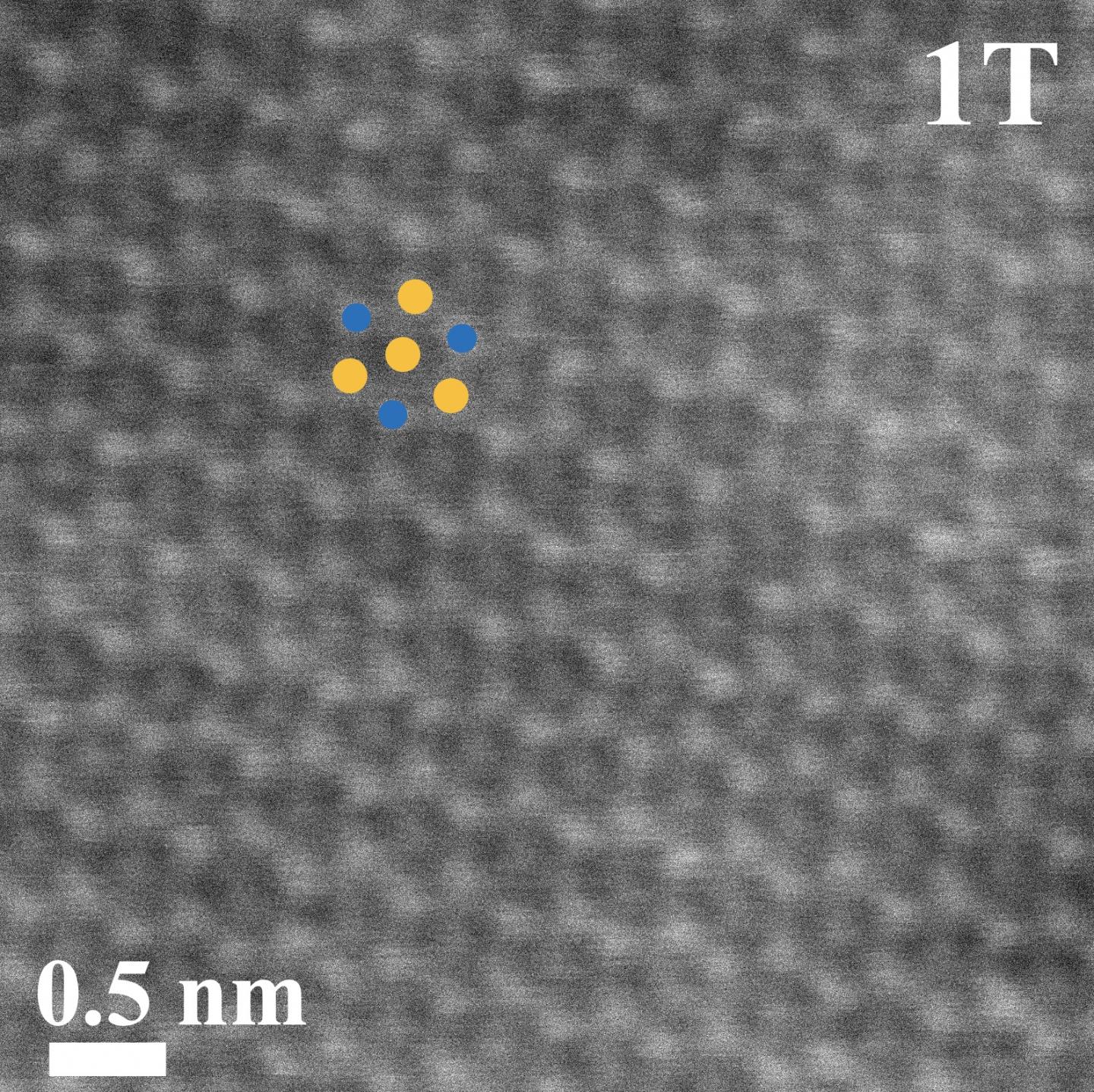
Rice University scientists have extended their technique to produce graphene in a flash to tailor the properties of other 2D materials.
The labs of chemist James Tour and materials theorist Boris Yakobson reported in the American Chemical Society's ACS Nano they have successfully "flashed" bulk amounts of 2D dichalcogenides, changing them from semiconductors to metallics.
Such materials are valuable for electronics, catalysis and as lubricants, among other applications.
The process employs flash Joule heating -- using an electrical charge to dramatically raise the material's temperature -- to convert semiconducting molybdenum disulfide and tungsten disulfide. The duration of the pulse and select additives can also control the now-metallic products' properties.
"This rapid process permits us to make an entirely new class of highly valued materials in large scale and without the use of solvents or water," Tour said.
Two-dimensional dichalcogenides look like hexagonal graphene from above, but viewing them from an angle reveals a sandwichlike structure. In molybdenum disulfide, for instance, a single plane of molybdenum atoms sits between similar, but offset, planes of sulfur.
Making each material in its metallic phase (known as 1T) previously required far more complex processes, according to the researchers. Even then, the products were known to be unstable in ambient conditions. Flash Joule heating appears to solve that problem, producing metastable dichalcogenides in a thousandth of a second.
Powdered, commercially available dichalcogenides mixed with carbon black or tungsten powder to increase their conductivity were placed in a ceramic tube capped with electrodes and flashed with more than 1,350 amps of power for a fraction of a second, then rapidly cooled. With the tube under vacuum, extraneous gases were vented, leaving mostly pure metallics to be harvested.
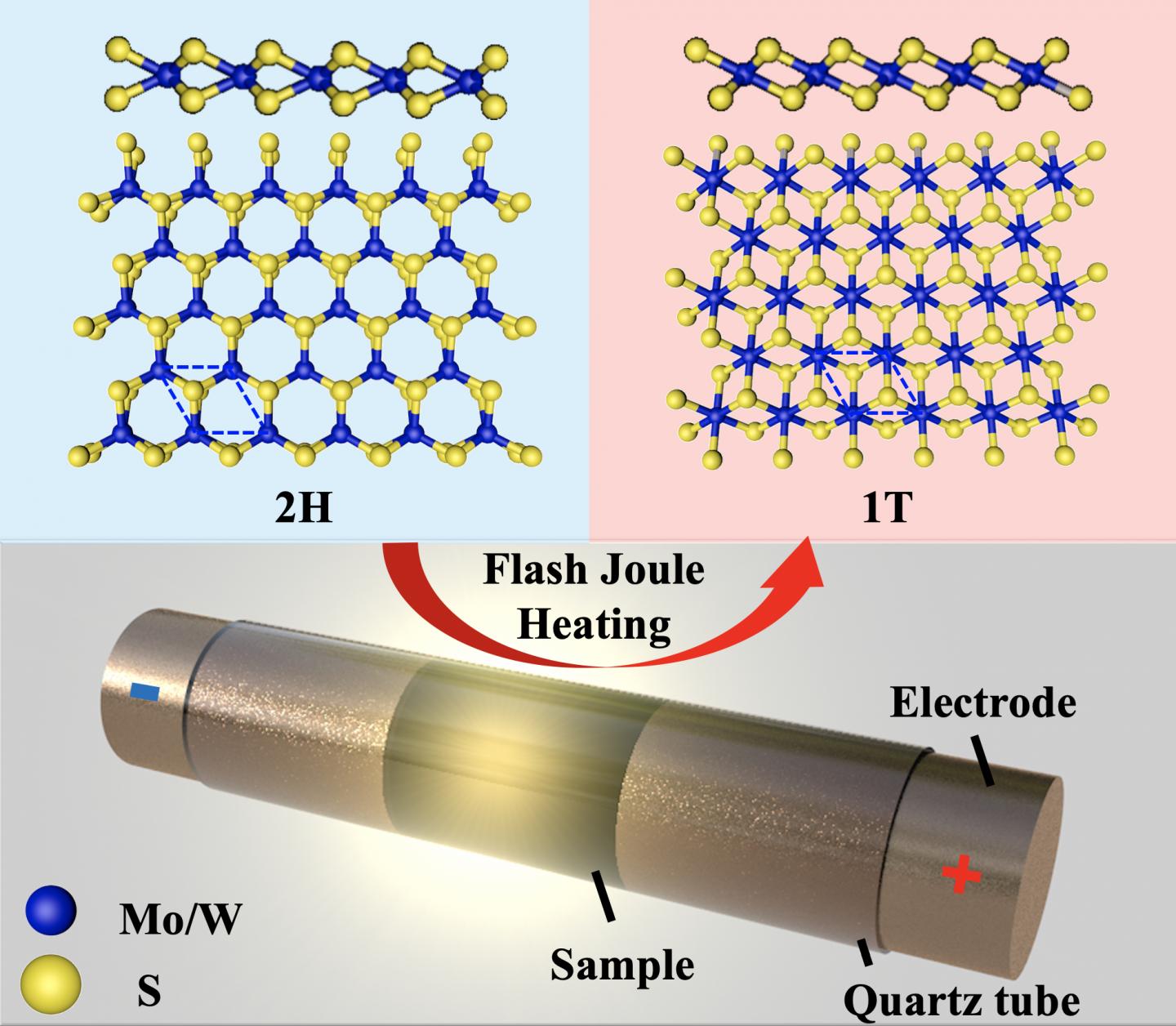
According to the Yakobson team's calculations, the large energy input forces structural defects to appear in the materials' crystal lattices, adding negative charges that make 1T the thermodynamically preferred phase.
"It is an interesting fast-forward incarnation of Le Chatelier's principle: Under voltage, the material changes to a more conducting 1T phase, to counteract/reduce the applied electric fields," said co-author Ksenia Bets, a researcher in the Yakobson group. "Our detailed computations reveal that the kinetic path is indirect: The sublimating sulfur creates a vacancy-rich lattice that energetically prefers a 1T structure."
The fact that conditions and additives can influence the final product should lead to a systematic study about possible variations, Tour said.
Rice graduate student Weiyin Chen is lead author of the paper. Additional co-authors are Rice graduate students Zhe Wang, Emily McHugh, Wala Algozeeb and Jinhang Chen; postdoctoral researchers Duy Xuan Luong and Bing Deng; alumni Muqing Ren and Michael Stanford; assistant research professor Hua Guo; research scientist Guanhui Gao; and undergraduates John Tianci Li and William Carsten.
Tour is the T.T. and W.F. Chao Chair in Chemistry as well as a professor of computer science and of materials science and nanoengineering. Yakobson is the Karl F. Hasselmann Professor of Materials Science and NanoEngineering and a professor of chemistry.
The Air Force Office of Scientific Research, the Department of Energy (DOE) National Energy Technology Laboratory and DOE Basic Energy Sciences supported the research.
Contact
James M. Tour
Department of Chemistry, Department of Materials Science and NanoEngineering
Smalley-Curl Institute, NanoCarbon Center, the Welch Institute for Advanced Materials, Smalley-Curl Institute
Rice University
tour@rice.edu
Reference
Millisecond Conversion of Metastable 2D Materials by Flash Joule Heating
Weiyin Chen, Zhe Wang, Ksenia V. Bets, Duy Xuan Luong, Muqing Ren, Michael G. Stanford, Emily A. McHugh, Wala A. Algozeeb, Hua Guo, Guanhui Gao, Bing Deng, Jinhang Chen, John Tianci Li, William T. Carsten, Boris I. Yakobson*, and James M. Tour*
Publication Date:January 7, 2021
certain wavelength and direction will also emit heat in the same ways. This fundamental relationship, known as reciprocity, limits our ability to independently control heat absorption and heat emission. But if absorption and emission could be separated, engineers could design devices that absorb heat from one direction while emitting it in another. By ‘steering’ thermal energy, they could create more efficient thermal management, energy conversion, infrared sensing, and thermal communicati...
MIT researchers have found that rhombohedral graphene — a naturally occurring staircase-like stack of four or five atomically thin carbon layers found in ordinary graphite — can host multiple distinct superconducting states simultaneously, a rarity among known superconductors. Publishing in Nature, the team reports that three of these states not only survive exposure to magnetic fields up to around 9 tesla (roughly 180,000 times Earth's magnetic field), which would normally destroy supercondu...

MIT researchers have developed a new approach that dramatically improves the modeling of chemically disordered metal alloys, a long-standing challenge in materials science. Traditional simulation techniques struggle with the complex atomic arrangements in real-world alloys. The team addressed this by creating smarter training datasets for machine-learning models that better capture the diverse local chemical environments in disordered materials. Using information theory to generate more repre...
