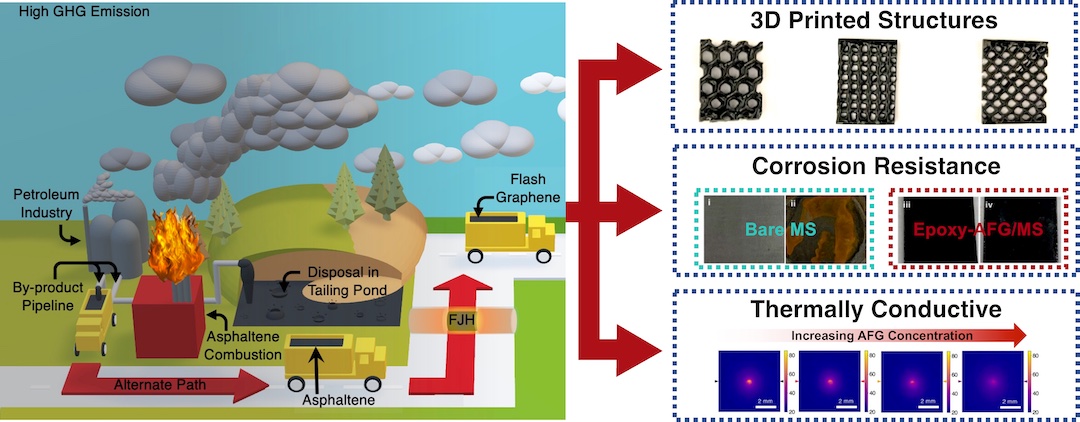
Asphaltenes, a byproduct of crude oil production, are a waste material with potential. Rice University scientists are determined to find it by converting the carbon-rich resource into useful graphene.
Muhammad Rahman, an assistant research professor of materials science and nanoengineering, is employing Rice’s unique flash Joule heating process to convert asphaltenes instantly into turbostratic (loosely aligned) graphene and mix it into composites for thermal, anti-corrosion and 3D-printing applications.
The process makes good use of material otherwise burned for reuse as fuel or discarded into tailing ponds and landfills. Using at least some of the world’s reserve of more than 1 trillion barrels of asphaltene as a feedstock for graphene would be good for the environment as well.
“Asphaltene is a big headache for the oil industry, and I think there will be a lot of interest in this,” said Rahman, who characterized the process as both a scalable and sustainable way to reduce carbon emissions from burning asphaltene.
Rahman is a lead corresponding author of the paper in Science Advances co-led by Rice chemist James Tour, whose lab developed flash Joule heating, materials scientist Pulickel Ajayan and Md Golam Kibria, an assistant professor of chemical and petroleum engineering at the University of Calgary, Canada.
Asphaltenes are 70% to 80% carbon already. The Rice lab combines it with about 20% of carbon black to add conductivity and flashes it with a jolt of electricity, turning it into graphene in less than a second. Other elements in the feedstock, including hydrogen, nitrogen, oxygen and sulfur, are vented away as gases.
“We try to keep the carbon black content as low as possible because we want to maximize the utilization of asphaltene,” Rahman said.
“The government has been putting pressure on the petroleum industries to take care of this,” said Rice graduate student and co-lead author M.A.S.R. Saadi. “There are billions of barrels of asphaltene available, so we began working on this project primarily to see if we could make carbon fiber. That led us to think maybe we should try making graphene with flash Joule heating.”
Assured that Tour’s process worked as well on asphaltene as it did on various other feedstocks, including plastic, electronic waste, tires, coal fly ash and even car parts, the researchers set about making things with their graphene.
Saadi, who works with Rahman and Ajayan, mixed the graphene into composites, and then into polymer inks bound for 3D printers. “We’ve optimized the ink rheology to show that it is printable,” he said, noting the inks have no more than 10% of graphene mixed in. Mechanical testing of printed objects is forthcoming, he said.
Reference
Sustainable valorization of asphaltenes via flash joule heating
M.A.S.R. Saadi, Paul A. Advincula, Md Shajedul Hoque Thakur, Ali Zein Khater, Shabab Saad, Ali Shayesteh Zeraati, Shariful Kibria Nabil, Aasha Zinke, Soumyabrata Roy, Minghe Lou, Sravani N. Bheemasetti, Md Abdullah Al Bari, Yiwen Zheng, Jacob L. Beckham, Venkataramana Gadhamshetty, Aniruddh Vashisth, Md Golam Kibria, James M. Tour, Pulickel M. Ajayan, Muhammad M. Rahman
https://www.science.org/doi/10.1126/sciadv.add3555
Rice University
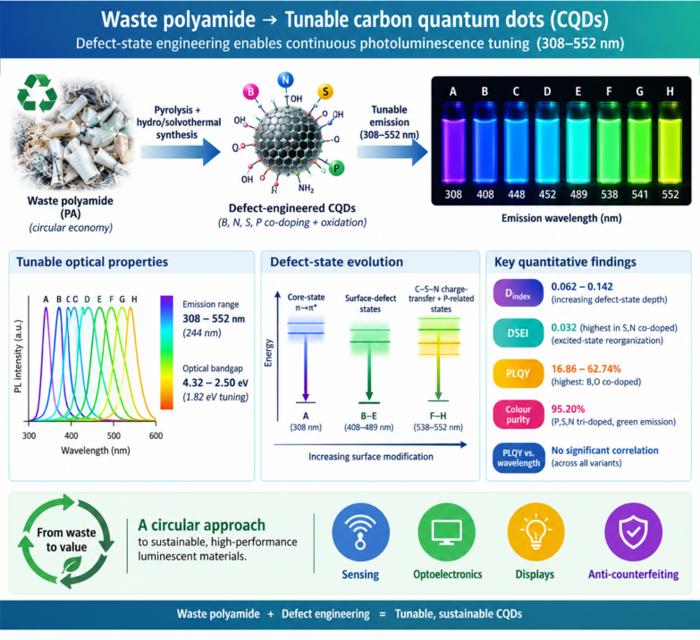
Waste polyamide-derived CQDs show continuous photoluminescence tuning from 308 to 552 nm through sequential defect-state engineering, with optical transition energies decreasing from 4.32 to 2.50 eV. @Christian Ebere Enyoh from Saitama University Carbon quantum dots (CQDs) are fluorescent carbon nanomaterials with potential applications in sensing, optoelectronics, displays, anti-counterfeiting, and environmental technologies. Their optical properties can be adjusted by modifying the carbon...
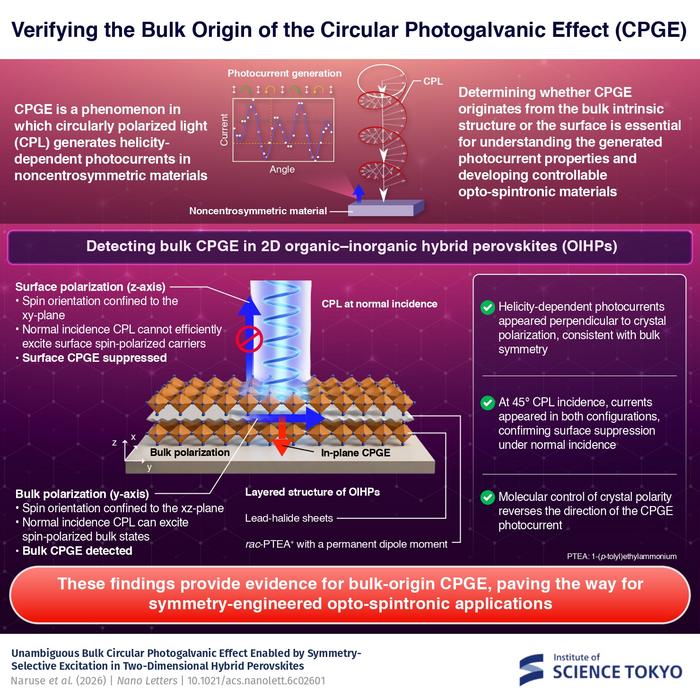
The researchers used circularly polarized light at normal incidence and found that helicity-dependent photocurrents appeared perpendicular to the crystal’s polarization but vanished when measured parallel to it, supporting a bulk origin of CPGE. @Institute of Science Tokyo The circular photogalvanic effect (CPGE), a phenomenon that generates helicity-dependent photocurrents in noncentrosymmetric materials, can originate purely from a crystal's internal structure without contribution from the...
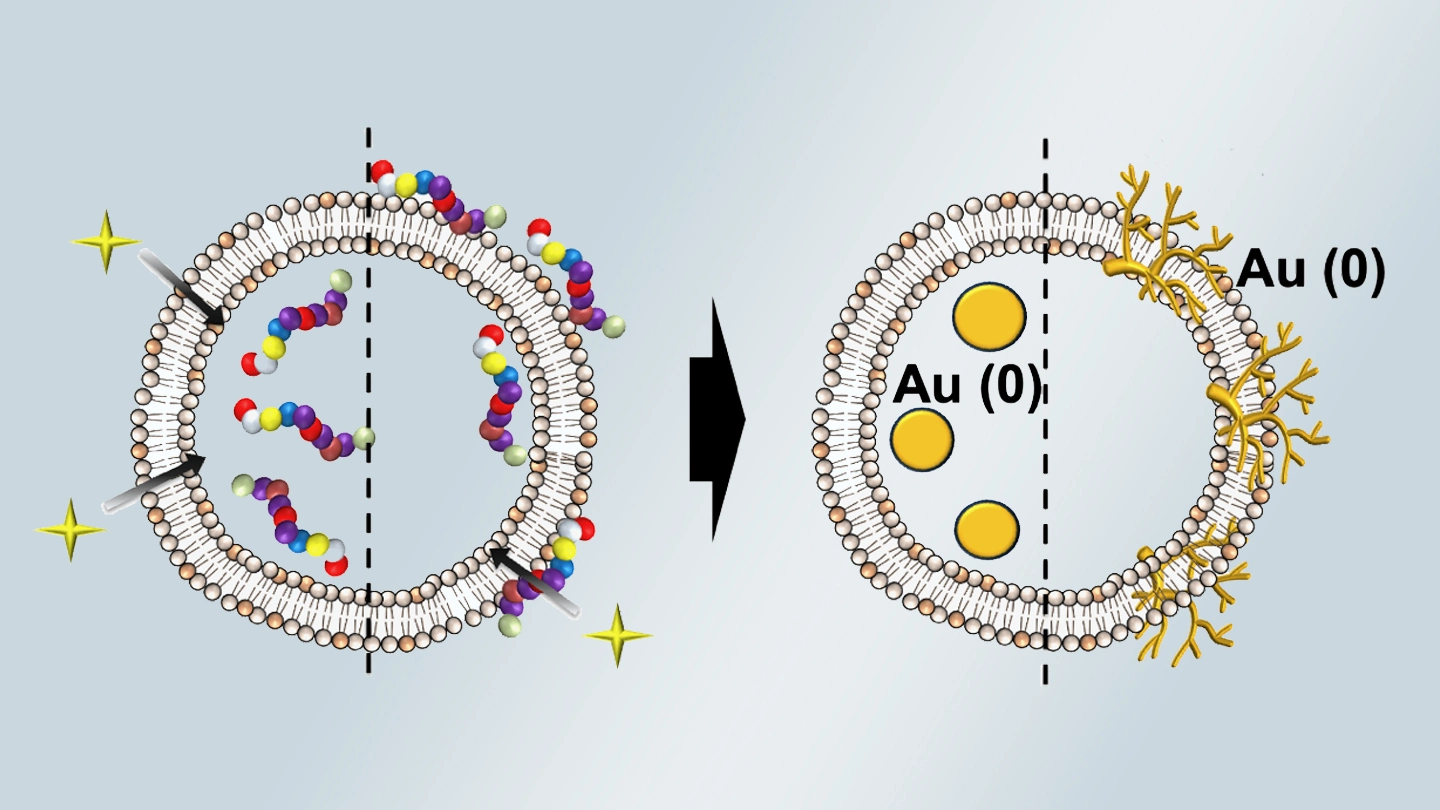
Summary of gold nanoparticle growth programming in liposome based on localization of biomineralization peptide The position of biomineralization peptides within liposomes can influence how gold nanoparticles grow, reports a research team from Institute of Science Tokyo. Peptides localized at the membrane interface promote branched structures, while those confined to the liposome interior favor spherical nanoparticles. The findings offer a new strategy for controlling nanoscale reaction...
