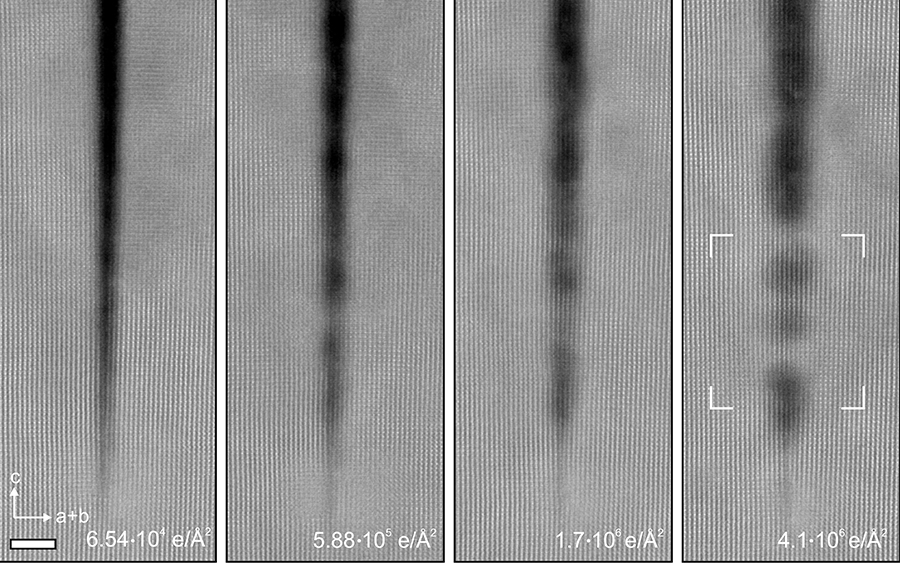
In a surprising new study, researchers at the University of Minnesota Twin Cities have found that the electron beam radiation that they previously thought degraded crystals can actually repair cracks in these nanostructures.
The groundbreaking discovery provides a new pathway to create more perfect crystal nanostructures, a process that is critical to improving the efficiency and cost-effectiveness of materials that are used in virtually all electronic devices we use every day.
“For a long time, researchers studying nanostructures were thinking that when we put the crystals under electron beam radiation to study them that they would degrade,” said Andre Mkhoyan, a University of Minnesota chemical engineering and materials science professor and lead researcher in the study. “What we showed in this study is that when we took a crystal of titanium dioxide and irradiate it with an electron beam, the naturally occurring narrow cracks actually filled in and healed themselves.”
The researchers accidentally stumbled upon the discovery when using the University of Minnesota’s state-of-the-art electron microscope to study the crystals for a completely different reason.
“I was studying the cracks in the crystals under the electron microscope and these cracks kept filling in,” said Silu Guo, a University of Minnesota chemical engineering and materials science Ph.D. student. “This was unexpected, and our team realized that maybe there was something even bigger that we should be studying.”
In the self-healing process, several atoms of the crystal moved together in tandem and met in the middle and formed a sort of bridge that filled the crack. For the first time, the researchers showed that the electron beams could be used constructively to engineer novel nanostructures atom-by-atom.
"Whether it's atomically sharp cracks or other types of defects in a crystal, I believe it's inherent in the materials we've grown, but it's truly astonishing to see how Professor Mkhoyan's group can mend these cracks using an electron beam," said University of Minnesota Chemical Engineering and Materials Science Professor Bharat Jalan, a collaborator on the research.
The researchers say the next step is to introduce new factors like changing the electron beam conditions or changing the temperature of crystal to find a way to improve or speed up the process.
“First we discovered, now we want to find more ways to engineer the process,” Mkhoyan said.
Reference
Mending cracks atom-by-atom in rutile TiO2 with electron beam radiolysis
Silu Guo, Hwanhui Yun, Sreejith Nair, Bharat Jalan & K. Andre Mkhoyan
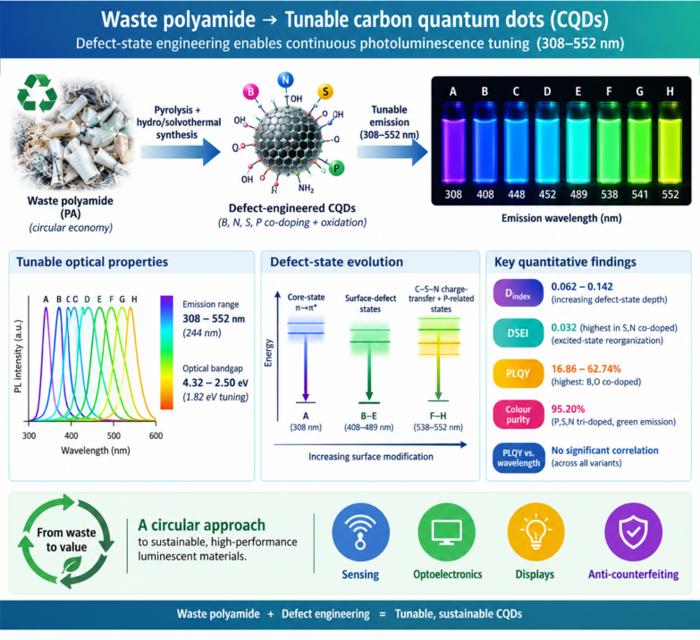
Waste polyamide-derived CQDs show continuous photoluminescence tuning from 308 to 552 nm through sequential defect-state engineering, with optical transition energies decreasing from 4.32 to 2.50 eV. @Christian Ebere Enyoh from Saitama University Carbon quantum dots (CQDs) are fluorescent carbon nanomaterials with potential applications in sensing, optoelectronics, displays, anti-counterfeiting, and environmental technologies. Their optical properties can be adjusted by modifying the carbon...
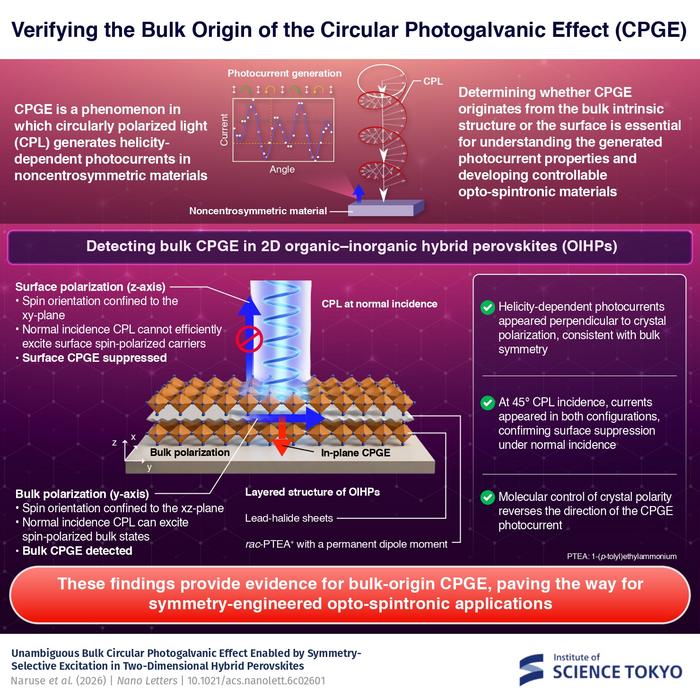
The researchers used circularly polarized light at normal incidence and found that helicity-dependent photocurrents appeared perpendicular to the crystal’s polarization but vanished when measured parallel to it, supporting a bulk origin of CPGE. @Institute of Science Tokyo The circular photogalvanic effect (CPGE), a phenomenon that generates helicity-dependent photocurrents in noncentrosymmetric materials, can originate purely from a crystal's internal structure without contribution from the...
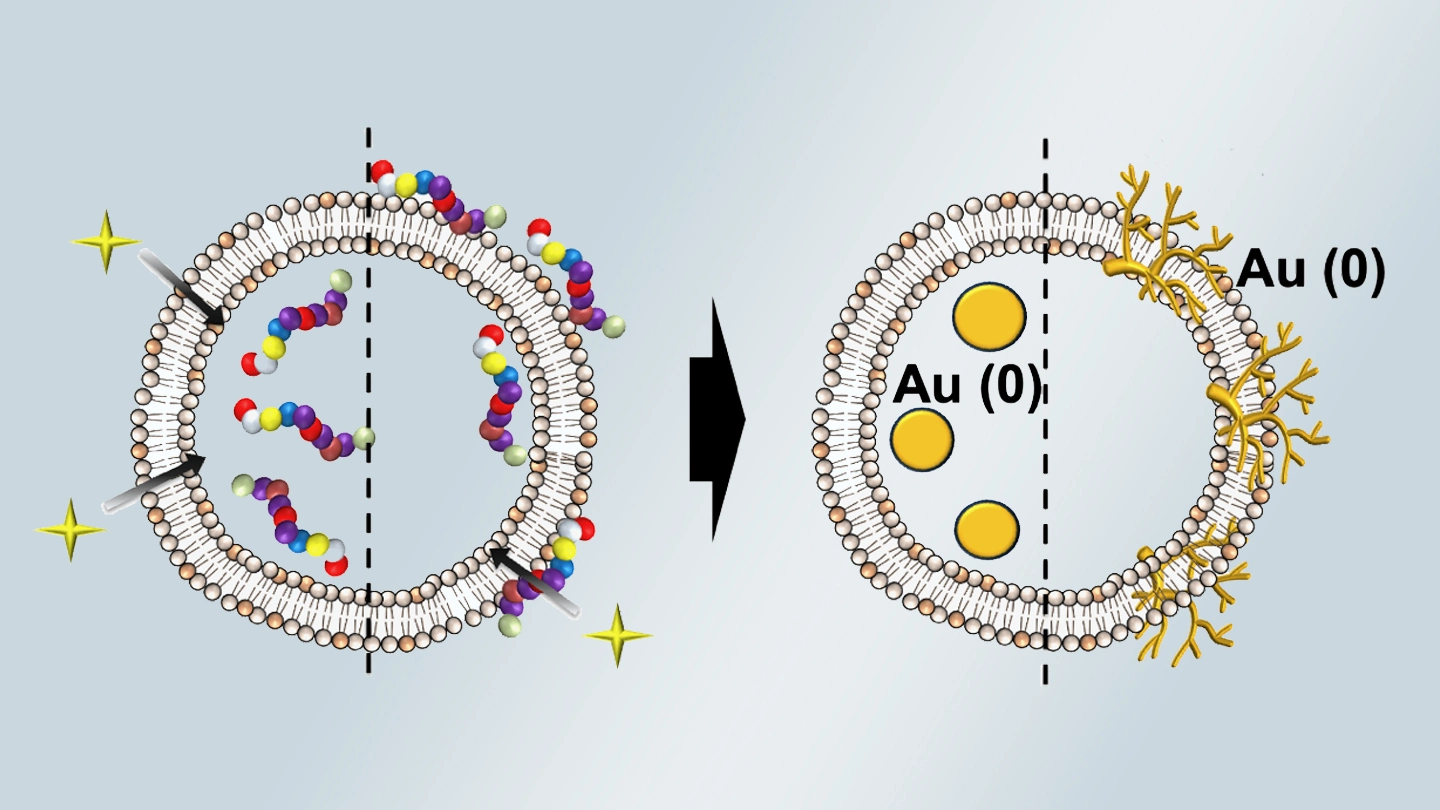
Summary of gold nanoparticle growth programming in liposome based on localization of biomineralization peptide The position of biomineralization peptides within liposomes can influence how gold nanoparticles grow, reports a research team from Institute of Science Tokyo. Peptides localized at the membrane interface promote branched structures, while those confined to the liposome interior favor spherical nanoparticles. The findings offer a new strategy for controlling nanoscale reaction...
