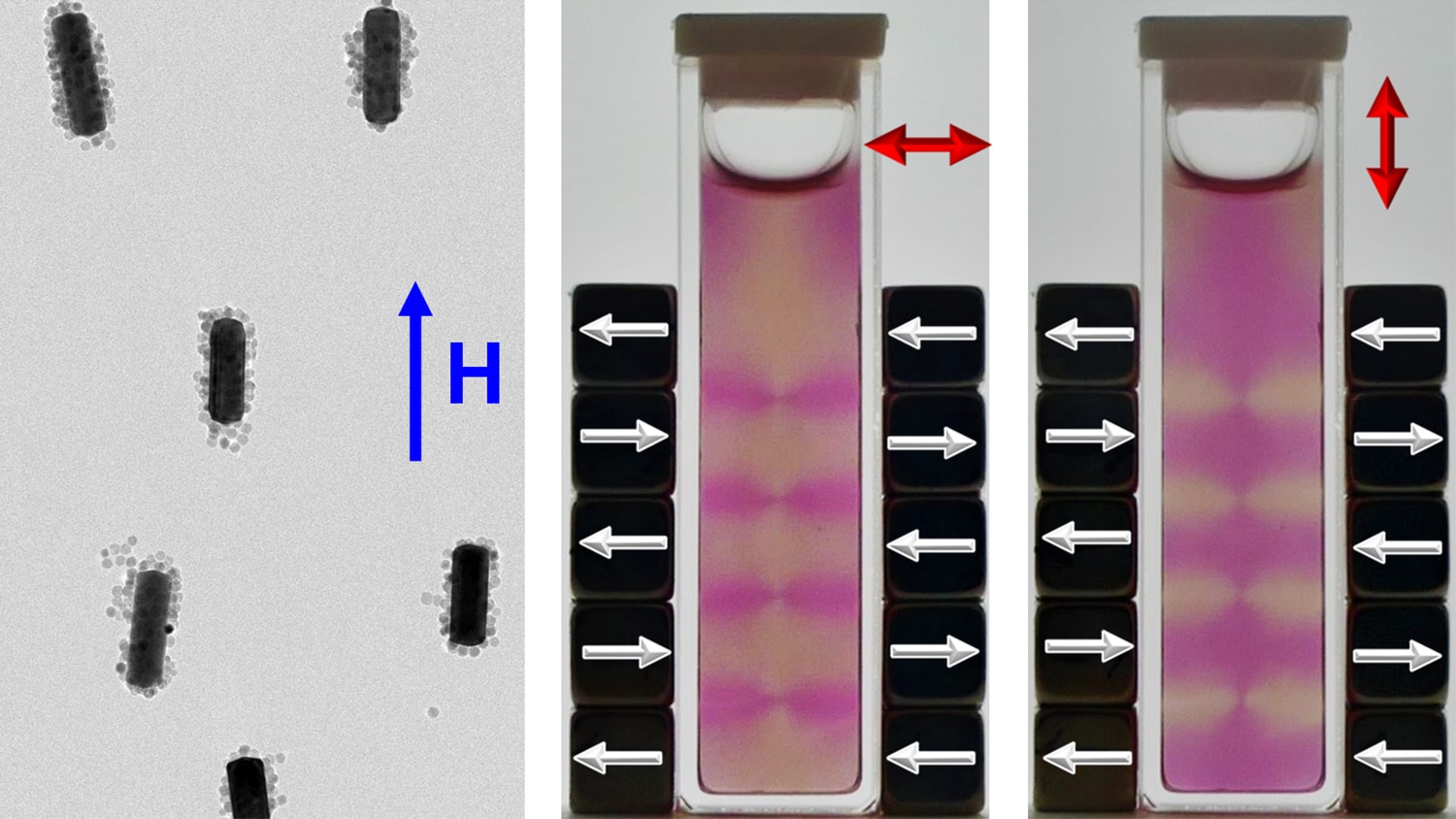
An international team of researchers has demonstrated a technique that allows them to align gold nanorods using magnetic fields, while preserving the underlying optical properties of the gold nanorods.
“Gold nanorods are of interest because they can absorb and scatter specific wavelengths of light, making them attractive for use in applications such as biomedical imaging, sensors, and other technologies,” says Joe Tracy, corresponding author of a paper on the work and a professor of materials science and engineering at North Carolina State University.
It is possible to tune the wavelengths of light absorbed and scattered by engineering the dimensions of the gold nanorods. Magnetically controlling their orientation makes it possible to further control and modulate which wavelengths the nanorods respond to.
“In other words, if you can control the alignment of gold nanorods, you have greater control over their optical properties,” Tracy says. “And using magnetic fields to control that alignment means that you can control the alignment without actually touching the nanorods.”
In their technique, the researchers synthesize separate solutions of gold nanorods and iron oxide nanoparticles. Mixing the solutions drives assembly of the iron oxide nanoparticles onto the surface of the gold nanorods. The resulting “coated” nanorods can then be controlled using a low-strength magnetic field.
“We’ve characterized both what is happening during this process and how well it works,” Tracy says. “We’ve demonstrated that we can bring the nanorods into alignment and that the process does not adversely affect the optical properties of the gold nanorods.”
“In addition, to the best of our knowledge, these nanorods have the smallest aspect ratio of any elongated nanoparticle that has been ‘decorated’ with iron oxide nanoparticles and aligned using magnetic fields,” says Mehedi Rizvi, first author of the paper and a Ph.D. student at NC State.
“In order for this technique to work, we’ve had to optimize many aspects of the system, including the dimensions of the gold nanorods, the size of the iron oxide nanoparticles, and the relative concentrations of both nanorods and nanoparticles in solution,” Rizvi says.
“We are currently in the process of exploring potential applications in imaging based on the multifunctional properties of magnetic-overcoated gold nanorods,” Tracy says.
Reference
Magnetic Alignment for Plasmonic Control of Gold Nanorods Coated with Iron Oxide Nanoparticles
Mehedi H. Rizvi, Ruosong Wang, Jonas Schubert, William D. Crumpler, Christian Rossner, Amy L. Oldenburg, Andreas Fery, Joseph B. Tracy
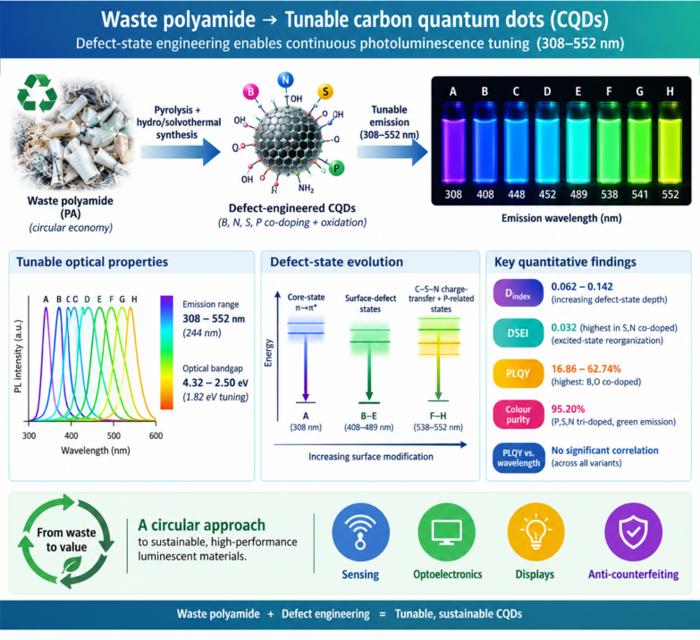
Waste polyamide-derived CQDs show continuous photoluminescence tuning from 308 to 552 nm through sequential defect-state engineering, with optical transition energies decreasing from 4.32 to 2.50 eV. @Christian Ebere Enyoh from Saitama University Carbon quantum dots (CQDs) are fluorescent carbon nanomaterials with potential applications in sensing, optoelectronics, displays, anti-counterfeiting, and environmental technologies. Their optical properties can be adjusted by modifying the carbon...
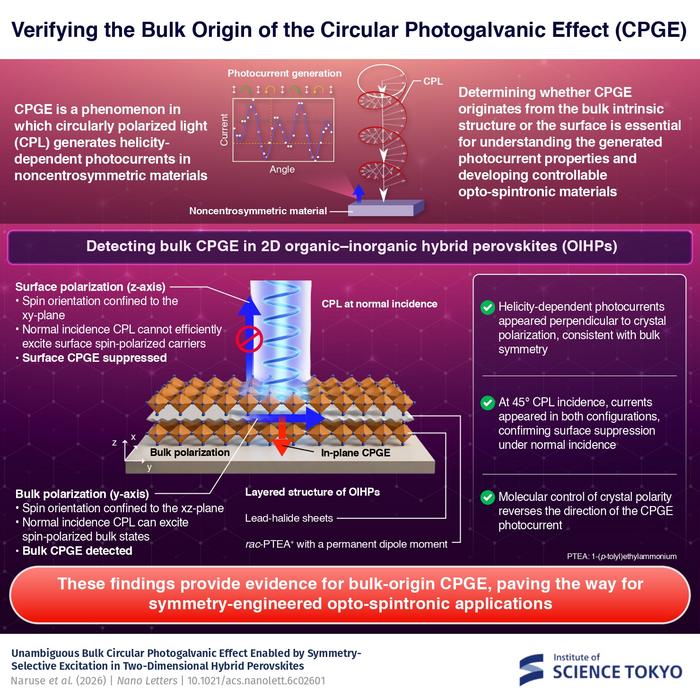
The researchers used circularly polarized light at normal incidence and found that helicity-dependent photocurrents appeared perpendicular to the crystal’s polarization but vanished when measured parallel to it, supporting a bulk origin of CPGE. @Institute of Science Tokyo The circular photogalvanic effect (CPGE), a phenomenon that generates helicity-dependent photocurrents in noncentrosymmetric materials, can originate purely from a crystal's internal structure without contribution from the...
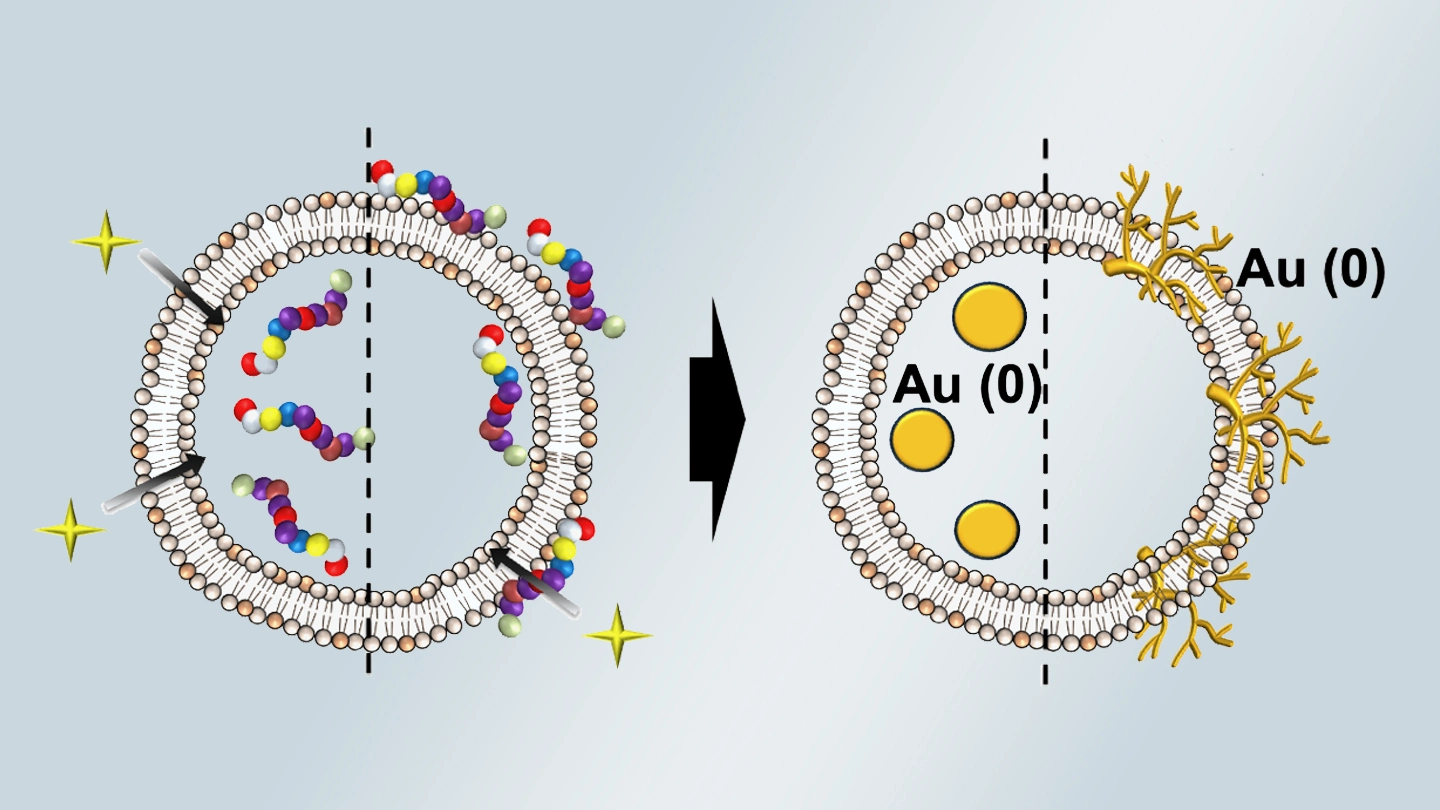
Summary of gold nanoparticle growth programming in liposome based on localization of biomineralization peptide The position of biomineralization peptides within liposomes can influence how gold nanoparticles grow, reports a research team from Institute of Science Tokyo. Peptides localized at the membrane interface promote branched structures, while those confined to the liposome interior favor spherical nanoparticles. The findings offer a new strategy for controlling nanoscale reaction...
