top of page

NEWSROOM


Ultra-thin lenses that make infrared light visible
Using a new technique, the ETH researchers succeeded in creating the first lithium niobate metalenses with precisely engineered nanostructures. While functioning as normal light focusing lenses, these devices can simultaneously change the wavelength of laser light. When infrared light with a wavelength of 800 nanometres is sent through the metalens, visible radiation with a wavelength of 400 nanometres emerges on the other side and is directed at a designated point.
Jun 3, 20254 min read


Scientists observe how blobs form crystals and discover a new crystal type
Crystals are solid materials made up of particles that arrange themselves in repeating patterns. This process of self-assembly—“orchestrating order from chaos,” as the researchers describe it—was once thought to follow a predictable, classic pattern of growth. But instead of always forming building block by building block, scientists are learning that crystals can grow through more complex pathways.
Apr 29, 20253 min read


Ultrafast plasmon-enhanced magnetic bit switching at the nanoscale
Researchers from Max Born Institute have demonstrated a successful way to control and manipulate nanoscale magnetic bits — the building blocks of digital data — using an ultrafast laser pulse and plasmonic gold nanostructures. The findings were published in Nano Letters.
Apr 24, 20253 min read


An elegant method for the detection of single spins using photovoltage
Diamonds with certain optically active defects can be used as highly sensitive sensors or qubits for quantum computers, where the quantum information is stored in the electron spin state of these colour centres. However, the spin states have to be read out optically, which is often experimentally complex. Now, a team at HZB has developed an elegant method using a photo voltage to detect the individual and local spin states of these defects. This could lead to a much more comp
Apr 23, 20252 min read


Twisted crystals open door to smaller, more powerful optical devices
In twisted moiré photonic crystals, how the layers twist and overlap can change how the material interact with light. By changing the twist angle and the spacing between layers, these materials can be fine-tuned to control and manipulate different aspects of light simultaneously — meaning the multiple optical components typically needed to simultaneous measure light’s phase, polarization, and wavelength could be replaced with one device.
Apr 10, 20253 min read
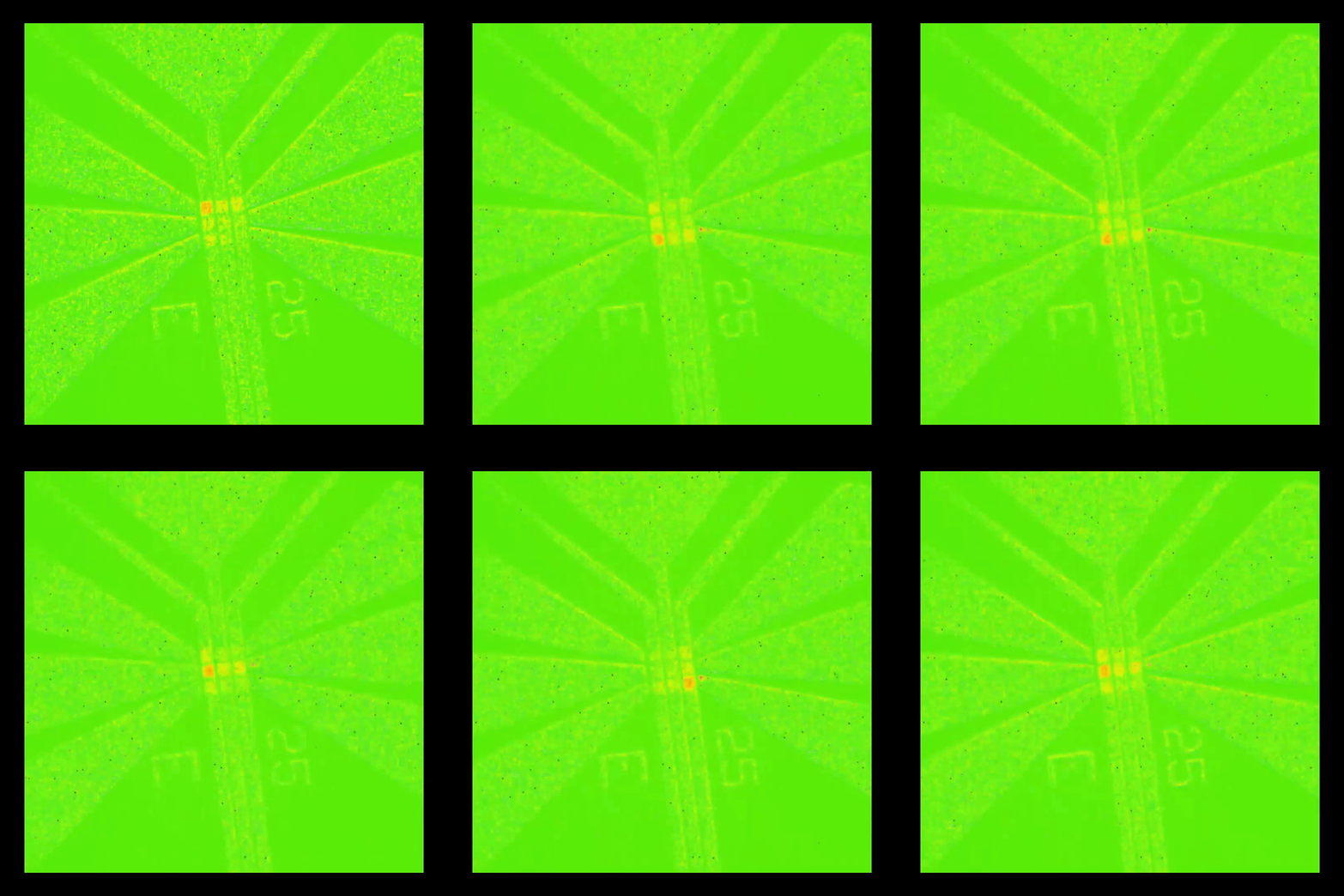
Programmable pixels could advance infrared light applications
A new active metasurface, the electrical-programmable graphene field effect transistor (Gr-FET), from the labs of Sheng Shen and Xu Zhang...
Apr 3, 20252 min read
bottom of page