Researchers at the Center for Multidimensional Carbon Materials (CMCM), within the Institute for Basic Science (IBS) have demonstrated graphene coating protects glass from corrosion.
Their research, published in ACS Nano, can contribute to solving problems related to glass corrosion in several industries. Glass has a high degree of both corrosion and chemical resistance. For this reason it is the primary packaging material to preserve medicines and chemicals. However, over time at high humidity and pH, some glass types corrode. Corroded glass loses its transparency and its strength is reduced. As a result, the corrosion of silicate glass, the most common and oldest form of glass, by water is a serious problem especially for the pharmaceutical, environmental and optical industries, and in particular in hot and humid climates.
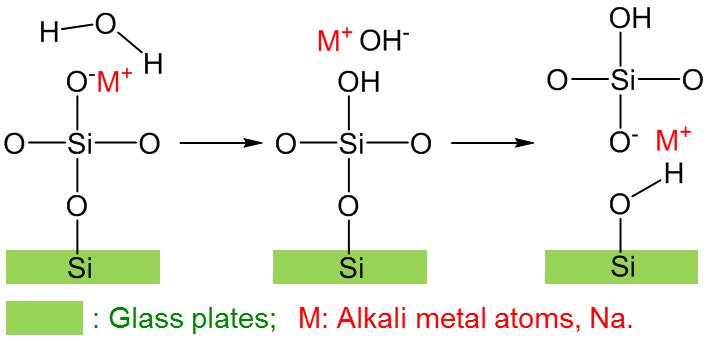
Although there are different types of glass, ordinary glazing and containers are made of silicon dioxide (SiO2), sodium oxide (Na2O) along with minor additives. Glass corrosion begins with the adsorption of water on the glass surface. Hydrogen ions from water then diffuse into the glass and exchange with the sodium ions present on the glass surface. The pH of the water near the glass surface increases, allowing the silicate structure to dissolve.
Scientists have been looking at how to coat glass to protect it from damage. An ideal protective coating should be thin, transparent, and provide a good diffusion barrier to chemical attack. Graphene with its chemical inertness, thinness, and high transparency makes it very promising as a coating material. Moreover, owing to its excellent chemical barrier properties it blocks helium atoms from penetrating through it. The use of graphene coating is being explored as a protective layer for other materials requiring resistance to corrosion, oxidation, friction, bacterial infection, electromagnetic radiation, etc.
IBS scientists grew graphene on copper using a technique previously invented by Prof. Rodney S. Ruoff and collaborators, and transferred either one or two atom-thick layers of graphene onto both sides of rectangular pieces of glass. The effectiveness of the graphene coating was evaluated by water immersion testing and observing the differences between uncoated and coated glass. After 120 days of immersion in water at 60°C, uncoated glass samples had significantly increased in surface roughness and defects, and reduced in fracture strength. In contrast, both the single and double layer graphene-coated glasses had essentially no change in both fracture strength and surface roughness.
"The purpose of the study was to determine whether graphene grown by chemical vapor deposition on copper foils, a now established method, could be transferred onto glass, and protect the glass from corrosion. Our study shows that even one atom-thick layer of graphene does the trick," explains Prof. Ruoff, director of the CMCM and Professor at the Ulsan National Institute of Science and Technology (UNIST). "In the future, when it is possible to produce larger and yet higher-quality graphene sheets and to optimize the transfer on glass, it seems reasonably likely that graphene coating on glass will be used on an industrial scale."
Graphene Coatings as Barrier Layers to Prevent the Water-Induced Corrosion of Silicate Glass
Institute for Basic Science (IBS)
#Graphene
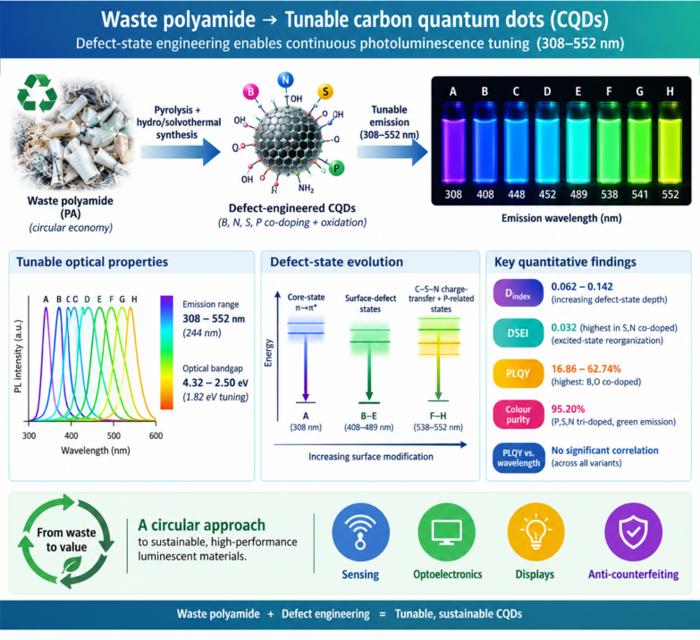
Waste polyamide-derived CQDs show continuous photoluminescence tuning from 308 to 552 nm through sequential defect-state engineering, with optical transition energies decreasing from 4.32 to 2.50 eV. @Christian Ebere Enyoh from Saitama University Carbon quantum dots (CQDs) are fluorescent carbon nanomaterials with potential applications in sensing, optoelectronics, displays, anti-counterfeiting, and environmental technologies. Their optical properties can be adjusted by modifying the carbon...
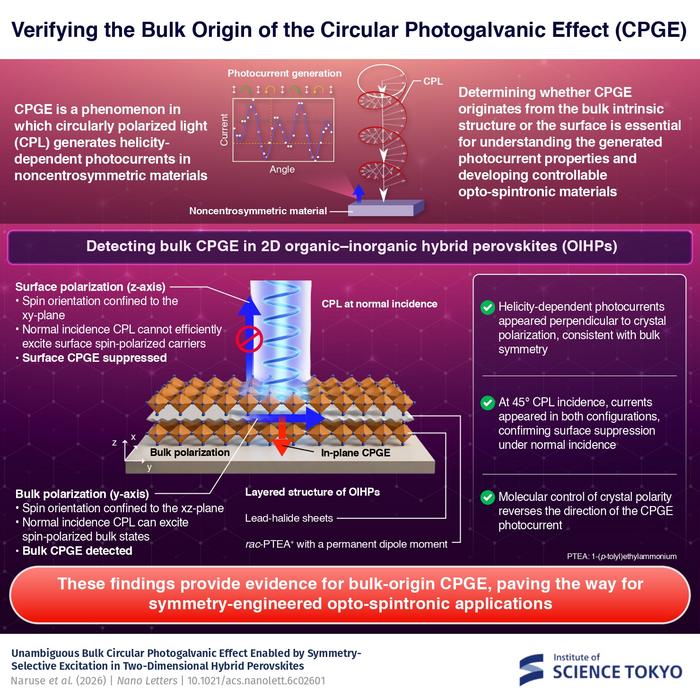
The researchers used circularly polarized light at normal incidence and found that helicity-dependent photocurrents appeared perpendicular to the crystal’s polarization but vanished when measured parallel to it, supporting a bulk origin of CPGE. @Institute of Science Tokyo The circular photogalvanic effect (CPGE), a phenomenon that generates helicity-dependent photocurrents in noncentrosymmetric materials, can originate purely from a crystal's internal structure without contribution from the...
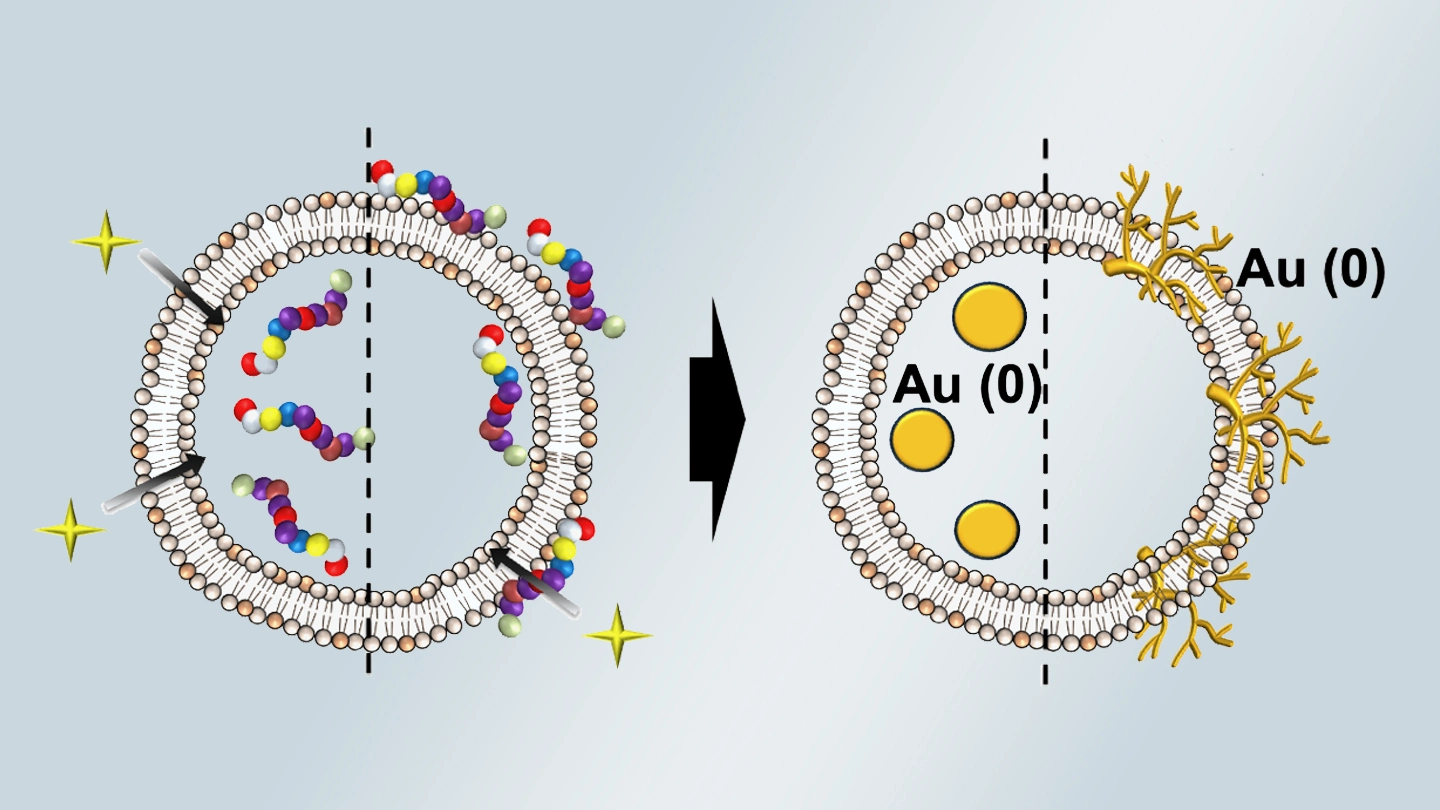
Summary of gold nanoparticle growth programming in liposome based on localization of biomineralization peptide The position of biomineralization peptides within liposomes can influence how gold nanoparticles grow, reports a research team from Institute of Science Tokyo. Peptides localized at the membrane interface promote branched structures, while those confined to the liposome interior favor spherical nanoparticles. The findings offer a new strategy for controlling nanoscale reaction...
