Polarization, the direction in which light vibrates, is invisible to the human eye. Yet, so much of our optical world relies on the control and manipulation of this hidden quality of light.
Materials that can manipulate the polarization of light -- known as birefringent materials -- are used in everything from digital alarm clocks to medical diagnostics, communications and astronomy.
Just as light's polarization can vibrate along a straight line or an ellipse, materials can also be linearly or elliptically birefringent. Today, most birefringent materials are intrinsically linear, meaning they can only manipulate the polarization of light in a limited way. If you want to achieve broad polarization manipulation, you need to stack multiple birefringent materials on top of one another, making these devices bulky and inefficient.
Now, researchers from the Harvard John A. Paulson School of Engineering and Applied Sciences have designed a metasurface that can be continuously tuned from linear to elliptical birefringence, opening up the entire space of polarization control with just one device. This single metasurface can operate as many birefringent materials in parallel, enabling more compact polarization manipulation, which could have far-reaching applications in polarization imaging, quantum optics, and other areas.
The research is published in Science Advances.
"It is a new type of birefringent material," said Zhujun Shi, a former graduate student at SEAS and first author of the paper. "We are able to tailor broad polarization behavior of a material beyond what naturally exists, which has a lot of practical benefits. What used to require three separate conventional birefringent components now only takes one".
"The ability to manipulate a fundamental property of light like polarization in completely new ways with a device that is compact and multifunctional will have important applications for quantum optics and optical communications," said Federico Capasso, Robert L. Wallace Professor of Applied Physics and Vinton Hayes Senior Research Fellow in Electrical Engineering at SEAS and senior author of the paper.
Metasurfaces are arrays of nanopillars spaced less than a wavelength apart that can perform a range of tasks, including manipulating the phase, amplitude and polarization of light. In the past, Capasso and his team have designed these highly ordered surfaces from the ground up, using simple geometric shapes with only a few design parameters.
In this research, however, the team turned to a new type of design technique known as topological optimization.
"Topological optimization is an inverse approach," said Shi. "You start with what you want the metasurface to do and then you allow the algorithm to explore the huge parameter space to develop a pattern that can best deliver that function."
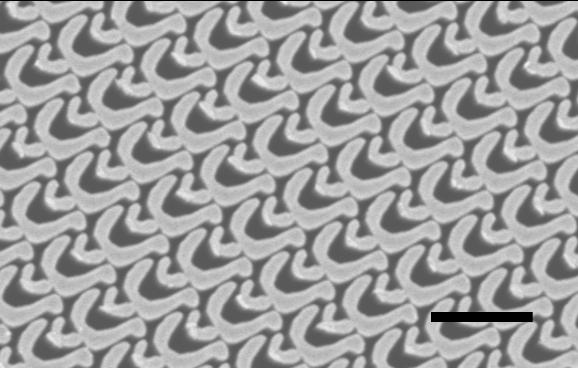
The result was surprising. Instead of neatly ordered rectangular pillars standing like toy soldiers, this metasurface is composed of nested half circles reminiscent of crooked smiley faces -- more like something a toddler would draw than a computer.
But these odd shapes have opened up a whole new world of birefringence. Not only can they achieve broad polarization manipulations like transforming linear polarization into any desired elliptical polarization but the polarization can also be tuned by changing the angle of the incoming light.
"Our approach has a wide range of potential applications across industry and scientific research, including polarization aberration correction in advanced optical systems," said Capasso.
Continuous angle-tunable birefringence with freeform metasurfaces for arbitrary polarization conversion
Zhujun Shi, Alexander Y. Zhu, Zhaoyi Li, Yao-Wei Huang, Wei Ting Chen, Cheng-Wei Qiu and Federico Capasso
Science Advances 03 Jun 2020: Vol. 6, no. 23, eaba3367
Contact information
Robert L. Wallace Professor of Applied Physics and Vinton Hayes Senior Research Fellow in Electrical Engineering
capasso@seas.harvard.edu
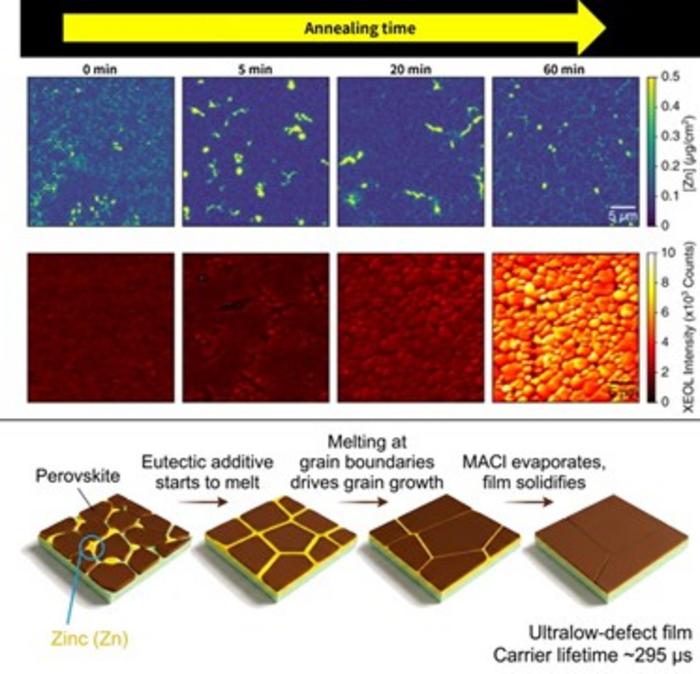
A eutectic mixture of methylammonium chloride and a zinc halide melts at about 100 degrees Celsius, forming a transient liquid layer at perovskite grain boundaries that lets crystals merge into larger, cleaner grains. The resulting films reached a carrier lifetime of roughly 295 microseconds and a surface recombination velocity of 0.3 cm/s, the lowest reported for lead halide perovskites.
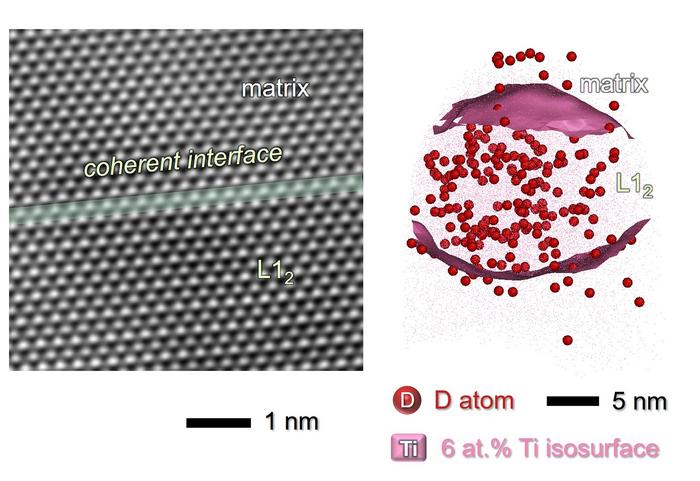
Researchers at the University of Sydney have directly observed hydrogen dissolved in the interstitial spaces between metal atoms in alloys, a world first. Using cryogenic atom probe tomography with deuterium tracers, electron microscopy and theoretical calculations, the team showed hydrogen occupies sites between atoms rather than only collecting at defects, and that local atomic arrangement and chemistry dictate where it prefers to reside.
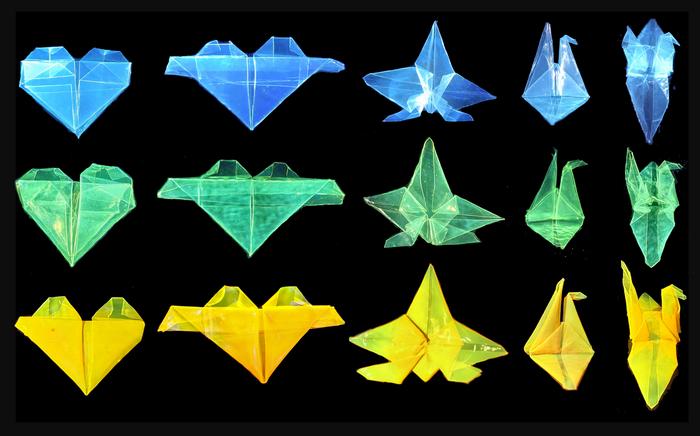
Researchers have developed carbon dots whose fluorescence shifts across the visible spectrum, from blue to red, depending on concentration, liquid environment and acidity. By tuning the particles' surfaces, the team produced versions that change color reversibly as pH shifts, then incorporated them into polymer powders, molded shapes and flexible films.
This week in nanotech
$10.2M raised
2 funding rounds · 18 deals tracked
New products
 Ti-WCMBN Nanomaterialia Featured
 Nion-compatible In Situ STEM Holders for Electrical BiasingHummingbird Scientific Featured
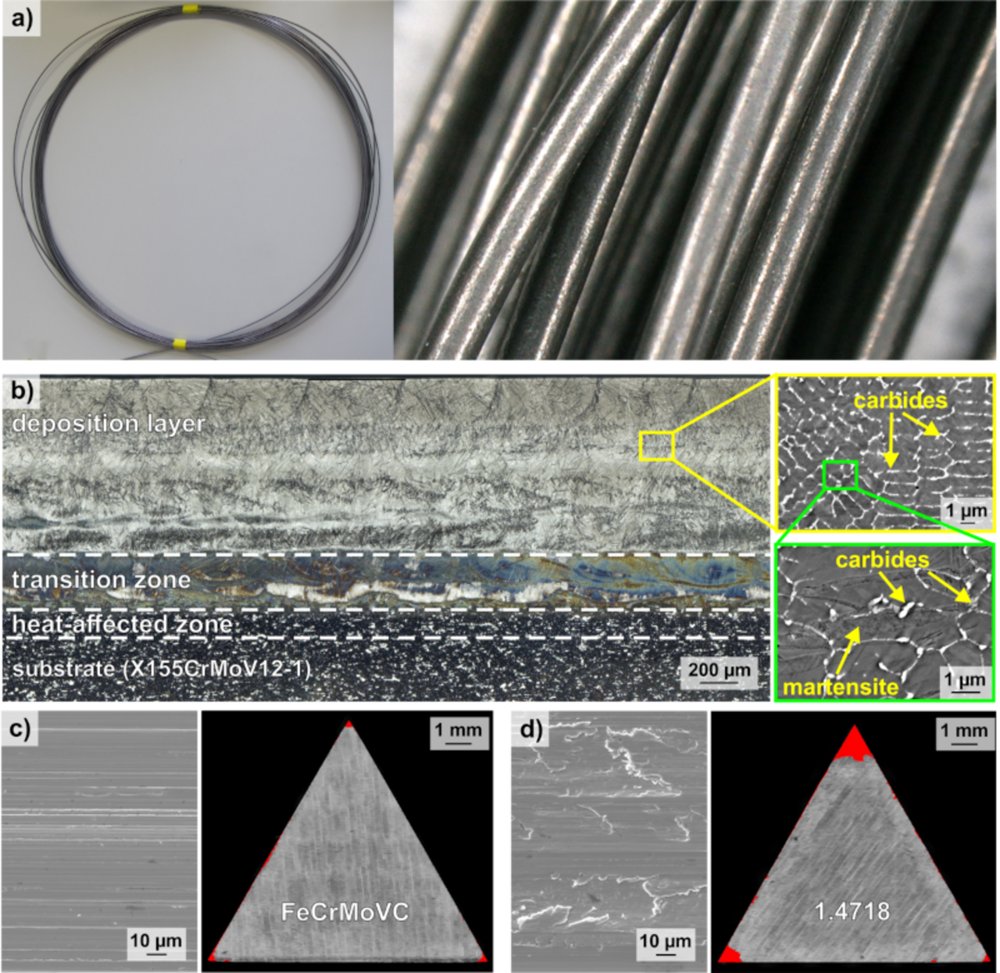 Fe85Cr4Mo8V2C1 wire filler materialLeibniz Institute for Solid State and Materials Research Dresden - IFW Dresden
Market insights
Last 30 days: Quantum Technologies was the busiest vertical: 52 of 174 events (30%).
Money raised per month
Behind the deal
Who led Sandia National Laboratories’s $3.4M Grant?
See the investors with Insights Pro →