Vanderbilt University
If you think learning traditional paper origami is a difficult practice, try wrapping your head around origami on the atomic scale.
In “Atomically-Precise, Custom-Design Origami Graphene Nanostructures,” published today in the journal Science, an international team of researchers have accomplished just that, using sophisticated and precise control of atoms to experiment with new structures and set the stage for future generations of breakthroughs in quantum technology.
“Under atomic-scale control of these graphene-based nanostructures, researchers are able to build fascinating new structures,” noted Vanderbilt University Distinguished Professor of Physics and Engineering Sokrates T. Pantelides who collaborated on the research. “In the future, these fundamental discoveries are likely to serve as groundwork for new devices our current generation can’t even begin to imagine.”
While the ancient art form of origami is currently used in large-scale applications, such as in architecture or battery design, researchers have long sought to apply origami techniques to small atomic structures, including graphene – a two-dimensional semimetal and “supermaterial” capturing the attention of researchers around the world for its properties of tensile strength, flexibility and impermeability – to name a few. However, technological limitations prevented researchers from using origami’s fine control to build and manipulate custom graphene structures.
A collaboration between Pantelides, University of Maryland Professor Min Ouyang, and a team of researchers at the Institute of Physics of the Chinese Academy of Sciences in Beijing headed by Professor Hong-Jun Gao, the findings build on many years of investigations of carbon-based nanostructures, including the discovery of carbon nanotubes and the successful isolation of monolayer graphene, which was awarded the 2010 Nobel Prize in Physics.
The experiments, conducted by Professor Hong-Jun Gao’s group in Beijing, use scanning tunneling microscope manipulation at low temperatures. These studies are the first to successfully and exactly fold and unfold graphene nano-islands in a variety of randomly chosen directions – each of which yields a complex nanostructure with distinct properties.
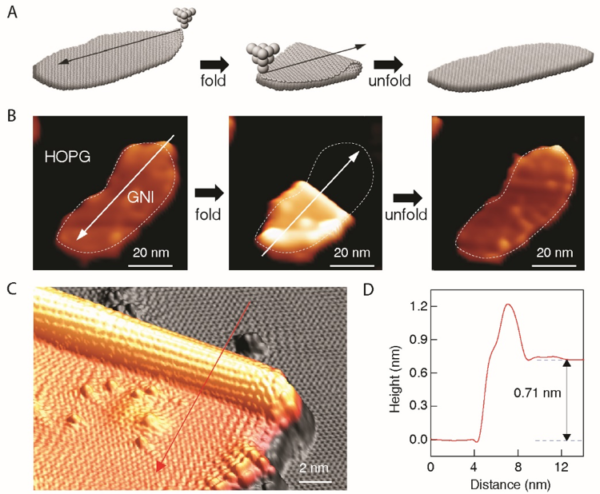
The image below illustrates the construction (and deconstruction) of a well-defined, folded graphene-based nanostructure through the use of origami.
As seen in the image, folding these small graphene fragments results in interesting structures, comprising a tubular edge, similar to the previously discovered carbon nanotubes, attached to a bilayer stack of graphene at a twisted angle.
Some graphene nano-islands can be used to form so-called intramolecular junctions, which are key components for electronic devices. The researchers measured the electrical properties of the origami structures and used theoretical quantum calculations to clarify their atomic-scale structure and electronic properties, setting the stage for the construction of custom nanostructures with engineered quantum properties, ultimately novel devices and even quantum machines.
The work was financially supported by the National Natural Science Foundation of China, National Key Research and Development Projects of China, and the Chinese Academy of Sciences. Work at Vanderbilt University was supported by the U.S. Department of Energy. Work at the University of Maryland was supported by the U.S. Office of Naval Research and the National Science Foundation.
Atomically precise, custom-design origami graphene nanostructures
Hui Chen, Xian-Li Zhang, Yu-Yang Zhang, Dongfei Wang, De-Liang Bao, Yande Que, Wende Xiao, Shixuan Du, Min Ouyang, Sokrates T. Pantelides, Hong-Jun Gao
Science 06 Sep 2019: Vol. 365, Issue 6457, pp. 1036-1040

Researchers at the University of Basel have identified and coherently controlled so called forbidden vibrational transitions in individual trapped nitrogen molecular ions without destroying them. Using quantum logic spectroscopy, a single calcium ion served as messenger, letting the team probe the molecule repeatedly and determine its fundamental vibrational frequency ten times more precisely than before.
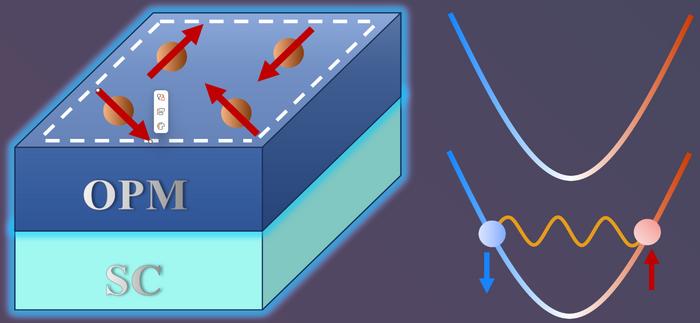
Odd-parity magnets host an intrinsic hidden Zeeman field that lifts Kramers degeneracy without any applied field, researchers report. Using an f-wave magnet model on a triangular lattice, the team shows how non-relativistic spin splitting and this hidden field combine to stabilize s-wave superconductivity far beyond the Pauli limit.
Rhombohedral hexalayer graphene, in which six carbon sheets are stacked with a slight lateral offset like staircase steps, hosts both superconductivity and electrically controllable orbital magnetism, researchers report in Nature Physics. The arrangement yields a rich collection of quantum states in a simple carbon-based material, positioning rhombohedral multilayer graphene as a platform for probing the fundamental mechanisms of superconductivity and magnetism and potentially for new ways of…
This week in nanotech
9 deals tracked
New products
 DLS-1 Mass Spectrometer for Fusion Gas AnalysisHiden Analytical Featured
 Orion Sputtering Deposition SystemsAJA International Featured
 Aether®Lam Research
Market insights
Last 30 days: Semiconductors & Electronics was the busiest vertical: 39 of 130 events (30%).
Money raised per month
Behind the deal
Who led Sandia National Laboratories’s $3.4M Grant?
See the investors with Insights Pro →