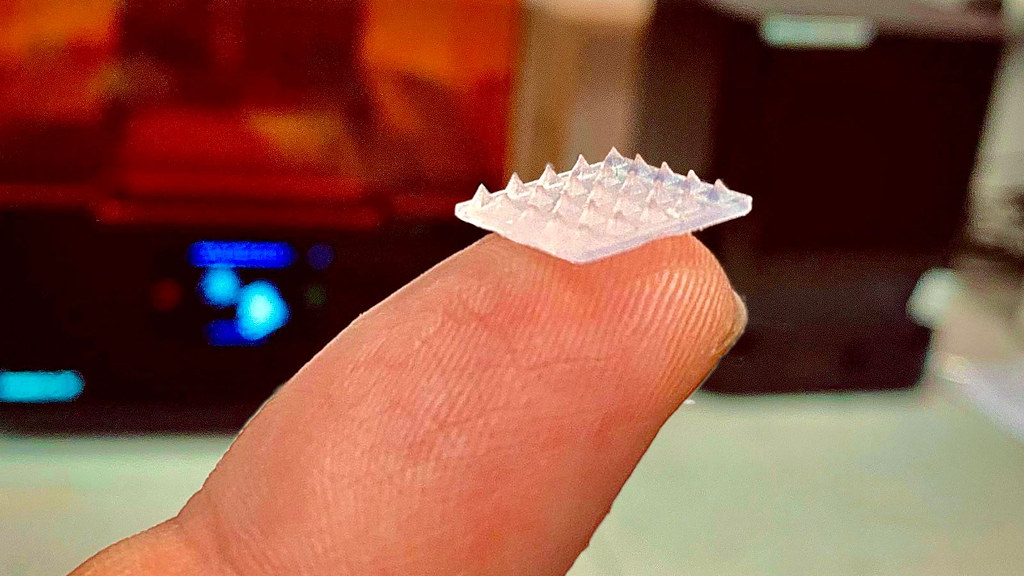
An affordable microneedle skin patch that delivers a controlled dosage of medicine directly into the body, eliminating the need for injections or oral medication, has been developed by a team led by scientists at the University of Bath.
It is hoped that the patches, which are described in the journal Biomaterials Advances, will be ready for use within the next five to 10 years.
What makes the microneedle patches unique is that they are made from a hydrogel (a gel-like substance in which water forms the liquid component), with the active ingredient encapsulated inside the hydrogel microneedle structure rather than in a separate reservoir.
They are also more affordable than other commercially available microneedle patches, as they are produced from 3D printed moulds. Moulds produced this way are easy to customise, which keeps the costs down.
Painless delivery
The patch is smaller than a pound coin. Barely visible microneedles painlessly pierce the first few layers of skin. Contact with fluid beneath the skin barrier causes the ‘hydrophilic’ (water-loving) needles to swell, prompting a specific dosage of the drug to be delivered into the body.
In experiments carried out at Bath, upon swelling, the patches delivered doses of antibiotics that elicited a strong response against two bacteria known to cause serious infections – Escherichia coli (E. coli) and Staphylococcus aureus.
The patch also works in reverse, extracting small quantities of fluid from beneath the skin for medical analysis. This may be helpful, for instance, for monitoring the levels of lactate (a component of lactic acid) and other chemicals in patients with an infection.
Clear benefits
Bath Chemical Engineer Dr Hannah Leese – who continues to refine the skin patch design along with fellow engineers PhD student Joseph Turner and Professor Pedro Estrela, and biologist Dr Maisem Laabei – says microneedle-based skin patches are an ideal system for delivering drugs and have clear benefits over traditional delivery approaches.
Dr Hannah Leese explains how the microneedle patches work. @ University of Bath
She said: “Injections are invasive and expensive, and they don’t suit everyone. A lot of people are needle-phobic and are understandably reluctant to receive medicine by injection even when treatment is really needed. Others are ill-suited to injections – for instance, elderly patients with thin skin.
“Also, sometimes the use of needles can introduce pathogens, such as bacteria, that may cause infections, especially in people with low immunity.”
She added that people generally have fewer objections to taking drugs by mouth, but there are downsides to oral medication too.
She said: “You can experience gastrointestinal side-effects; there is a delay between taking the medication and the drug getting to where it’s needed in the body; doses need to be higher because a lot of the formulation is broken down in the gut, and if the patient is taking antibiotics, this can also contribute to antimicrobial drug-resistance.'
Towards clinical trials
“Our next step is to continue to refine the microneedle platform and run animal studies before moving to human clinical trials,” said Dr Leese, adding: “I'm hopeful these patches will be ready for patient use within the next five to 10 years."
Dr Leese anticipates that the patches will be able to deliver both drugs that circulate the entire body and drugs that need to remain more localised – for instance, when there is an infection in a discrete section of skin. There is also scope for the patches to deliver vaccines and to monitor hormone levels.
“We can also see there being a role for these patches in the health and wellness fields,” she said. “I can picture the day people have microneedles under their smartwatches to detect fluctuations in the stress hormone, cortisol.”
Reference
Antimicrobial releasing hydrogel forming microneedles
Joseph G Turner, Maisem Laabei, Shuxian Li, Pedro Estrela, Hannah S Leese
ONI recorded 177 scientific publications using its technology in 2026 to date, surpassing its previous annual high. Publications rose 72% in 2025, from 82 to 141.
Nicoya Lifesciences reported that BALANCE project partners demonstrated autonomous bioreactor control and integrated its Alto Digital SPR platform for automated antibody titer measurement from crude bioreactor samples.
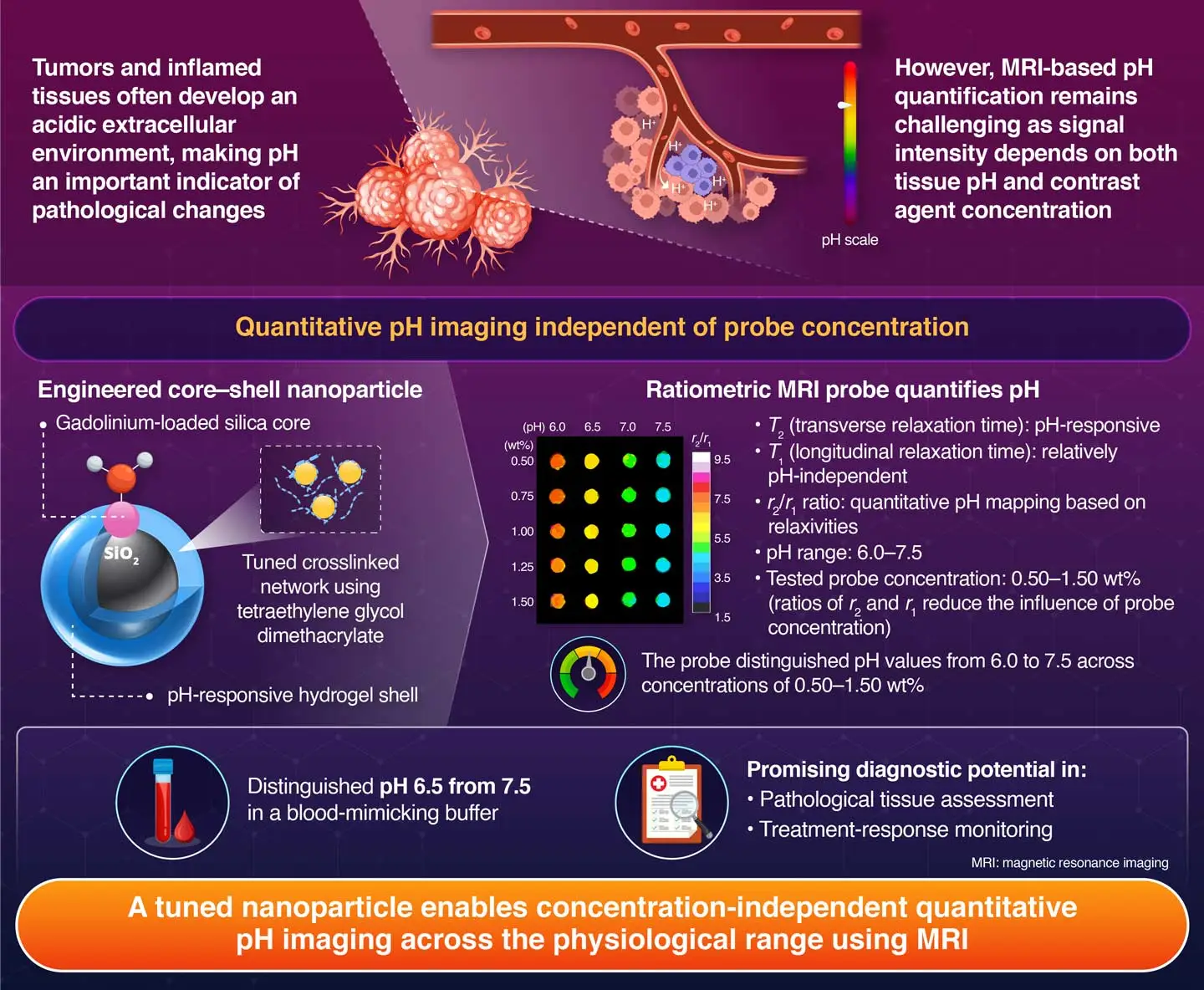
Researchers have built a core-shell nanoparticle MRI contrast agent that reports tissue pH independently of probe concentration. A gadolinium-loaded silica core sits inside a crosslinked polymer hydrogel shell tuned with tetraethylene glycol dimethacrylate; as acidity rises the shell shrinks, shifting transverse relaxivity while longitudinal relaxivity holds steady. Ratiometric imaging of the r2/r1 ratio resolved pH 6.0 to 7.5 across agent concentrations and in serum.
This week in nanotech
25 deals tracked
New products
 Ti-WCMBN Nanomaterialia Featured
 Nion-compatible In Situ STEM Holders for Electrical BiasingHummingbird Scientific Featured
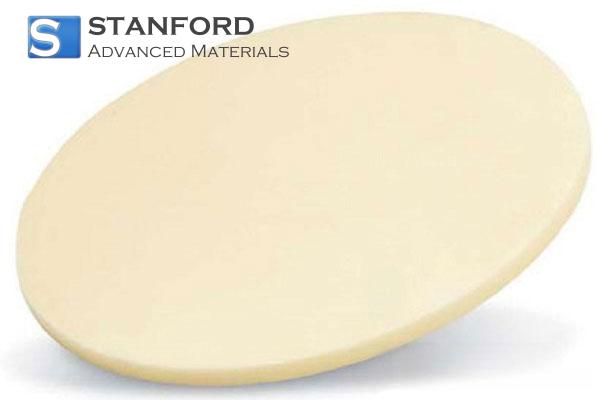 Indium Tin Oxide (ITO) Sputtering Target(ST0334)Stanford Advanced Materials (SAM)
Market insights
Last 30 days: Semiconductors & Electronics was the busiest vertical: 55 of 176 events (31%).
Money raised per month