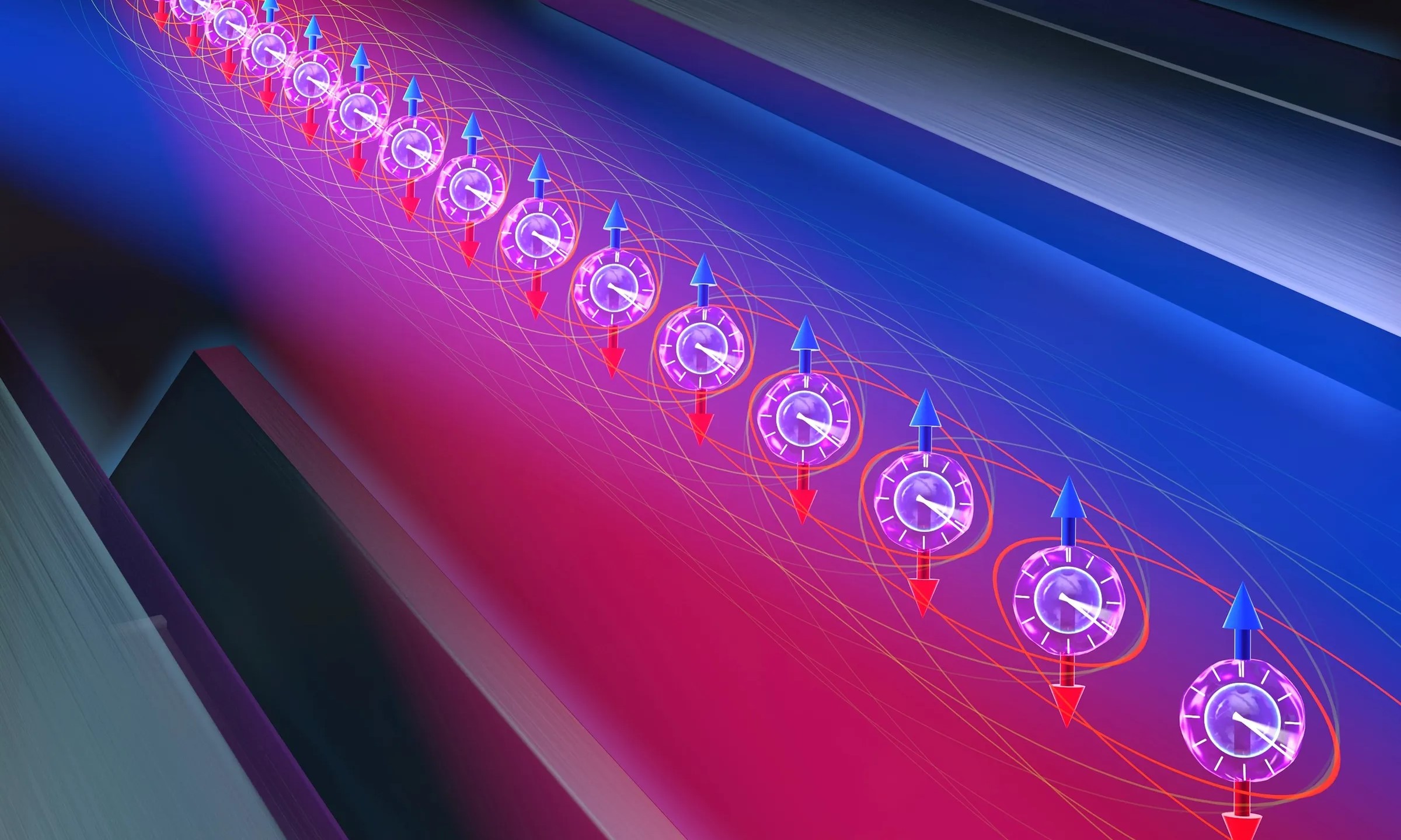
Quantum physics has allowed for the creation of sensors far surpassing the precision of classical devices. Now, several studies in Nature show that the precision of these quantum sensors can be significantly improved using entanglement produced by finite-range interactions. Innsbruck researchers led by Christian Roos were able to demonstrate this enhancement using entangled ion-chains with up to 51 particles.
Metrological institutions around the world administer our time, using atomic clocks based on the natural oscillations of atoms. These clocks, pivotal for applications like satellite navigation or data transfer, have recently been improved by using ever higher oscillation frequencies in optical atomic clocks. Now, scientists at the University of Innsbruck and the Institute of Quantum Optics and Quantum Information (IQOQI) of the Austrian Academy of Sciences led by Christian Roos show how a particular way of creating entanglement can be used to further improve the accuracy of measurements integral to an optical atomic clock’s function.
Measurement error halved in experiment
Observations of quantum systems are always subject to a certain statistical uncertainty. “This is due to the nature of the quantum world,” explains Johannes Franke from Christian Roos' team. “Entanglement can help us reduce these errors.” With the support of theorist Ana Maria Rey from JILA in Boulder, USA, the Innsbruck physicists tested the measurement accuracy on an entangled ensemble of particles in the laboratory. The researchers used lasers to tune the interaction of ions lined up in a vacuum chamber and entangled them. “The interaction between neighboring particles decreases with the distance between the particles. Therefore, we used spin-exchange interactions to allow the system to behave more collectively,” explains Raphael Kaubrügger from the Department of Theoretical Physics at the University of Innsbruck. Thus, all particles in the chain were entangled with each other and produced a so-called squeezed quantum state. Using this, the physicists were able to show that measurement errors can be roughly halved by entangling 51 ions in relation to individual particles. Previously, entanglement-enhanced sensing mainly relied on infinite interactions, limiting its applicability to only certain quantum platforms.
Even more accurate clocks
With their experiments, the Innsbruck quantum physicists were able to show that quantum entanglement makes sensors even more sensitive. “We used an optical transition in our experiments that is also employed in atomic clocks,” says Christian Roos. This technology could improve areas where atomic clocks are currently used, such as satellite-based navigation or data transfer. Moreover, these advanced clocks could open new possibilities in pursuits like the search for dark matter or the determination of time-variations of fundamental constants.
Christian Roos and his team now want to test the new method in two-dimensional ion ensembles. The current results were published in the journal Nature. In the same issue, researchers published very similar results using neutral atoms. The research in Innsbruck was financially supported by the Austrian Science Fund FWF and the Federation of Austrian Industries Tyrol, among others.
Reference
Quantum-enhanced sensing on optical transitions through finite-range interactions
Johannes Franke, Sean R. Muleady, Raphael Kaubruegger, Florian Kranzl, Rainer Blatt, Ana Maria Rey, Manoj K. Joshi & Christian F. Roos
Quantinuum reported third quarter 2026 financial results and raised its 2026 revenue outlook after landing its largest cloud agreement. The company also unveiled a roadmap for its Nexus developer platform.
IonQ reported record third quarter revenue of $173.8 million, up 336 percent year over year, and raised full year 2026 guidance to $505 to $515 million on 110 percent quantum computing growth. Backlog more than doubled to $1.2 billion, with demand led by Superion 256 system deployments, including NVIDIA's first on-premise quantum computer. The company also advanced to Stage C of DARPA's Quantum Benchmarking Initiative and acquired Elisity to extend quantum security.
IonQ announced a partnership with QuantumCT, Connecticut's statewide quantum initiative, which will purchase access to IonQ's trapped-ion quantum computers for state organizations. The contract includes more than 150 hours of cloud runtime.
This week in nanotech
$10.2M raised
1 funding round · 13 deals tracked
New products
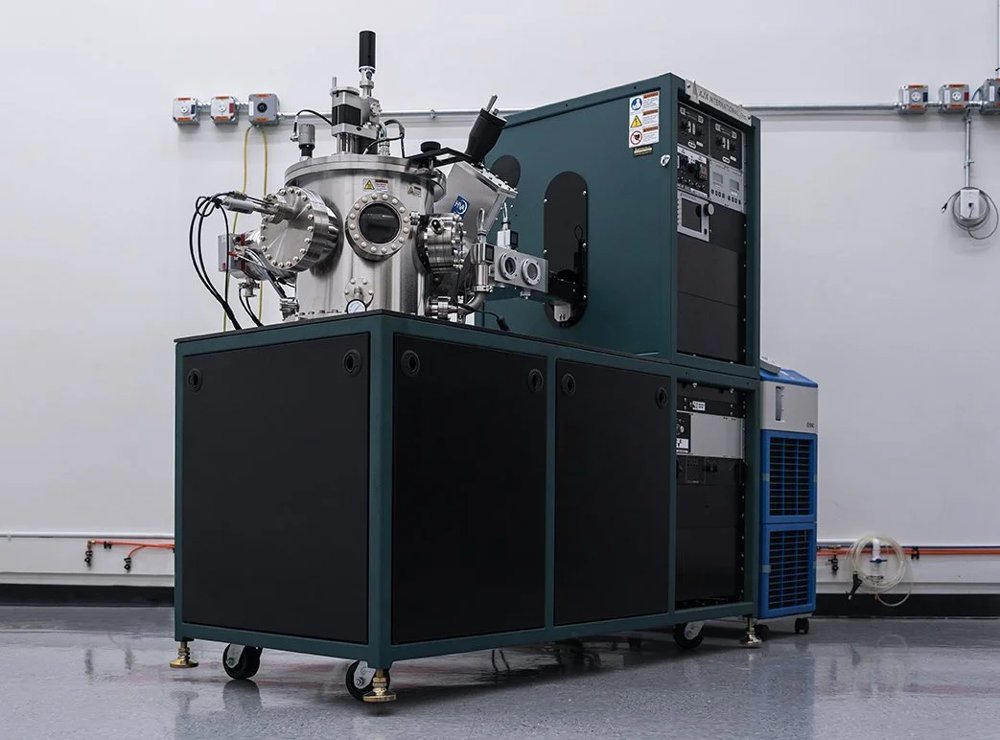 Orion Sputtering Deposition SystemsAJA International Featured
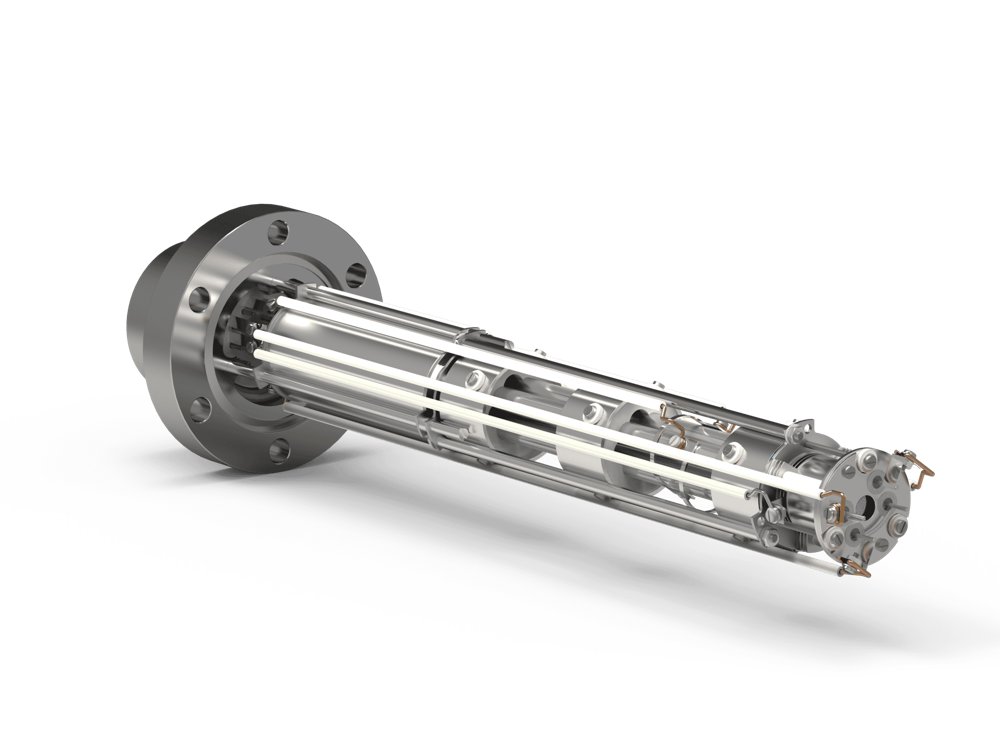 DLS-1 Mass Spectrometer for Fusion Gas AnalysisHiden Analytical Featured
 Talphene™ Graphene AdditivesTalga Group
Market insights
Last 30 days: Quantum Technologies was the busiest vertical: 52 of 174 events (30%).
Money raised per month