
By creating special atoms, RIKEN physicists have tested what happens to quantum electrodynamics (QED)—a quantum theory describing the interaction of charged particles with electromagnetic fields—when the electric field is ramped up. The demonstration opens the possibility of using the exotic atoms to perform further experiments at high fields.
QED is a highly successful theory that combines two pillars of modern physics—special relativity and quantum physics. The quantum equivalent of classical electromagnetics formulated by James Maxwell, QED was developed by some of the greatest minds of 20th century physics, including Richard Feynman, Julian Swinger and Shinichiro Tominaga.
So far it has passed every test thrown at it over the last 70 years with flying colors. But most experiments have been performed at low electric fields. Physicists are keen to discover if QED’s untarnished record extends into high fields, especially since theoretical calculations become much harder to perform in this region.
“QED has not been well verified at all in the high-field regime of x-rays,” notes Toshiyuki Azuma of the RIKEN Atomic, Molecular and Optical Physics Laboratory.
But since these high fields go beyond those that exist in normal atoms, such measurements have been challenging to perform.
Now, to test QED in the high-field regime, Azuma and his co-workers have performed high-precision measurements on special neon atoms, which they made using the facilities at the Japan Proton Accelerator Research Complex (J-PARC).
To create the atoms, the team stripped off all their electrons by adding a muon—a subatomic particle that has the same negative charge as an electron, but is about 207 times heavier. This larger mass means that the muon resides much closer to the atom’s nucleus and thus experiences a much greater electric field from the protons in the nucleus.
Measurements of x-rays emitted by these atoms agreed well with values predicted by QED. While QED lives to see another test, the real value of the experiments was their demonstration of the usefulness of muonic atoms for probing high-field QED.
Both the measurements and the subsequent analysis were demanding. “Two things enabled us to succeed in performing this measurement,” Azuma says. “One is we had highly sensitive detectors and the other is we had access to intense, low-energy muon beams that are only available in Japan right now.” He notes that the detectors were originally developed for an x-ray satellite for astronomical observations. “It was also quite tough to analyze the results,” Azuma adds. “We needed more than two years.”
Reference
Proof-of-Principle Experiment for Testing Strong-Field Quantum Electrodynamics with Exotic Atoms: High Precision X-Ray Spectroscopy of Muonic Neon
T. Okumura et al.
https://journals.aps.org/prl/abstract/10.1103/PhysRevLett.130.173001
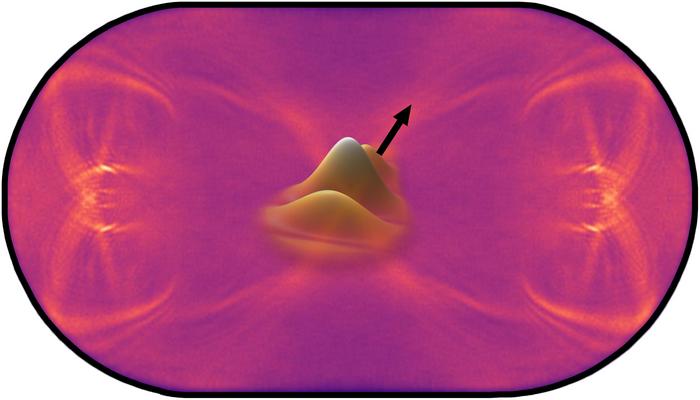
A quantum "wave packet" (in the middle) launched from the same kind of starting point behaves differently. Even after bouncing around for a very long time, faint filament-like patterns (bright glow) are still visible, a tattoo tracing back to its early history. This lingering imprint is the "quantum birthmark" described in the study. Credit: Joonas Keski-Rahkonen, Tampere University Even the most chaotic quantum systems keep a permanent mark of their own past – a "quantum birthmark" – that...
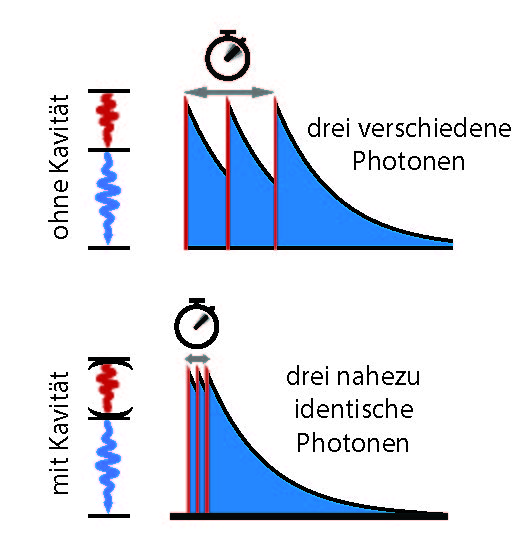
Illustration (University of Basel, Timon Baltisberger): Biexziton decay can generate photons of very high quality if the system is specifically controlled using an optical cavity. Under these conditions, 90 per cent of the photons are indistinguishable. Working in close collaboration, researchers from Paderborn University, the University of Basel and Ruhr University Bochum have made a significant breakthrough in the field of quantum communication. In their recently published paper in the...
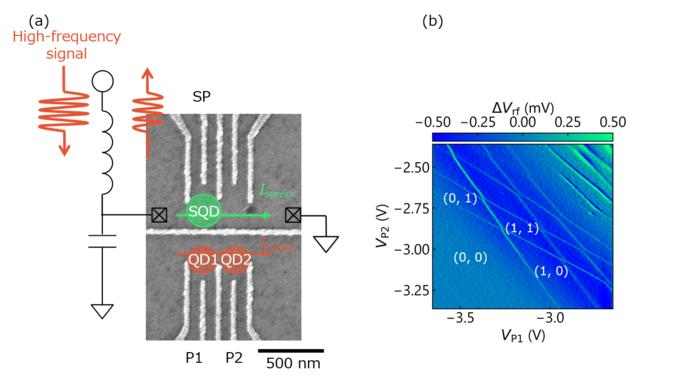
(a) The structure of the gate electrodes on the ZnO device used in the experiment in this paper. (b) The charge stability diagram indicating the formation of ZnO double quantum dot in few-electron regime. Researchers at Tohoku University, in collaboration with the National Institute for Materials Science (NIMS) and the University of Tokyo, have taken an important step toward semiconductor quantum computing using zinc oxide (ZnO). The team successfully demonstrated charge sensing,...
