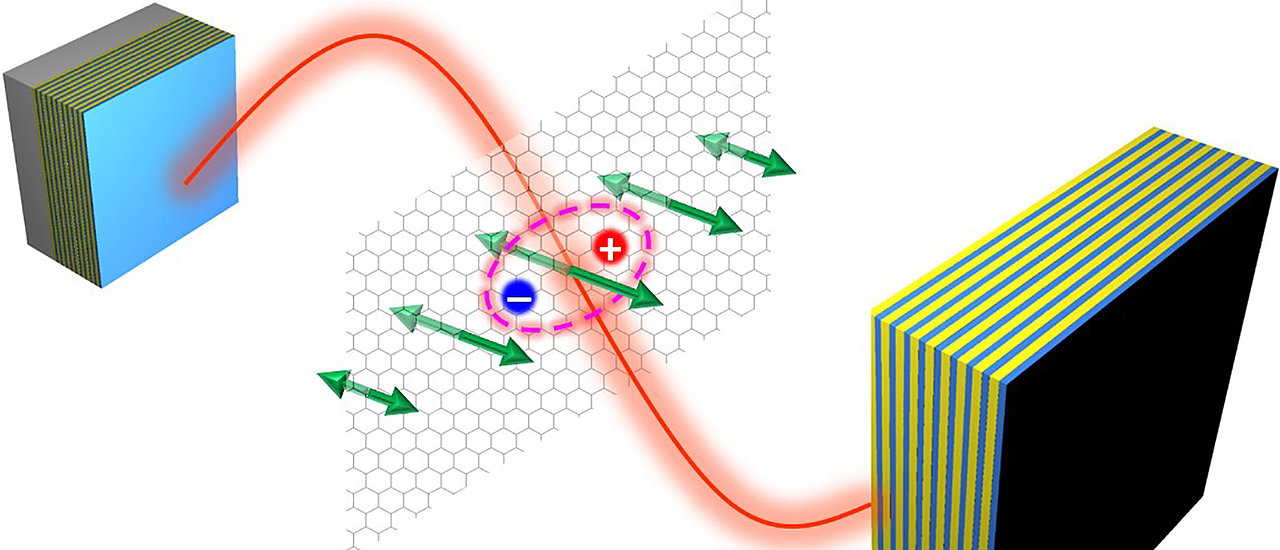
Atomically thin two-dimensional (2D) materials can provide highly interesting excitonic properties, which render them an attractive platform to explore polaritonic physics.
In the literature, a variety of inorganic exciton-polariton systems have been studied experimentally and described theoretically using the broadly accepted model of two coupled oscillators, where only the coupling between excitons and cavity photons is considered.
Now, Donghai Li and a group of researchers from Julius-Maximilians-Universität (JMU) Würzburg in Bavaria, Germany, have found that placing 2D semiconductors in microcavities can lead to a strong interaction between not just excitons and cavity photons but also with phonons. The team believes that their results could shift the paradigm of exciton-polariton physics in 2D materials by highlighting and quantifying the role of phonons therein.
Novel method with temporal resolution of 20 femtoseconds
The team developed a novel method of coherent 2D micro-spectroscopy, which provides spectral resolution for both the excitation and detection steps in combination with microscopic spatial resolution and 20 femtosecond temporal resolution.
With this technique, a rich multipeak spectrum of excitations, which thus far remained inaccessible to linear photoluminescence experiments, is mapped. Comparison with a novel vibronic polariton model, which takes into account not only the degree of freedom of excitons and photons, but also that of phonons reveals multiple polariton branches induced by exciton-photon-phonon hybridization.
This marks the discovery of previously unobserved bright states in microcavities with embedded 2D materials. The JMU researchers expect that the discovery will be of importance for the ongoing attempts of realizing room-temperature Bose-Einstein condensation and polariton lasing in these systems.
Reference
Hybridized Exciton-Photon-Phonon States in a Transition Metal Dichalcogenide van der Waals Heterostructure Microcavity
Donghai Li, Hangyong Shan, Christoph Rupprecht, Heiko Knopf, Kenji Watanabe, Takashi Taniguchi, Ying Qin, Sefaattin Tongay, Matthias Nuß, Sven Schröder, Falk Eilenberger, Sven Höfling, Christian Schneider, and Tobias Brixner
https://journals.aps.org/prl/abstract/10.1103/PhysRevLett.128.087401
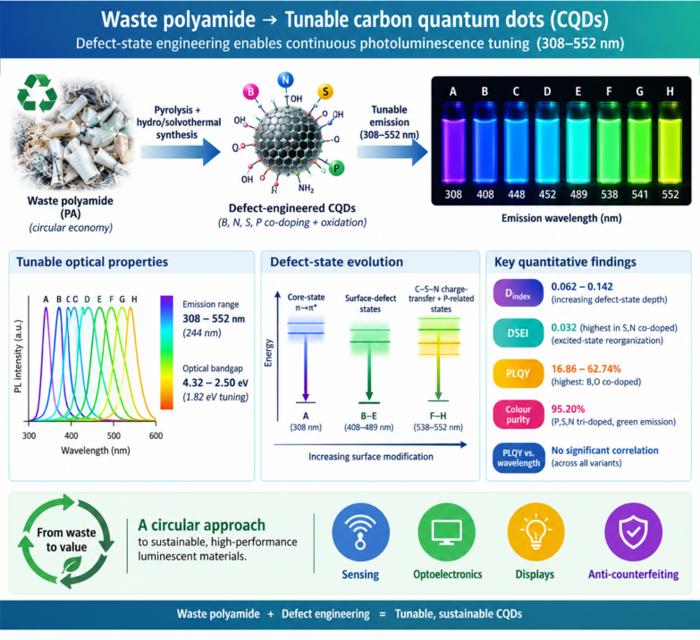
Waste polyamide-derived CQDs show continuous photoluminescence tuning from 308 to 552 nm through sequential defect-state engineering, with optical transition energies decreasing from 4.32 to 2.50 eV. @Christian Ebere Enyoh from Saitama University Carbon quantum dots (CQDs) are fluorescent carbon nanomaterials with potential applications in sensing, optoelectronics, displays, anti-counterfeiting, and environmental technologies. Their optical properties can be adjusted by modifying the carbon...
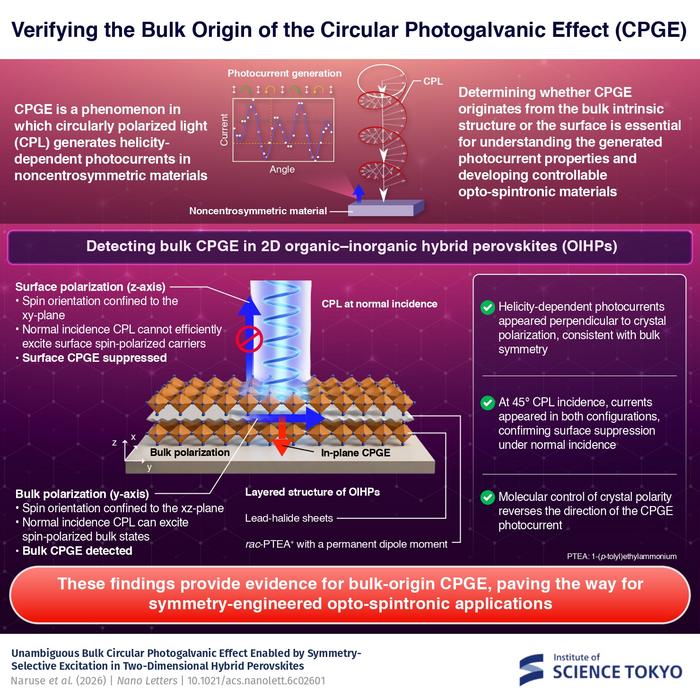
The researchers used circularly polarized light at normal incidence and found that helicity-dependent photocurrents appeared perpendicular to the crystal’s polarization but vanished when measured parallel to it, supporting a bulk origin of CPGE. @Institute of Science Tokyo The circular photogalvanic effect (CPGE), a phenomenon that generates helicity-dependent photocurrents in noncentrosymmetric materials, can originate purely from a crystal's internal structure without contribution from the...
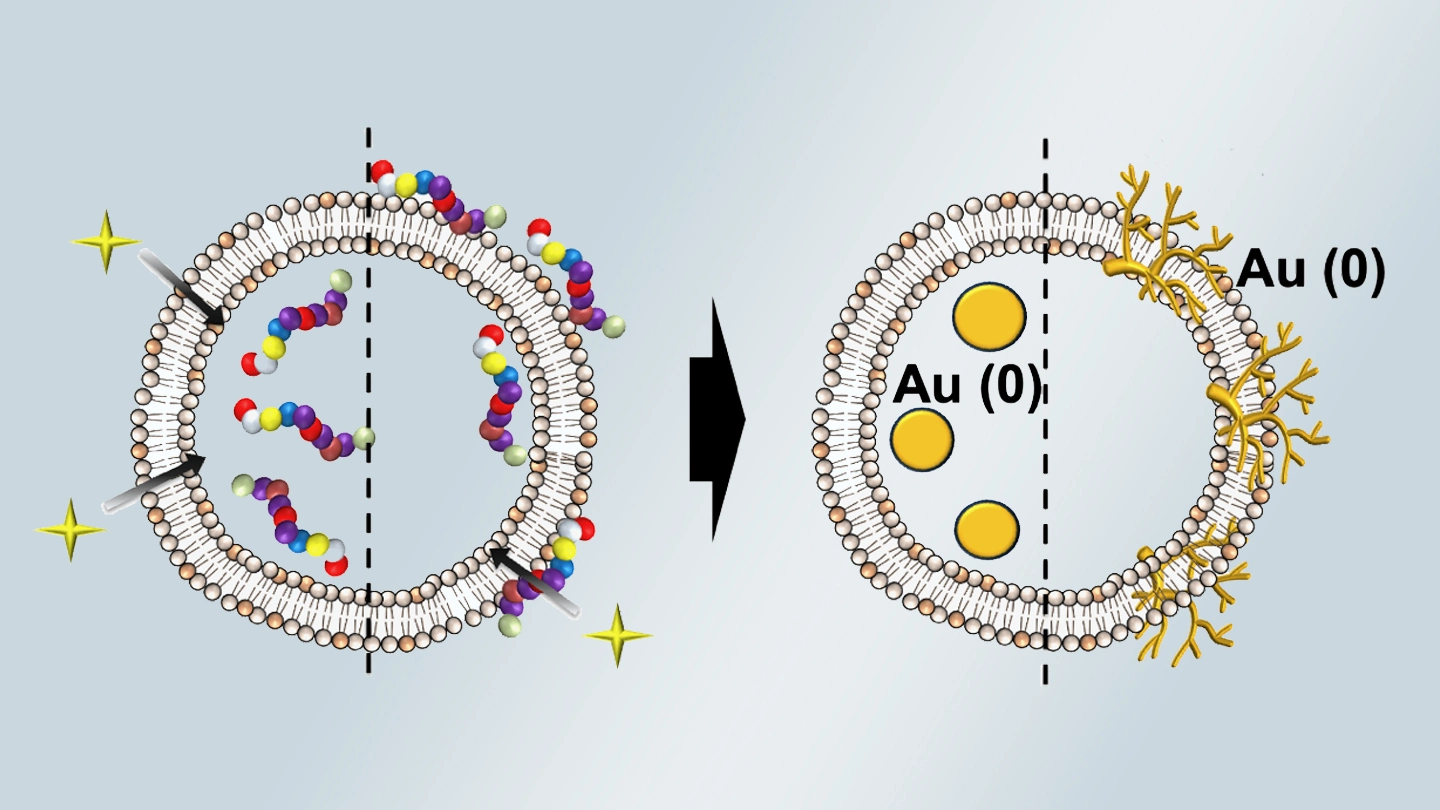
Summary of gold nanoparticle growth programming in liposome based on localization of biomineralization peptide The position of biomineralization peptides within liposomes can influence how gold nanoparticles grow, reports a research team from Institute of Science Tokyo. Peptides localized at the membrane interface promote branched structures, while those confined to the liposome interior favor spherical nanoparticles. The findings offer a new strategy for controlling nanoscale reaction...
