Purdue University
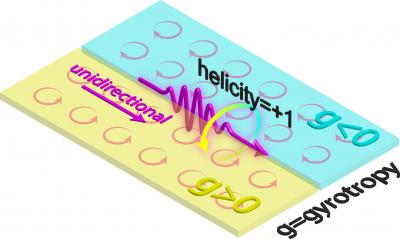
Researchers at Purdue University have created a quantum spin wave for light. This can be a carrier of information for future nanotechnologies but with a unique twist: they only flow in one direction.
The article "Unidirectional Maxwellian spin waves", by Todd Van Mechelen and Zubin Jacob has been published in the open access journal Nanophotonics on degruyter.com.
Information technologies at the nanoscale rely on manipulating particles such as electrons and photons. The electron, which is the carrier of charge (electricity), is a fermion while the photon, which is the long-distance transmitter of information, is a boson.
The most important difference between a fermion and a boson is literally how they "spin". Even though electron spin is widely utilized in commercial nanotechnologies such as magnetic memories, optical spin has only recently become a fundamental degree of freedom in nanophotonics with possible applications in fiber optics, plasmonics, resonators and even quantum metrology. This explosion of research into optical spin is due to the remarkable features of strongly confined electromagnetic waves. At the nanoscale, spin and direction of motion of light are intrinsically locked to one another.
The researchers used many designs to achieve this behavior, in particular, an interface of mirror symmetric gyrotropic media, illustrated in the accompanying figure. Gyrotropy is a form of material response to light waves that transfer spinning behavior of electrons to photons (shown by circular arrows).
"Our research opens up the possibility of new applications where devices communicate information in one direction but block it completely in the reverse. This is important for the safe functioning of high power devices as well as for reducing interference between transmitted/received electromagnetic signals from cellphone antennas," said Zubin Jacob.
Unidirectional Maxwellian spin waves
Todd Van Mechelen, Zubin Jacob
Nanophotonics Published Online: 2019-06-19
Contact information:
Zubin Jacob
Associate Professor of Electrical and Computer Engineering at Purdue University
zjacob@purdue.edu
Phone: 765-49-43514
Zubin Jacob Research Group - Electrodynamics
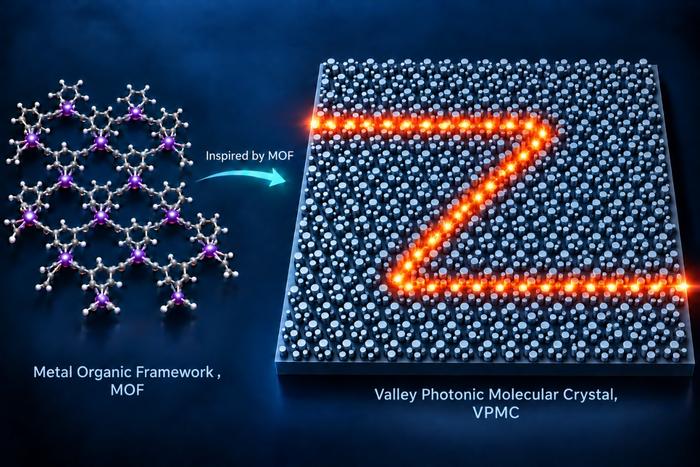
Inspired by Metal-Organic Framework based topological insulators, researchers at Tsinghua University proposed valley photonic molecular crystal (VPMC) and investigated the impact of molecular rotation on the valley-topological properties of VPMC. Credit: Tsinghua University/Xue Feng A research team led by Yidong Huang at Tsinghua University, including Xue Feng and Yongzhuo Li, has developed valley photonic molecular crystals (VPMCs) on a silicon platform. Combining theoretical modeling,...
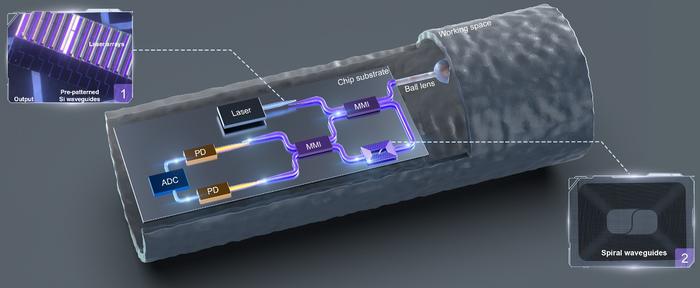
The system integrates a III-V semiconductor light source, SiN-based interferometers, Si-Ge photodetectors (PDs), and an integrated ball-lens microprobe, thereby combining the distinct advantages of multiple photonic integration platforms. The insets illustrate complementary technologies that can be incorporated to realize a miniaturized, fully integrated OCT system. Abbreviations: ADC, analog-to-digital converter. Inset 1: Foundry-scalable embedded III-V lasers on silicon-on-insulator (SOI)...

From left to right: Three photons with different quantum states enter an interferometer with three beam splitters. At each beam splitter, they can take different paths at the same time in superposition. The researchers then measured how often the three photons ended up together at the same output. Counterintuitively, it is possible to make the photons more similar to each other and at the same make them less likely to “bunch” together. AI-generated illustration, by Leonardo Novo. We usually...
