top of page

NEWSROOM


McGill researchers develop a cheaper, safer material for use in solar panels, sensors and optical devices
Using proteins from a common tobacco plant virus, McGill chemistry researchers have developed a simple, eco-friendly way to arrange gold nanoparticles into ultrathin sheets, strengthening the particles’ optical properties. The result: cheaper, safer materials for solar panels, sensors and advanced optical devices. Gold nanoparticles are only effective in strengthening optical signals when the nanoparticles are arranged on a surface and spaced at exact distances. Until now, cr
Dec 9, 20252 min read
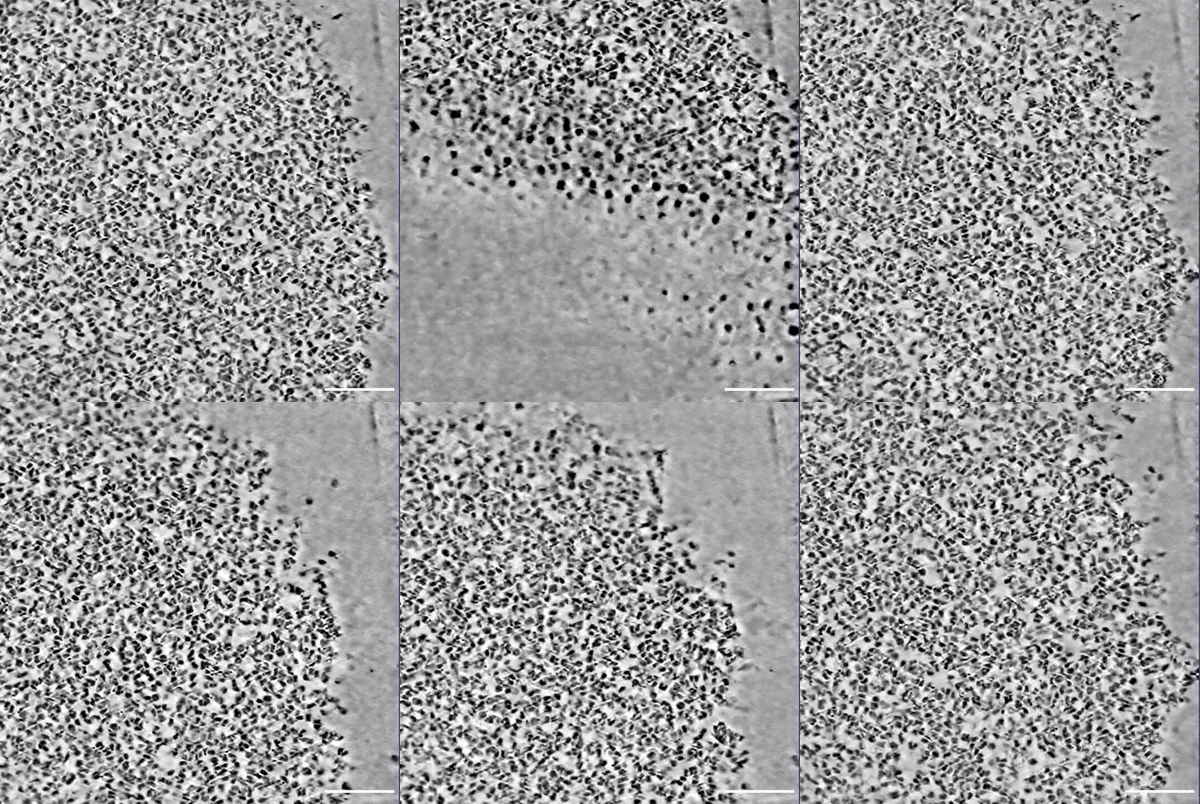
Insight emerges: MBL Consortium visualizes the creation of condensates
One of the enigmas of life is emergence, when the whole becomes more than its parts. Flocks of birds can instantly change direction when a predator appears, guided not by a lead bird but by a collective intelligence that no single bird can possess on its own. Multitudes of molecules skitter chaotically in a cell, but certain ones find each other, interact, and give rise to sophisticated cellular structures and functions that could not have been predicted by studying the molec
Dec 5, 20254 min read


Nobel Prize-awarded material that puncture and kill bacteria
Bacteria that multiply on surfaces are a major headache in healthcare when they gain a foothold on, for example, implants or in catheters. Researchers at Chalmers University of Technology in Sweden have found a new weapon to fight these hotbeds of bacterial growth – one that does not rely on antibiotics or toxic metals. The key lies in a completely new application of this year's Nobel Prize-winning material: metal-organic frameworks. These materials can physically impale, pun
Nov 27, 20254 min read


Microrobot delivers drugs directly to their site of action
Drugs are often only needed at a specific site in the body. That is why medical research has long been trying to deliver them precisely to where they are needed – in the case of a stroke, directly to the vicinity of the blood clot. A team from ETH Zurich has now achieved decisive breakthroughs on several levels in pursuit of this goal. The results have been published in the prestigious journal Science. The authors of the publication include Professor Tessa Lühmann from the In
Nov 17, 20254 min read


Nanopores act like electrical gates
The study found that rectification happens because of the way the electric charges lining the inside of the pore influence ion movement. The charge distribution makes it easier for ions to pass in one direction than the other, like a one-way valve. Gating, on the other hand, occurs when a large flow of ions leads to a charge imbalance that structurally destabilizes the pore, which causes part of the pore to temporarily collapse, blocking the flow of ions.
Nov 12, 20252 min read


Microscopic DNA ‘flowers’ could deliver medicine exactly where it’s needed
Researchers at the University of North Carolina have created microscopic soft robots shaped like flowers that can change shape and behavior in response to their surroundings, just like living organisms do. These tiny “DNA flowers” are made from special crystals formed by combining DNA and inorganic materials. They can reversibly fold and unfold in seconds, making them among the most dynamic materials ever developed on such a small scale. Each flower’s DNA acts like a tiny com
Oct 21, 20253 min read
bottom of page