top of page

NEWSROOM


Researchers create a never-before-seen molecule and prove its exotic nature with quantum computing
Published recently in Science, it is the first experimental observation of a half-Möbius electronic topology in a single molecule. To the scientists’ knowledge, a molecule with such topology has never before been synthesized, observed, or even formally predicted. Understanding this molecule’s behavior at the electronic structure level required something equally fundamental: a high fidelity quantum computing simulation. The discovery advances science on two fronts. For chemist
Mar 114 min read


Tiny imperfections with dramatic impacts in quantum systems
Researchers at Delft University of Technology have demonstrated for the first time that even realistic, small amounts of disorder in modern quantum simulators can cause the system to exhibit completely different physical behaviour. Quantum simulators play a central role in the development of future quantum technologies, including quantum computers and advanced materials design. For these technologies to work reliably, we must understand how sensitive they are to imperfections
Mar 42 min read
New method measures energy dissipation in the smallest devices
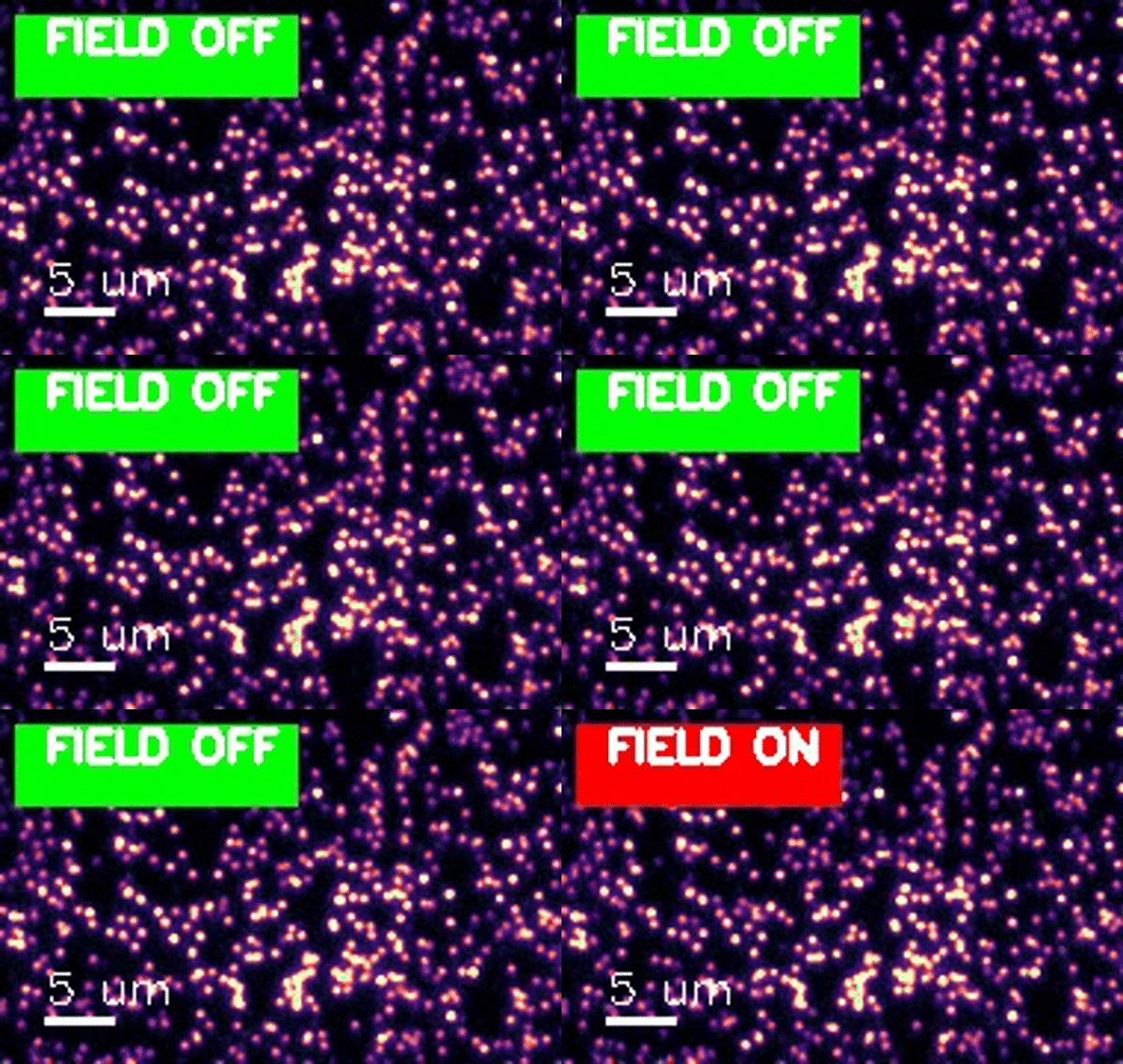
Video showing the blinking quantum dots from the experiment. The researchers turned a laser field on and off to drive them far from equilibrium and modulate their blinking. | Shen, Y., Chen, C., Ma, H., et al. "Non-equilibrium entropy production and information dissipation in a non-Markovian quantum dot." Nat. Phys. (2026), https://doi.org/10.1038/s41567-026-03177-8 In order to build the computers and devices of tomorrow, we have to understand how they use energy today. That’
Feb 194 min read


Measuring time at the quantum level
© EPFL “The concept of time has troubled philosophers and physicists for thousands of years, and the advent of quantum mechanics has not simplified the problem,” says Professor Hugo Dil, a physicist at EPFL. “The central problem is the general role of time in quantum mechanics, and especially the timescale associated with a quantum transition.” Quantum events, like tunnelling, or an electron changing its state by absorbing a photon, happen at mind‑bending speeds. Some take on
Feb 93 min read


Metal clumps in quantum state: Vienna research team breaks records
Can a small lump of metal be in a quantum state that extends over distant locations? A research team at the University of Vienna answers this question with a resounding yes. In the journal Nature, physicists from the University of Vienna and the University of Duisburg-Essen show that even massive nanoparticles consisting of thousands of sodium atoms follow the rules of quantum mechanics. The experiment is currently one of the best tests of quantum mechanics on a macroscopic s
Jan 223 min read


New quantum boundary discovered: Spin size determines how the Kondo effect behaves
Quantum spins interacting collectively create unique behaviors impossible for individual particles. The Kondo effect—where localized spins interact with conduction electrons—is central to understanding these phenomena, but in real materials, additional electron behaviors obscure the pure spin interactions. For nearly 50 years, physicists sought to realize the Kondo necklace model, which isolates spin interactions by removing this complexity. Researchers at Osaka Metropolitan
Jan 213 min read
bottom of page