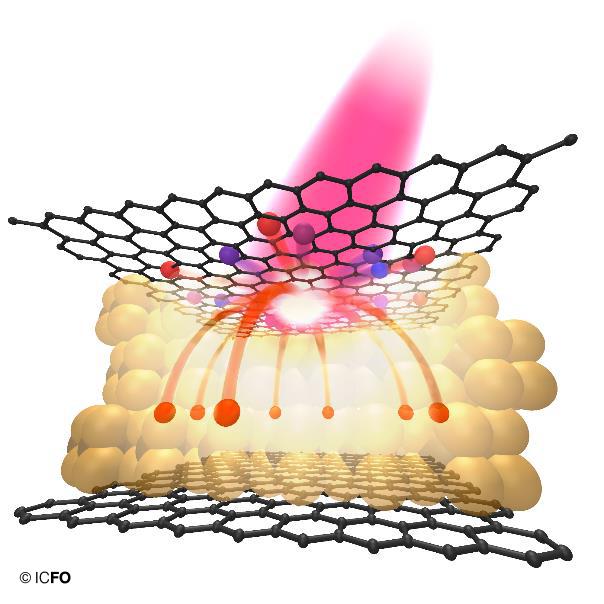
In a recent work published in Nature Communications, the research group led by ICREA Professor at ICFO Frank Koppens demonstrate a novel way to detect low-energy photons using vertical heterostructures made by stacking graphene and other 2D semiconducting materials. By studying the photoresponse of these atomically thin sandwiches, the researchers have shown that it is possible to generate a current by heating electrons in graphene with infrared light and extracting the hottest electrons over a vertical energy barrier.
This ingenious mechanism, named photo-thermionic effect, takes advantage of the unique optical properties of graphene such as its broadband absorption, ultrafast response and gate-tunability.
Moreover, owing to their vertical geometry, devices relying on this effect make use of the entire surface of graphene and can be potentially scaled up and integrated with flexible or rigid platforms.
More generally, this study reveals once again the amazing properties of these man-made heterostructures. According to Prof. Frank Koppens "this is just the tip of the iceberg, these 2D sandwiches still have a lot to reveal". ICFO researcher Mathieu Massicotte, first author of this study, emphasizes the new possibilities opened up by these new materials: "Everyone knows it is possible to detect light with graphene using in-plane geometries, but what about the out-of-plane direction? To answer, you need to think outside the 2D box!"
The results obtained from this study have shown that heterostructures made of 2D materials and graphene can be used to detect low-energy photons which could lead to new, fast and efficient optoelectronic applications, such as high-speed integrated communication systems and infrared energy harvesting. In addition, it demonstrates the compatibility of 2D materials with the digital chips currently utilized in cameras, paving the way for low cost infrared spectrometers and imaging systems.
Reference:
M. Massicotte, P. Schmidt,F. Vialla, K. Watanabe, T. Taniguchi, K. J. Tielrooij & F. H. L. Koppens, Photo-thermionic effect in vertical graphene heterostructures, Nature Communications 7, Article number: 12174 doi:10.1038/ncomms12174
ICFO
#Graphene #Semiconductors
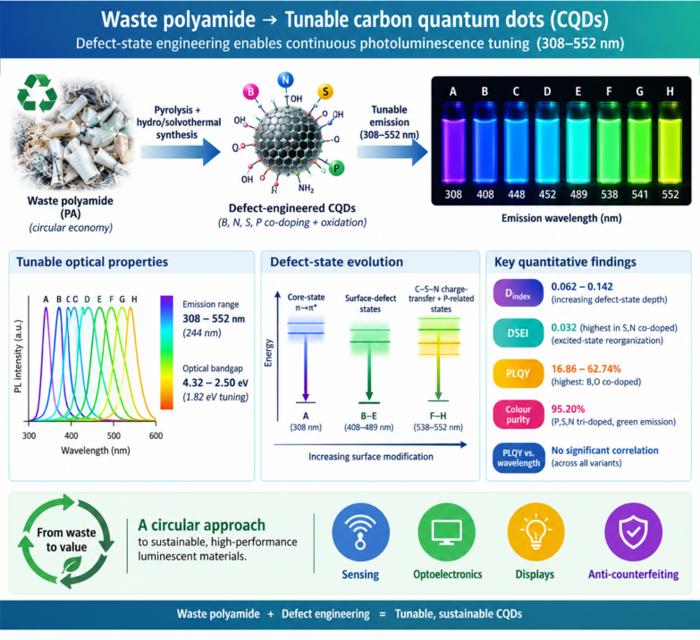
Waste polyamide-derived CQDs show continuous photoluminescence tuning from 308 to 552 nm through sequential defect-state engineering, with optical transition energies decreasing from 4.32 to 2.50 eV. @Christian Ebere Enyoh from Saitama University Carbon quantum dots (CQDs) are fluorescent carbon nanomaterials with potential applications in sensing, optoelectronics, displays, anti-counterfeiting, and environmental technologies. Their optical properties can be adjusted by modifying the carbon...
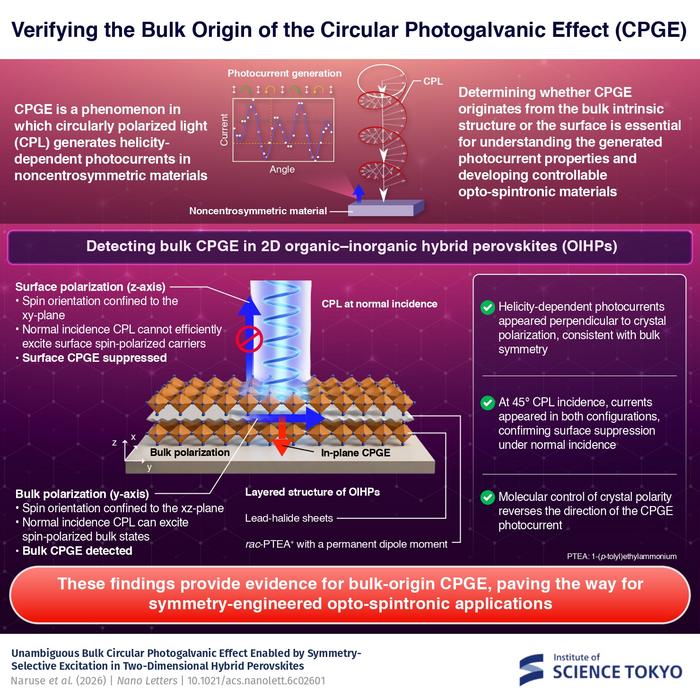
The researchers used circularly polarized light at normal incidence and found that helicity-dependent photocurrents appeared perpendicular to the crystal’s polarization but vanished when measured parallel to it, supporting a bulk origin of CPGE. @Institute of Science Tokyo The circular photogalvanic effect (CPGE), a phenomenon that generates helicity-dependent photocurrents in noncentrosymmetric materials, can originate purely from a crystal's internal structure without contribution from the...
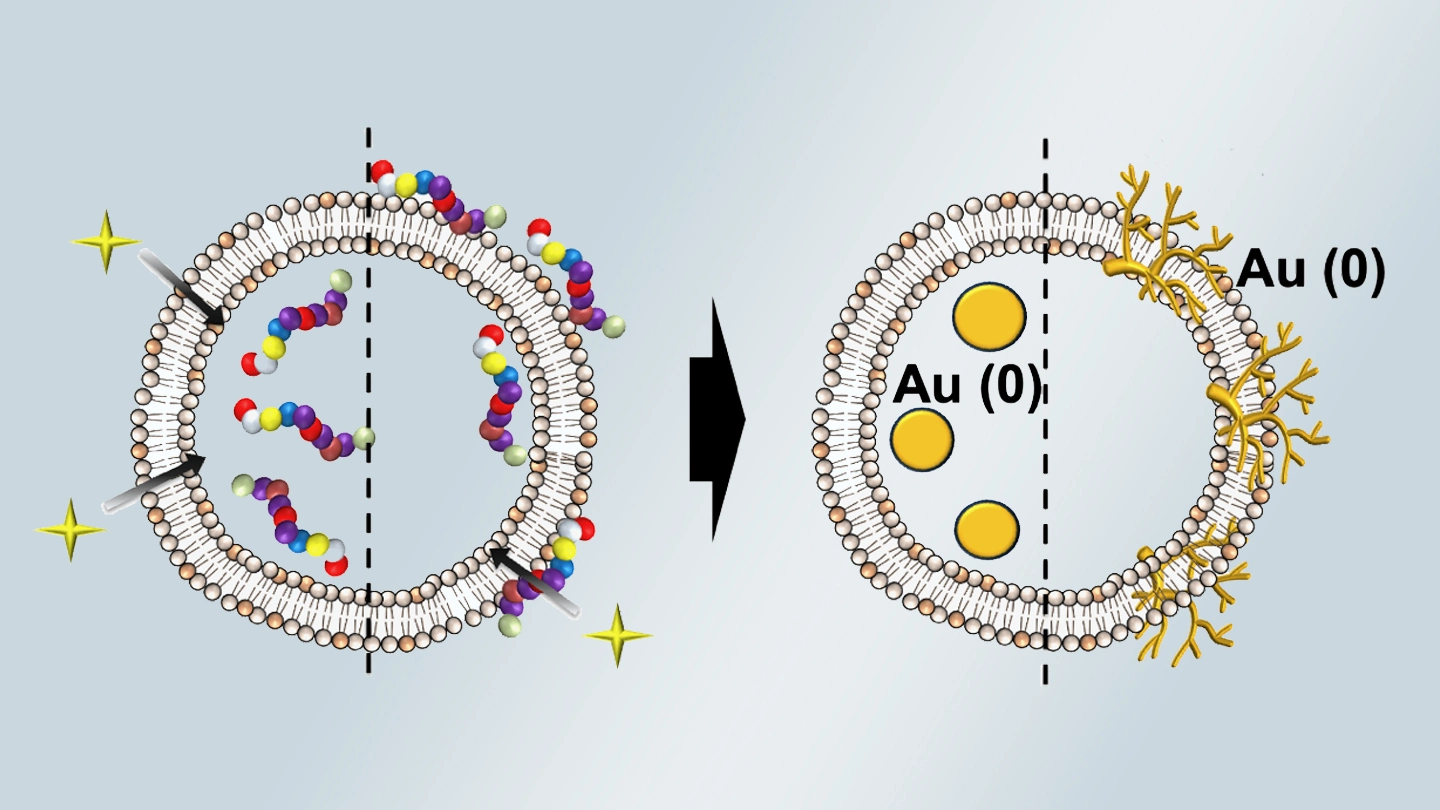
Summary of gold nanoparticle growth programming in liposome based on localization of biomineralization peptide The position of biomineralization peptides within liposomes can influence how gold nanoparticles grow, reports a research team from Institute of Science Tokyo. Peptides localized at the membrane interface promote branched structures, while those confined to the liposome interior favor spherical nanoparticles. The findings offer a new strategy for controlling nanoscale reaction...
