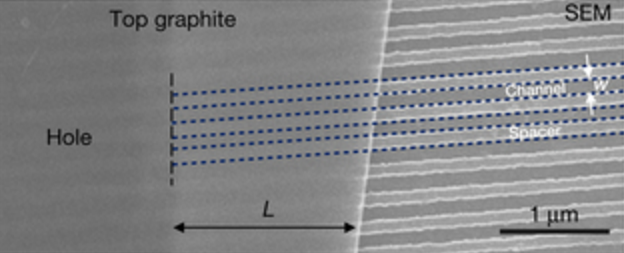
Materials containing tiny capillaries and cavities are widely used in filtration, separation and many other technologies, without which our modern lifestyle would be impossible. Those materials are usually found by luck or accident rather than design. It has been impossible to create artificial capillaries with atomic-scale precision.
Now a Manchester group led by postdoctoral researcher Radha Boya and Nobel laureate Andre Geim show how to make the impossible possible, as reported in Nature.
The new technology is elegant, adaptable and strikingly simple. In fact, it is a kind of antipode of the famous material graphene. When making graphene, people often take a piece of graphite and use Scotch tape to extract a single atomic plane of carbon atoms, graphene. The remaining graphite is discarded.
In this new research, Manchester scientists similarly extracted a strip of graphene from graphite, but discarded the graphene and focused on what was left: an ultra-thin cavity within the graphite crystal.
Such atomic scale cavities can be made from various materials to achieve not only a desired size but also to choose properties of capillary walls. They can be atomically smooth or rough, hydrophilic or hydrophobic, insulating or conductive, electrically charged or neutral; the list goes on.
The voids can be made as cavities (to confine various substances) or open-ended tunnels (to transport different gases and liquids), which is of huge interest for fundamental research and many applications. It is limited only by imagination what such narrow tunnels with designer properties can potentially do for us.
Properties of materials at this truly atomic scale are expected to be quite different from those we are familiar with in our macroscopic world. To demonstrate that this is the case of their atomic-scale voids, the Manchester group tested how water runs through those ultra-narrow pipes.
To everyone's surprise, they found water to flow with little friction and at high speed, as if the channels were many thousands times wider than they actually are.
Radha Boya commented 'This is an entirely new type of nanoscale systems. Such capillaries were never imagined, even in theory. No one thought that this degree of accuracy in design could be possible. New filtration, desalination, gas separation technologies are kind of obvious directions but there are so many others to explore'.
Sir Andre added 'Making something useful out of an empty space is certainly cute. Finding that this space offers so much of new science is flabbergasting. Even with hindsight, I did not expect the idea to work so well. There are myriads of possibilities for research and development, which now need to be looked at. We are stunned by the choice.'
Molecular transport through capillaries made with atomic-scale precision
doi:10.1038/nature19363
University of Manchester
#Nanostructures #Graphene