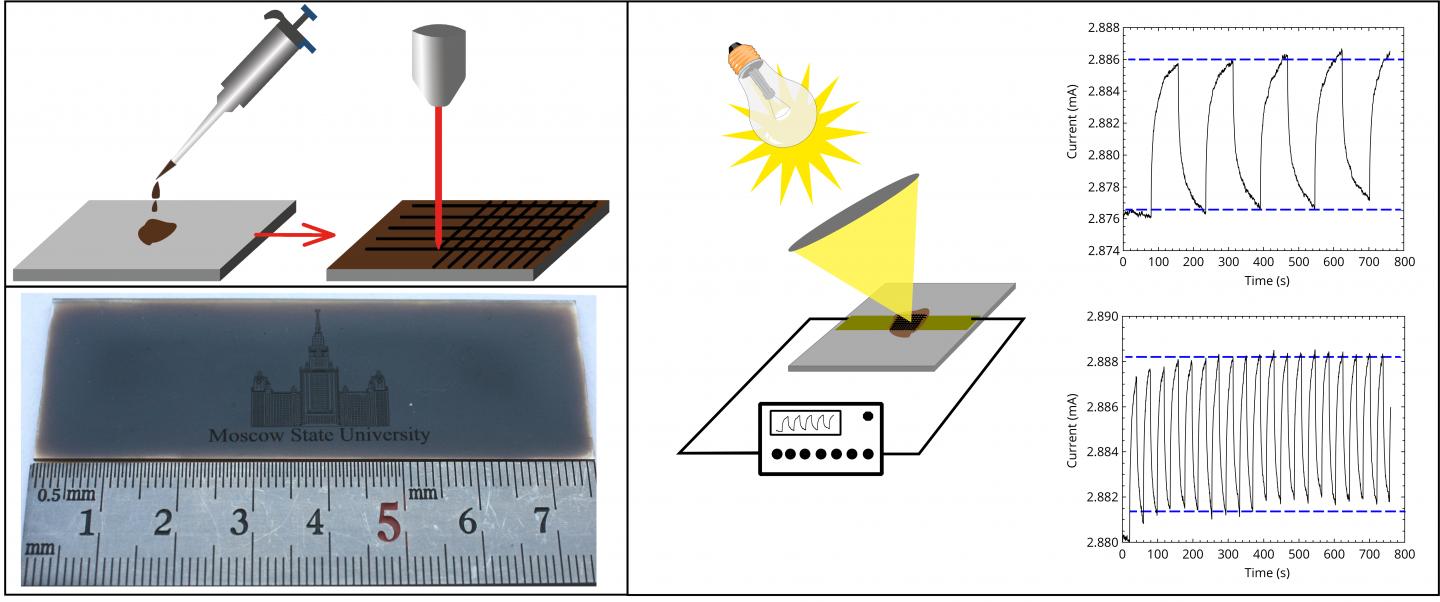
Bolometer is a device for measuring electromagnetic radiation energy flow based on measurement of variations of physical parameters of thermosensitive element as a result of heating by absorption of radiation energy.
"We studied thermal and optical properties of the carbon structures derived from the reduced graphene oxide in a wide range of wavelengths from visible to infrared. In addition to the optical and thermal properties of the carbon structures, we have demonstrated the bolometer prototype that operates at room temperature without additional cooling", says Stanislav Evlashin, the first author of the article, the researcher of the Skobeltsyn Institute of Nuclear Physics Lomonosov Moscow State University (SINP MSU), PhD in Physico-Mathematical Sciences.
Synthesis and investigations of the new materials for bolometric sensors have a great scientific and practical importance. Such materials should possess a high effective absorption over a wide spectral range, high stable thermoresistive effect (change in electrical conductance with temperature), and, of course, they must be cheap to manufacture.
To create bolometer prototype the water solution of graphene oxide was used, which was obtained by the standard method of graphite oxidation, which is known and widely used. The resulting suspension of graphene oxide was deposited on the substrate for subsequent laser microstructuring. Laser treatment causes partial reduction of graphene oxide film and changes morphology, consequently, it changes optical and thermal properties of graphene oxide.
The material synthesis and development of the bolometer prototype was held at SINP MSU. Studies on the optical properties were carried out at Physics Department of Moscow State University. Research on the thermal properties were carried out at LPI RAS.
"Laser microstructuring of graphene oxide opens up the possibility of selective creation of antireflective, thermally-conductive and electrically-conductive coatings. Developed method is quite cheap, compatible with conventional semiconductor technology and allows you to create antiabsorbing coatings that would cover large areas on almost any surface. The observed properties of reduced graphene oxide partially show the prospects of it's use in bolometric matrices and other IR devices," - says Stanislav Evlashin.
Controllable Laser Reduction of Graphene Oxide Films for Photoelectronic Applications
Skolkovo Institute of Science and Technology, 3 Nobel, 143025 Skolkovo, Russia
ACS Appl. Mater. Interfaces, 2016, 8 (42), pp 28880–28887
DOI: 10.1021/acsami.6b10145
Lomonosov Moscow State University
#Graphene
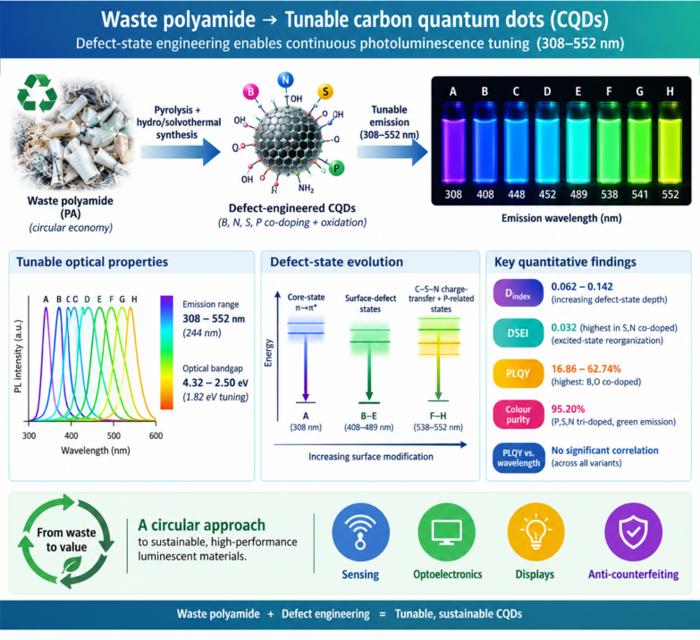
Waste polyamide-derived CQDs show continuous photoluminescence tuning from 308 to 552 nm through sequential defect-state engineering, with optical transition energies decreasing from 4.32 to 2.50 eV. @Christian Ebere Enyoh from Saitama University Carbon quantum dots (CQDs) are fluorescent carbon nanomaterials with potential applications in sensing, optoelectronics, displays, anti-counterfeiting, and environmental technologies. Their optical properties can be adjusted by modifying the carbon...
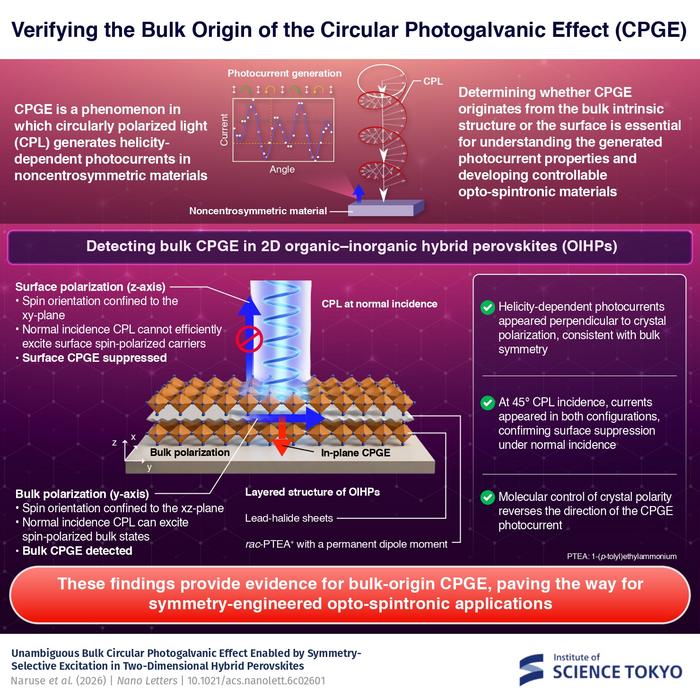
The researchers used circularly polarized light at normal incidence and found that helicity-dependent photocurrents appeared perpendicular to the crystal’s polarization but vanished when measured parallel to it, supporting a bulk origin of CPGE. @Institute of Science Tokyo The circular photogalvanic effect (CPGE), a phenomenon that generates helicity-dependent photocurrents in noncentrosymmetric materials, can originate purely from a crystal's internal structure without contribution from the...
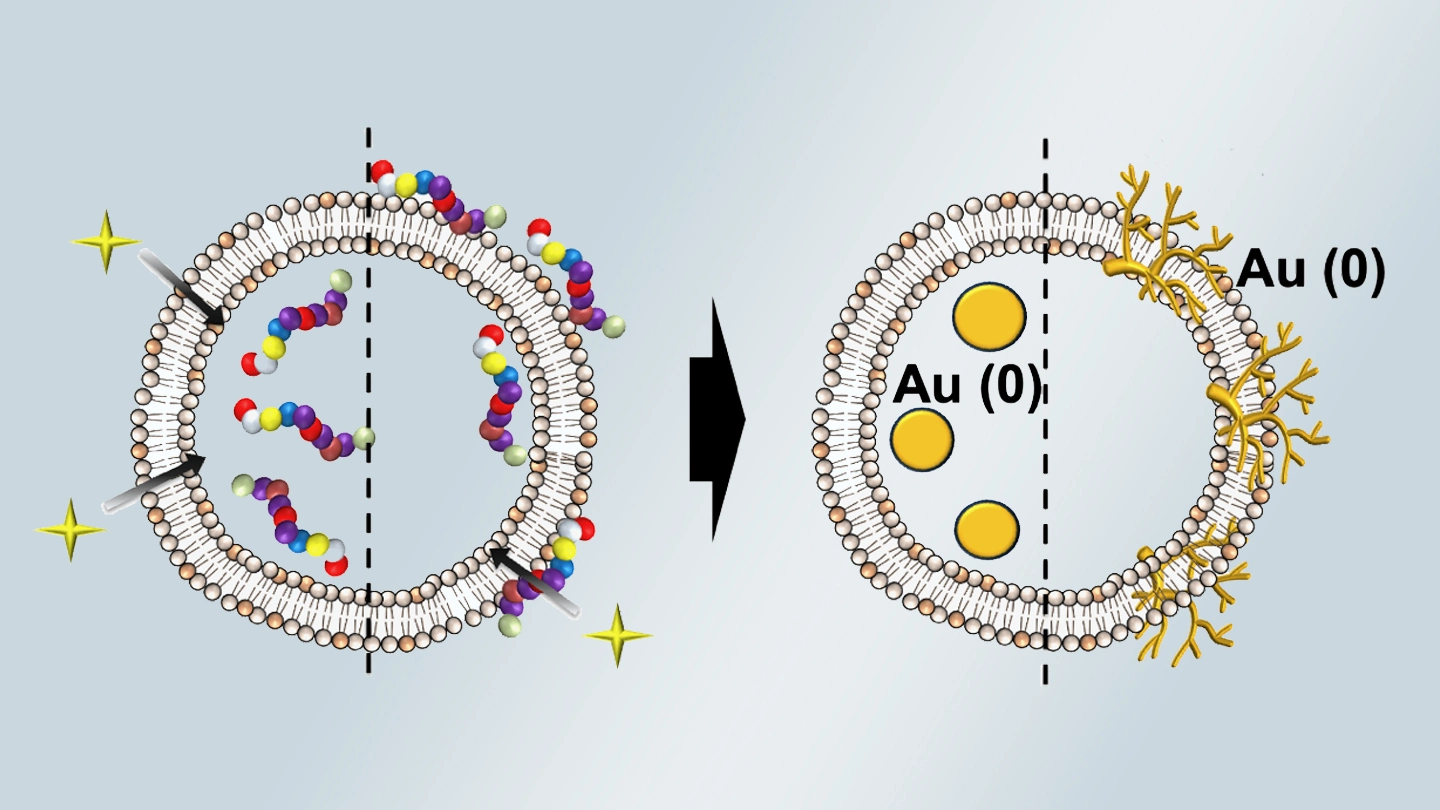
Summary of gold nanoparticle growth programming in liposome based on localization of biomineralization peptide The position of biomineralization peptides within liposomes can influence how gold nanoparticles grow, reports a research team from Institute of Science Tokyo. Peptides localized at the membrane interface promote branched structures, while those confined to the liposome interior favor spherical nanoparticles. The findings offer a new strategy for controlling nanoscale reaction...
