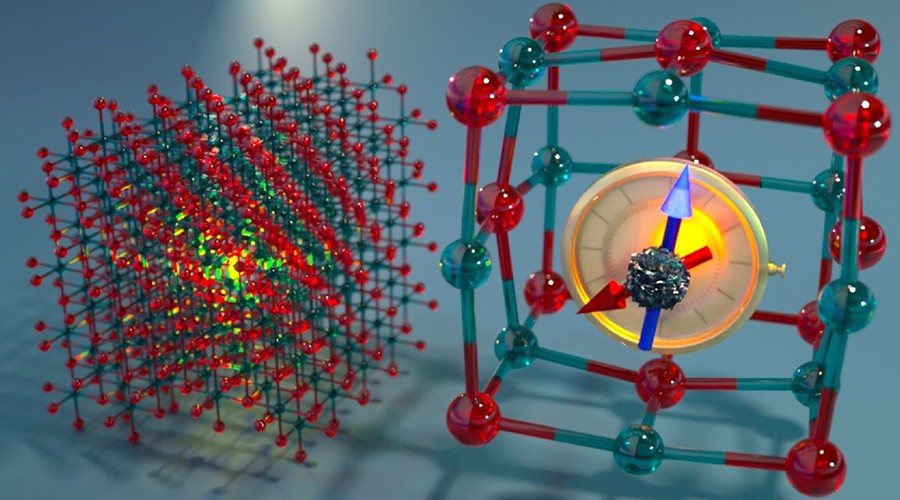
Calcium oxide is a cheap, chalky chemical compound commonly used in the manufacturing of cement, plaster, paper, and steel. But the material may soon have a more high-tech application.
UChicago Pritzker School of Molecular Engineering researchers and their collaborator in Sweden have used theoretical and computational approaches to discover how tiny, lone atoms of bismuth embedded within solid calcium oxide can act as qubits — the building blocks of quantum computers and quantum communication devices. These qubits are described in Nature Communications.
“This system has even better properties than we expected,” said Giulia Galli, Liew Family Professor at Pritzker Molecular Engineering and Chemistry and senior author of the new work. “It has an incredibly low level of noise, can hold information for a long time, and is not made with a fancy, expensive material.”
A quantum bit, or qubit, is the basic unit of information that encodes data in quantum computing. Today, researchers have developed many different types of qubits, which are often composed of tiny point defects within semiconducting materials. Some of the properties of these defects can be used to store pieces of information. However, many existing qubits are incredibly fragile; electronic or magnetic “noise” in their surroundings can change their properties, erasing any information that was encoded within them.
In 2022, a collaboration between scientists in Japan and the groups of David Awschalom and Galli simulated the properties of more than 12,000 materials to discover new potential solids that could contain promising defects acting as qubits. That work turned up calcium oxide as one of a number of materials with the potential to contain qubits that encoded information with very low levels of noise for an especially long period of time.
“Our previous work told us that if you find the right defects to put within its structure, calcium oxide would be a perfect medium for storing quantum information,” said Nikita Onizhuk, a postdoctoral fellow in the Galli group and one of the authors of the paper. “So our new goal was to find the ideal defect.”
In the new paper, Galli and her colleagues used a series of computational methods that were established over recent years to screen more than 9,000 different defects within calcium oxide for their potential as qubits. The results pointed toward one type of defect — in which an antimony, bismuth or iodine atom is embedded within the usual structure of calcium and oxygen that make up calcium oxide.
“We never could have guessed that these exact defects would be so promising,” said Joel Davidsson of Linköping University, the first author of the paper and the main developer of the high-throughput approach used to discover novel spin defects. “The only way to do this was with thorough and unbiased screen procedures.”
Galli’s team then showed through their modeling approaches that the bismuth defect within calcium oxide can theoretically encode data with little noise and for relatively long periods of time (multiple seconds compared to the milliseconds of coherence shown by many qubits). It also has the potential to mesh well with telecommunications devices because of the material’s refractive index and its ability to emit photons of light.
Galli and collaborators are now working with experimental groups who can build the calcium-oxide-based materials and test whether the predictions hold true.
“We’re at the very early stages, but from a fundamental science point of view, we think this material is very promising,” Galli said.
Reference
Discovery of atomic clock-like spin defects in simple oxides from first principles
Joel Davidsson, Mykyta Onizhuk, Christian Vorwerk & Giulia Galli

A quantum "wave packet" (in the middle) launched from the same kind of starting point behaves differently. Even after bouncing around for a very long time, faint filament-like patterns (bright glow) are still visible, a tattoo tracing back to its early history. This lingering imprint is the "quantum birthmark" described in the study. Credit: Joonas Keski-Rahkonen, Tampere University Even the most chaotic quantum systems keep a permanent mark of their own past – a "quantum birthmark" – that...
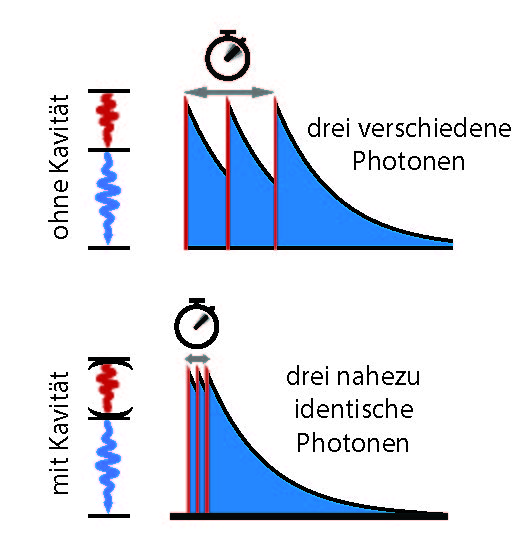
Illustration (University of Basel, Timon Baltisberger): Biexziton decay can generate photons of very high quality if the system is specifically controlled using an optical cavity. Under these conditions, 90 per cent of the photons are indistinguishable. Working in close collaboration, researchers from Paderborn University, the University of Basel and Ruhr University Bochum have made a significant breakthrough in the field of quantum communication. In their recently published paper in the...
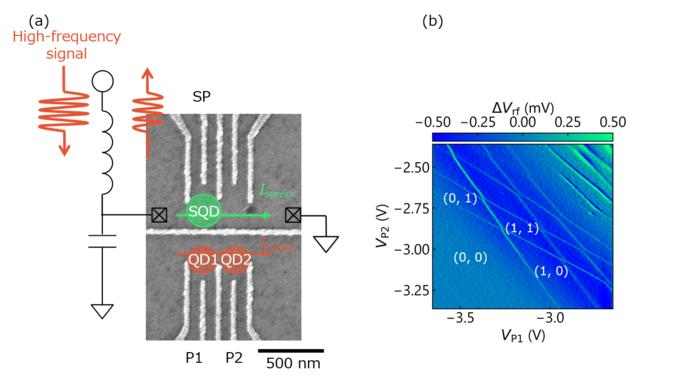
(a) The structure of the gate electrodes on the ZnO device used in the experiment in this paper. (b) The charge stability diagram indicating the formation of ZnO double quantum dot in few-electron regime. Researchers at Tohoku University, in collaboration with the National Institute for Materials Science (NIMS) and the University of Tokyo, have taken an important step toward semiconductor quantum computing using zinc oxide (ZnO). The team successfully demonstrated charge sensing,...
