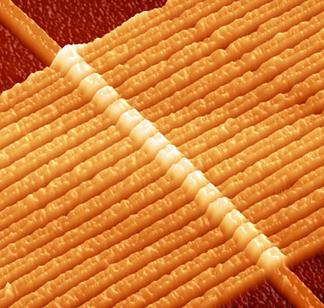
Lack of uniformity is possibly the biggest challenge in today's technology of memristor devices as it gives rise to problems like inconsistency, stochastic variability, and instability of the memory state. A uniform switching mechanism in memristors is something researchers have been looking in the last several decades.
Now, an international team, led by the scientists from the National University of Singapore (NUS), has developed a solution to address this long-standing problem in the field of organic and molecular electronics.
This work was published in the journal Advanced Materials on 6 September 2020.
Professor T. Venkatesan, who led this project, said, "We are working on an organic material system that is possibly one of the most efficient platforms for realising artificial intelligence and brain-inspired computing. My former graduate student Dr Sreetosh Goswami, who is now a postdoctoral researcher at the NUS Department of Physics, is the key architect of this work. While working on our previous studies on molecular memristors that were published in Nature Materials and Nature Nanotechnology, he discovered that the conductance switching is amazingly uniform."
"A molecular switching mechanism should ideally be uniform. The fact that no one ever observed a uniform switching puts the credibility of organic memristors into question. What it says is that either the existing measurements are problematic, or the mechanism is non-molecular," explained Dr Sreetosh.
In this paper, the team resolved the problem by demonstrating a homogeneous molecular switching with less than 7 nanometre spatial resolution. This work also provided guidance on how such measurements should be performed, and how ideal molecular switching should look like.
Dr Sreetosh added, "I thank Professor Venkatesan for sending me to France to collaborate with HORIBA on the tunnelling enhanced Raman Spectroscopy measurements. These measurements enabled characterisation at molecular levels, and what we showed here is a small part of the data we have acquired. Much more exciting results are on the way."
The material systems used in this study is the brainchild of Professor Sreebrata Goswami, who is from the Indian Association for the Cultivation of Science, Kolkata. Professor Sreebrata shared, "The correlation we have observed between micro and nano-scale measurements in this study is just amazing. It shows the homogeneity and scalability of a molecular mechanism in a device. Through nano-Raman spectroscopy, we were able to monitor the individual bonds in a molecule as a function of voltage. Such deterministic understanding of molecular mechanism charts routes to design new molecular systems, and we are currently in progress of doing so."
"While usual memristors show switching energy in the order of pico joule, these devices promise switches with energy dissipation in the range of atto joules. This is a huge advantage offered by the material system," elaborated Associate Professor Ariando. He is a co-author of the paper, and also the lead Principal Investigator of the grant that supported this research.
This research was conducted in collaboration with HORIBA in France, and Professor Stanley Williams of Texas A&M University.
The NUS research team is currently using these molecular platforms to realise brain-inspired functionalities such as unsupervised learning, classification in addition to probabilistic computing.
"We believe this has the potential to revolutionise current technology by orders of magnitude in terms of energy cost," said Prof Venkatesan.
Reference:
Nanometer‐Scale Uniform Conductance Switching in Molecular Memristors
Sreetosh Goswami Debalina Deb Agnès Tempez Marc Chaigneau Santi Prasad Rath Manohar Lal Ariando R. Stanley Williams Sreebrata Goswami Thirumalai Venkatesan
First published: 06 September 2020
https://doi.org/10.1002/adma.202004370
Contact:
Professor T. Venkatesan
NUSNNI‐NanoCore
National University of Singapore
+65 6516 5187
venky@nus.edu.sg

Researchers at Johannes Gutenberg University Mainz (JGU) are the first to directly utilize orbital currents without the need for conversion of the orbital current into a spin current. “We have thus realized the first purely orbitronic device approach,” said Dr. Christin Schmitt, a scientist in the research group of Professor Mathias Kläui at the JGU Institute of Physics. Orbitronics is a promising technology for future memory devices, as it could enable the realization of large-scale storage...
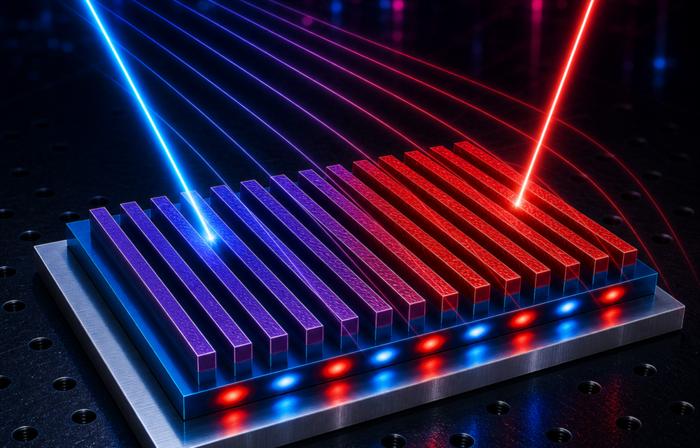
certain wavelength and direction will also emit heat in the same ways. This fundamental relationship, known as reciprocity, limits our ability to independently control heat absorption and heat emission. But if absorption and emission could be separated, engineers could design devices that absorb heat from one direction while emitting it in another. By ‘steering’ thermal energy, they could create more efficient thermal management, energy conversion, infrared sensing, and thermal communicati...
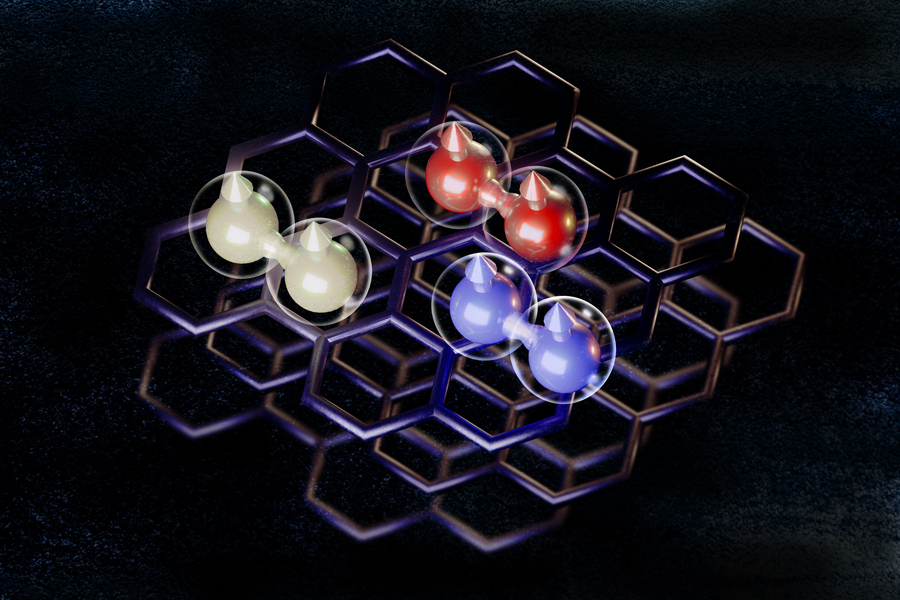
MIT researchers have found that rhombohedral graphene — a naturally occurring staircase-like stack of four or five atomically thin carbon layers found in ordinary graphite — can host multiple distinct superconducting states simultaneously, a rarity among known superconductors. Publishing in Nature, the team reports that three of these states not only survive exposure to magnetic fields up to around 9 tesla (roughly 180,000 times Earth's magnetic field), which would normally destroy supercondu...
