Centre national de la recherche scientifique (CNRS)
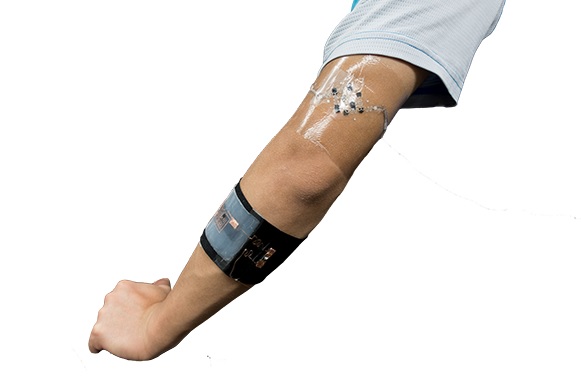
A unique new flexible and stretchable device, worn against the skin and capable of producing electrical energy by transforming the compounds present in sweat, was recently developed and patented by CNRS researchers from l'Université Grenoble Alpes and the University of San Diego (USA). This cell is already capable of continuously lighting an LED, opening new avenues for the development of wearable electronics powered by autonomous and environmentally friendly biodevices. This research was published in Advanced Functional Materials on September 25, 2019.
The potential uses for wearable electronic devices continue to increase, especially for medical and athletic monitoring. Such devices require the development of a reliable and efficient energy source that can easily be integrated into the human body. Using "biofuels" present in human organic liquids has long been a promising avenue.
Scientists from the Département de chimie moléculaire (CNRS/Université Grenoble Alpes), who specialize in bioelectrochemistry, decided to collaborate with an American team from the University of San Diego in California, who are experts in nanomachines, biosensors, and nanobioelectronics. Together they developed a flexible conductive material consisting of carbon nanotubes, crosslinked polymers, and enzymes joined by stretchable connectors that are directly printed onto the material through screen-printing[1].
The biofuel cell, which follows deformations in the skin, produces electrical energy through the reduction of oxygen and the oxidation of the lactate present in perspiration. Once applied to the arm, it uses a voltage booster to continuously power an LED. It is relatively simple and inexpensive to produce, with the primary cost being the production of the enzymes that transform the compounds found in sweat. The researchers are now seeking to amplify the voltage provided by the biofuel cell in order to power larger portable devices.
Patents:
- F. Giroud, A. J. Gross, S. Cosnier. Bioelectrode for the detection and/or oxidation of glucose and its manufacturing process and device comprising it. French patent n° 1662997 submitted December 21, 2016 . Published 22 June 2018. Extension PCT n°PCT/FR2017053689 submitted December 21, 2017. Published PCT n° WO2018115710A1 28 June 2018.. Applicants: CNRS
- S. Cosnier, R. Haddad. Electrochemical reactor block. French patent n° 1559069 submitted September 25, 2015 ; n°3041819. Published March 31, 2017. Extension Europe, USA, Japan n°16777723.4 ; FR20160552310 ; submitted September 14, 2016.. Applicants: Université Joseph Fourier and CNRS
Stretchable and Flexible Buckypaper-Based Lactate Biofuel Cell for Wearable Electronics
Xiaohong Chen, Lu Yin, Jian Lv, Andrew J. Gross, Minh Le, Nathaniel Georg Gutierrez, Yang Li, Itthipon Jeerapan, Fabien Giroud, Anastasiia Berezovska, Rachel K. O’Reilly, Sheng Xu, Serge Cosnier, and Joseph Wang
Advanced Functional Materials (2019)
DOI : 10.1002/adfm.201905785
Contact information:
Serge Cosnier
CNRS Researcher
serge.cosnier@univ-grenoble-alpes.fr
Phone: +33 4 56 52 08 10
Fabien Giroud
University of Grenoble Alpes researcher
fabien.giroud@univ-grenoble-alpes.fr
Phone: + 33 4 56 52 08 15

Researchers led by Professor Jaeyune Ryu at Seoul National University identified local pH near electrodes as a decisive variable in organic electrosynthesis. By designing a reactor that narrows electrode spacing and flows electrolyte to counterbalance acidic and alkaline zones, they raised selectivity for lactones and epoxides, feedstocks for biodegradable plastics, polyurethanes, adhesives, and epoxy resins, from about 16% to 97% using only oxygen and electricity, eliminating added peroxide…

Silver nanoparticles with diameters of ~10 nm deliver the best performance as electrocatalysts. The silver particles are sprayed onto the electrode together with a conductive carbon powder. The ideal mixture consists of 20 per cent by mass silver and 80 per cent by mass carbon powder. This image was taken using a transmission electron microscope (TEM). © HZB Via electrolysis, CO₂ can be reduced to CO, a raw material for further chemical products such as fuels. Within the GreenQuest Project,...

A flexible metal–organic framework developed by researchers from Institute of Science Tokyo enables the structural determination of large "beyond rule of 5" molecules from microgram-scale samples. Using APF-40 as a crystalline sponge, the researchers determined the structures of 12 pharmaceutical-related molecules, including the 899 Da drug molecule doramectin and trace ivermectin derivatives. The method could aid drug discovery, natural products research, and the characterization of rare...






