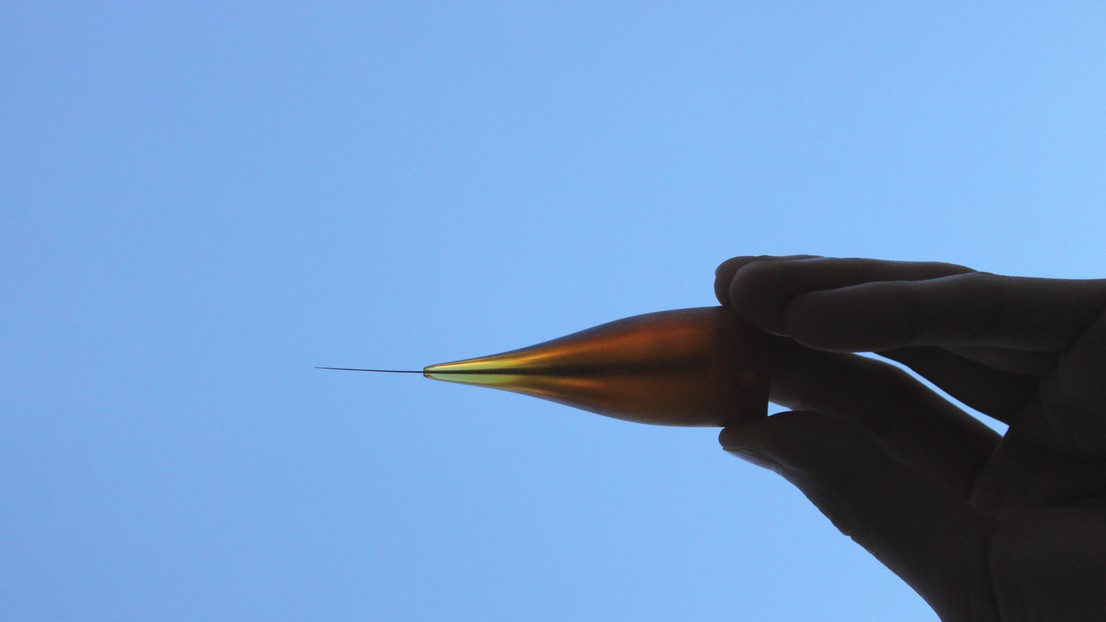
Platinum, copper, nickel and phosphorous – those are the components of an amorphous metal alloy with excellent mechanical properties. The alloy is also very corrosion-resistant and attract much interest in watchmaking and micromechanics. Now three scientists from EPFL’s Laboratory of Photonic Materials and Fiber Devices (FIMAP) – PhD student Inès Richard, postdoc Wei Yan and Professor Fabien Sorin – have given it a new purpose: they are using it to make electrodes for plastic fibers. Their paper, which was co-authored by Professor Jörg Löffler from ETH Zurich, has been published in Nature Nanotechnology.
A thin electrical conductor
“Our metallic glass is part of a new category of metals with an amorphous structure,” says Richard. “When the alloy is heated to a certain temperature, it first turns viscous and then becomes crystalline and solid." The advantage is that while the alloy is in a viscous state, it can be stretched into a nanometric-sized, uniform shape that runs the length of the fiber. That’s a step up from the crystalline metals that are normally used – they’re stretched while in a liquid state, which means they can break into droplets if their diameter gets too small.
"Thanks to this alloy and our work with Professor Vasiliki Tileli, who provided further insight into how the process works, we were able to create a very thin, electrically conductive fiber,” says Professor Sorin. “It's just 40 nanometers thick – that’s about 50 times smaller than a standard electrode fiber."
Making rats walk
Because the alloy is viscous, it can be combined with another liquid during the production process without the two mixing. "We added liquid selenium, which can detect light,” says Yan. “The alloy is highly conductive, and because thanks to the high quality of the interface between both materials, it also enhanced the fiber's performance and sensitivity."
"We also worked with Professors Stéphanie Lacour and Grégoire Courtine to test our metallic glass fibers on rats," says Richard. Lacour helped develop a method for integrating the electrodes into chronic implants. Then Courtine's lab tested the implants' functionalities on rats. His researchers sent electrical impulses directly into the rats' brains, causing them to move, and recorded the signals from their neurons. The metallic glass fibers developed at EPFL are designed for use in biomedical devices and electronics.
Reference:
Structured nanoscale metallic glass fibres with extreme aspect ratios
Wei Yan, Inès Richard, Güven Kurtuldu, Nicholas D. James, Giuseppe Schiavone, Jordan W. Squair, Tung Nguyen‐Dang, Tapajyoti Das Gupta, Yunpeng Qu, Jake D. Cao, Reinis Ignatans, Stéphanie P. Lacour, Vasiliki Tileli, Grégoire Courtine, Jörg F. Löffler & Fabien Sorin
Nature Nanotechnology (2020)
DOI: 10.1038/s41565-020-0747-9
Contact information:
Fabien Sorin
Associate Professor
Laboratory of Photonic Materials and Fibre Devices.
EPFL
fabien.sorin@epfl.ch
+41 21 693 10 93
EPFL
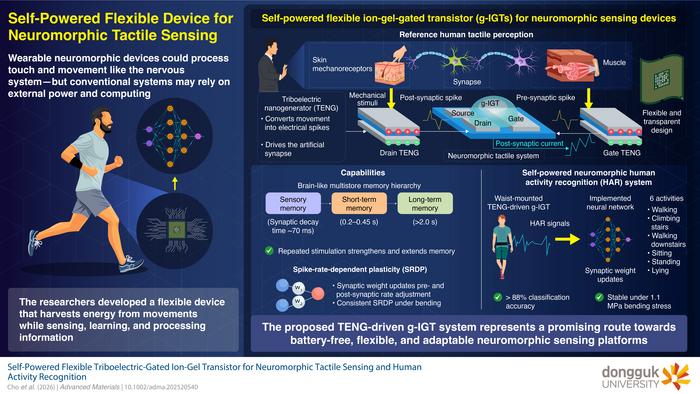
The proposed TENG-driven g-IGT is a flexible, self-powered neuromorphic device capable of reproducing multiple memory states and spike-rate-dependent learning Neuromorphic devices, which are designed to emulate aspects of biological neural networks, are promising candidates for developing low-power and intelligent sensing technologies, including wearable applications. Among the device architectures explored for neuromorphic computing, graphene-channel ion-gel-gated transistors (g-IGTs) are...
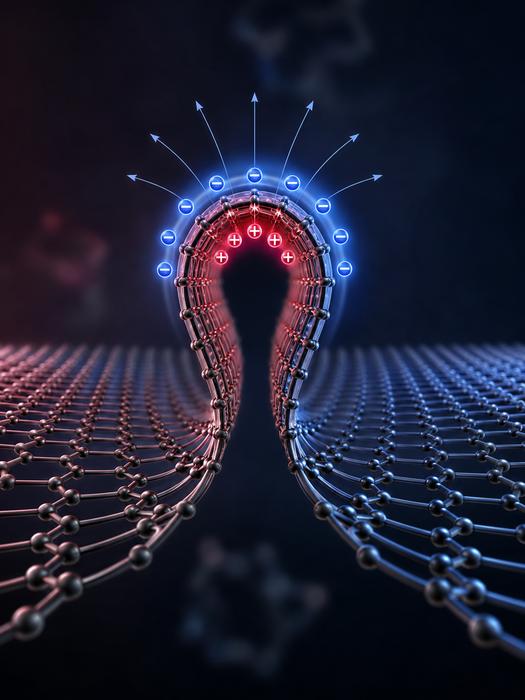
Rice University researchers have shown that sub-nanometer wrinkles in graphene generate flexoelectric charge separation, reshaping local electrical behavior through curvature alone. Extreme bending produces polarization far stronger than in larger systems and may enable geometry-controlled electronics without chemical doping. Published in Advanced Materials.
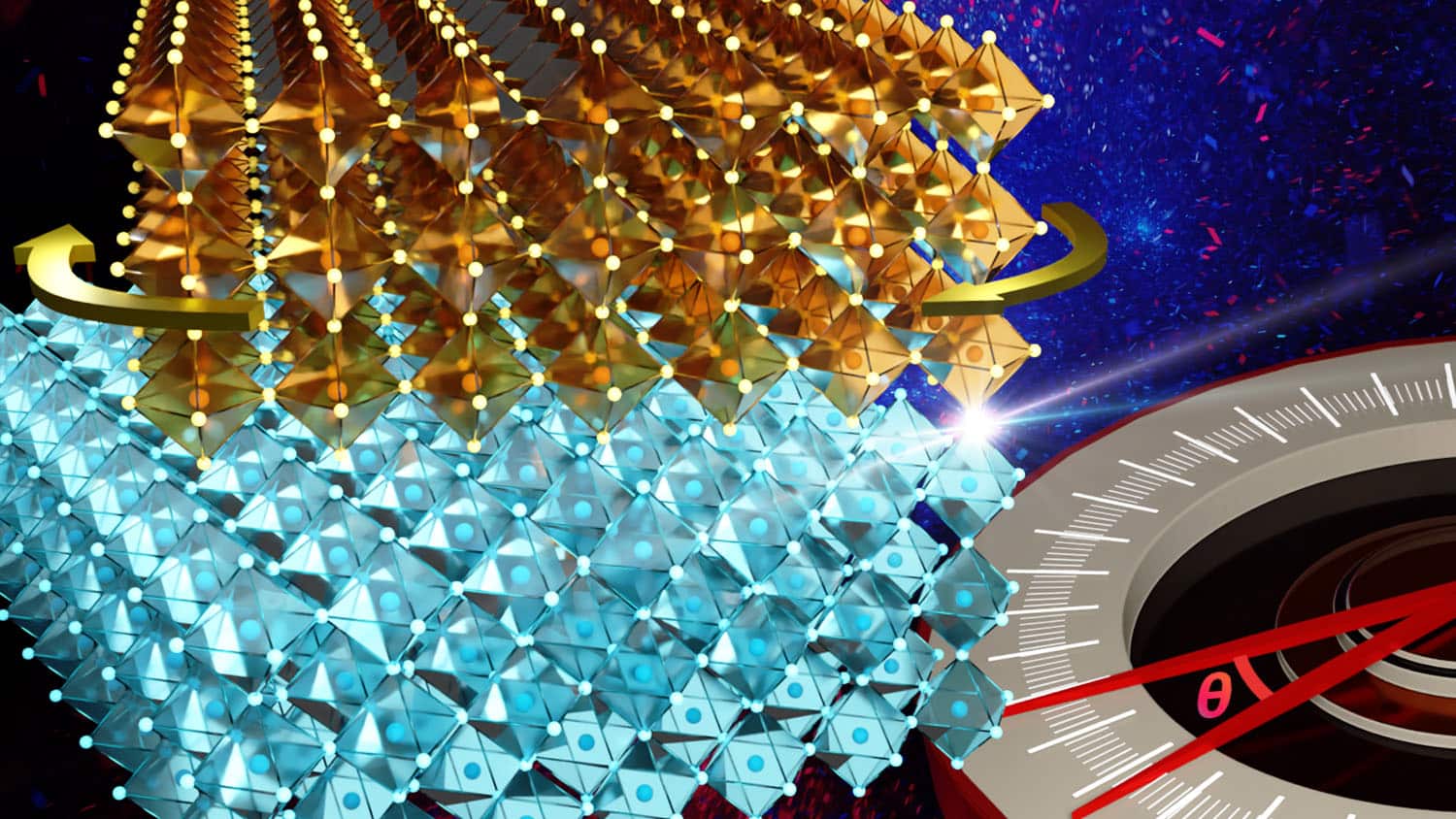
Researchers at NC State have extended twistronics beyond van der Waals materials into strongly bonded crystalline oxides. By stacking sodium niobate membranes with twist angles controlled down to 0.1 degrees, and confirming results via synchrotron X-ray diffraction, the team found interlayer bonds distort the atomic lattice, shifting phase structure and domain configuration. The technique works at near-millimeter scale, far larger than typical twistronic devices, marking a real step toward pract
