top of page

NEWSROOM


The hidden structure behind a widely used class of materials
Relaxor ferroelectrics have been used in electronics and sensors for decades, but the source of their unique properties was a mystery until now.
Apr 304 min read


Mind the gap! Semiconductor industry is relying on the wrong materials
2D materials are widely seen as a promising path toward better computer chips. Researchers at TU Wien now show: some of these materials are unsuitable due to an underestimated effect. But there are alternatives
Apr 203 min read
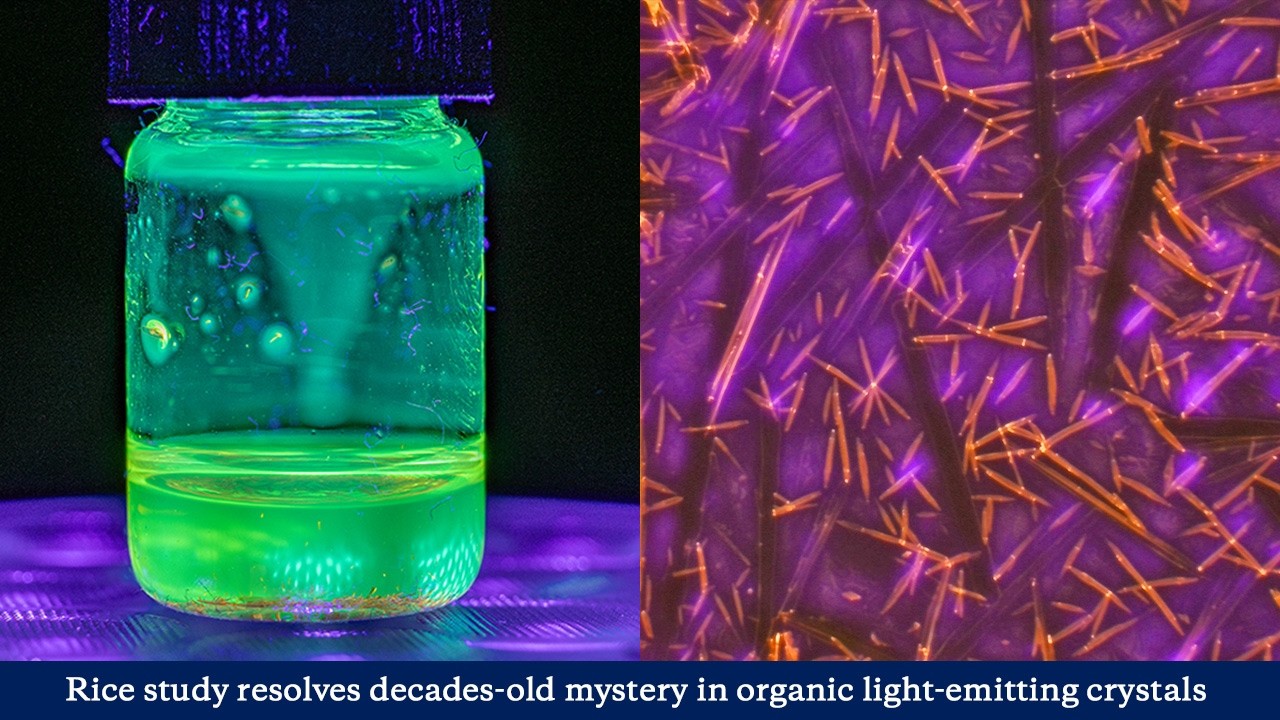
Rice study resolves decades-old mystery in organic light-emitting crystals
Findings reveal how molecular defects can enhance light conversion efficiency
Apr 103 min read


How surfaces grow: Research team demonstrates universal 2D growth
A Würzburg research team has achieved the world’s first experimental confirmation of the Kardar–Parisi–Zhang (KPZ) universality class in two-dimensional quantum systems. Using polaritons in a precisely engineered GaAs semiconductor cooled to near absolute zero, they tracked the nonlinear, random growth process in both space and time—proving the famous 1986 growth equation holds in 2D.
Apr 103 min read


Catching light in air: programmable Mie voids boost light matter interaction
Air cavities help atom-thin semiconductors shine brighter
Mar 34 min read


Alloy-engineered valleytronics
A monolayer of the transition metal dichalcogenide alloy MoWSe₂ with K⁺ and K⁻ valleys. The purple lines indicate the external magnetic field, the application of which leads to the splitting of exciton state energies as a result of the Zeeman effect. This phenomenon is illustrated as different separations between the valence band and the conduction band in the two valleys. @ Grzegorz Krasucki, Faculty of Physics, University of Warsaw Scientists from the Faculty of Physics at
Feb 244 min read
bottom of page