Tokyo Institute of Technology (Tokyo Tech)
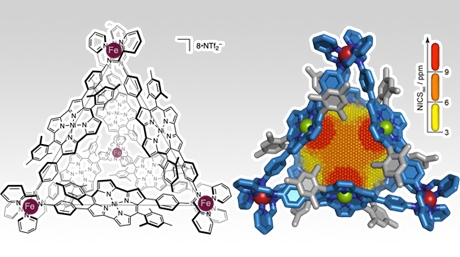
Researchers at Tokyo Institute of Technology, the University of Cambridge, and the University of Copenhagen have built a self-assembled nanocage with a very unusual nanospace: Its walls are made of antiaromatic molecules, which are generally considered too unstable to work with. By overturning assumptions about the limits of nano-chemical engineering, the study creates an entirely new nanospace for scientists to explore. Nanometer-sized cavities are already finding a range of useful applications in chemistry, medicine and environmental science.
Scientists including Masahiro Yamashina of Tokyo Institute of Technology (JSPS Overseas Research Fellow, at that time) and Jonathan R. Nitschke of the University of Cambridge, reporting their work in the journal Nature, describe the construction of a new type of nanospace inside "a self-assembled cage composed of four metal ions with six identical antiaromatic walls."
Until now, many teams have developed nanocages with aromatic walls, but none with antiaromatic compounds, owing to the challenges posed by their inherent instability. Aromaticity refers to a property of ring-shaped organic compounds that makes them highly stable, whereas antiaromaticity describes compounds that are far more reactive, due to a difference in the number of so-called π-electrons shared by the ring. (For a quick summary of the differences between the two types of compounds, refer to Antiaromatic molecule displays record electrical conductance.)
The team's search for a suitable building block for their nanocage led them to a 2012 study by Hiroshi Shinokubo and co-workers in Japan. This study reported the synthesis of an unusually stable, nickel-based antiaromatic compound called norcorrole. Then, drawing on Jonathan R. Nitschke and his group's expertise in subcomponent self-assembly, the team succeeded in building a three nanometer-diameter cage with a norcorrole skeleton.
To investigate the degree of antiaromacity within the cage, the team performed nucleus-independent chemical shift (NICS) calculations. The results indicated that the norcorrole panels appear to work together to enhance antiaromacity. The NICS value was consistently high in the central part of the cage, suggesting that the panels reinforce each other.

The unique environment inside the cage was further tested by encapsulating a series of guest molecules, beginning with coronene which has been already encapsulated within the aromatic cage.
The researchers hypothesized that when exposed to an external magnetic field, guest molecules in an aromatic-walled cage would experience a shielding effect, while those in an antiaromatic-walled cage would experience a deshielding effect.
As predicted by theory, nuclear magnetic resonance (NMR) spectroscopy analyses revealed a deshielding effect attributable to the antiaromatic walls.
All guest molecules tested in the study showed significant downfield chemical shifting, an indicator of the degree of deshielding. The shift differences ranged from 0.7 to 14.9 parts per million. Of these, a carbon nanobelt showed the highest degree of downfield shifting observed so far resulting from an antiaromatic environment.
The cage can be considered as a new type of NMR shift reagent, the researchers say, meaning that it could be a useful tool for structural analysis, ie for interpreting the finest structures of organic compounds.
Future work will focus on investigating chemical reactivity within the nanospace.
An antiaromatic-walled nanospace
Masahiro Yamashina, Yuya Tanaka, Roy Lavendomme, Tanya K. Ronson, Michael Pittelkow & Jonathan R. Nitschke
Nature volume 574, pages 511–515(2019)
DOI: 10.1038/s41586-019-1661-x
Contact information:
Masahiro Yamashina
Assistant Professor, Department of Chemistry, Tokyo Tech
yamashina@chem.titech.ac.jp
Phone: +81-3-5734-2311
Jonathan R. Nitschke
Professor, Department of Chemistry, University of Cambridge
jrn34@cam.ac.uk
Phone: +44-0-1223-33632

Silver nanoparticles with diameters of ~10 nm deliver the best performance as electrocatalysts. The silver particles are sprayed onto the electrode together with a conductive carbon powder. The ideal mixture consists of 20 per cent by mass silver and 80 per cent by mass carbon powder. This image was taken using a transmission electron microscope (TEM). © HZB Via electrolysis, CO₂ can be reduced to CO, a raw material for further chemical products such as fuels. Within the GreenQuest Project,...

A flexible metal–organic framework developed by researchers from Institute of Science Tokyo enables the structural determination of large "beyond rule of 5" molecules from microgram-scale samples. Using APF-40 as a crystalline sponge, the researchers determined the structures of 12 pharmaceutical-related molecules, including the 899 Da drug molecule doramectin and trace ivermectin derivatives. The method could aid drug discovery, natural products research, and the characterization of rare...
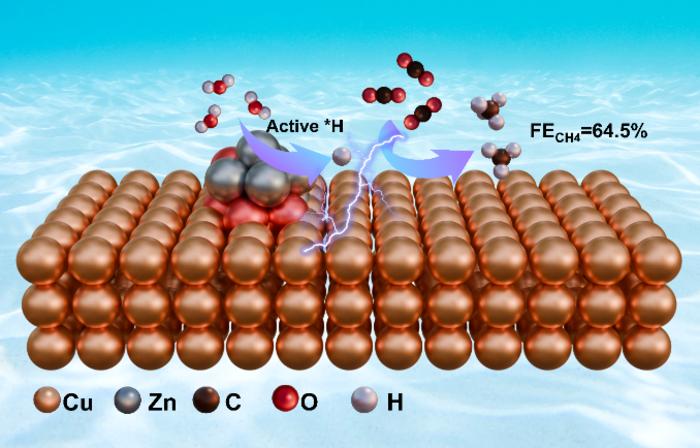
image: CuZn800@C was constructed via solvothermal method and utilizes the high-temperature volatility of zinc to prepare through calcination at different temperatures, which displays a high methane Faradaic efficiency of 64.5% and a remarkable partial current density of -551.3 mA/cm2 at -1.7 V vs. RHE, along with excellent stability. Zn and Cu form a tandem reaction system. Zn sites promote water splitting to provide protons, while Cu sites reduce the energy barrier for *CO hydrogenation....






